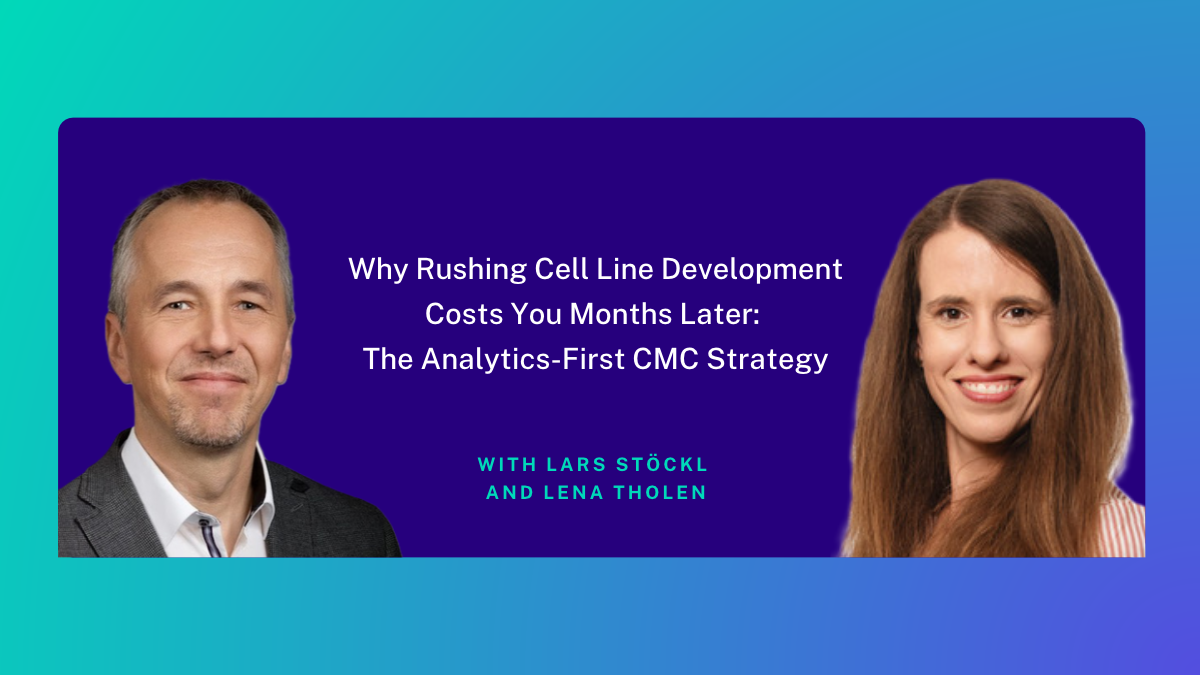
Antibody leads with perfect profiles on paper can turn into costly detours when reality sets in—think turbid solutions, low productivity, and glycan chaos that quietly emerge late in the game. Instead of scrambling for fixes downstream, what does it take to bake reliability and quality into the earliest CMC decisions?
Today, we feature Lars Stöckl and Lena Tholen, industry experts from FyoniBio GmbH, who have deep experience guiding biotech teams through the maze of CMC development, troubleshooting both common and unusual product quality challenges.
Episode Highlights
- Key factors in selecting host cell lines and the importance of matching the platform to molecule complexity [02:34]
- The role of broad analytical assays early in cell line and pool development for better decision-making [03:34]
- Glycosylation, post-translational modifications, and analytical strategies for both standard antibodies and more complex biotherapeutics [05:10]
- When and how to conduct developability and manufacturability assessments, especially for novel or specialized molecules [06:55]
- Troubleshooting glycosylation and aggregation problems—when to tweak the process and when to reconsider the molecule [08:05]
- Importance of clear, direct communication with clients regarding manufacturability and process viability [09:32]
- Example of how different CHO cell lines can dramatically impact molecule outcome and company trajectory [12:08]
- Keeping pace with technological advances through collaboration, conferences, and feasibility studies with startups [13:55]
- The move toward customization over standardization in cell line and process development [18:07]
In Their Words
We had one customer who came to us after they did lead identification at a discovery company. They took that molecule to a CDMO, produced a clone on that, and found the clone is not working. So the molecule at the end was an antibody after Protein A purification, was turbid, and they could not really go on. Low productivity, turbid molecule, never seen in discovery. – Lars Stöckl
Podcast Transcript
David Brühlmann [00:00:22]:
Welcome back. Imagine the analytical data for your lead molecule come back and the glycan profile is not what you expected. Is the cause in the cell line or in the process? And what do you change first? In part 2, Lars Stöckl and Lena Tholen of FyoniBio continue our conversation on building quality into biologics development, from the earliest decisions to the handover to manufacturing. Let’s pick up where we left off. Check here Part 1 of our conversation.
I would like to talk about an important milestone in CMC development, which is cell line generation. You mentioned that you have different platforms, a K1, you have HEK and other systems. What are the important decisions that you have to make early on, and what do people in general underestimate with cell line development?
Lena Tholen [00:02:33]:
I think the important decisions early on are, first of all, selecting a good host cell line. And this is mostly based on the molecule itself. So, for example, if we have a standardized IgG1 without any mutations, so a really standard project itself, then you say, okay, that sounds quite easy. We can stick to one general host cell line, for example, CHO-K1, and do a fast-track approach for cell line development. Totally fine for that end.
If you’re going more into complex questions like bispecifics or multispecifics, there are a lot of really crazy molecules coming into the market, up to pentaspecifics, then you really need to think, okay, which cell line is definitely capable of doing that? We, for example, say, initially, it makes more sense to integrate not only one host cell line because if you select a host cell line wisely, you can shorten time in the development, in the USP development.
You can shorten time in the DSP because quality is already improved. And then it’s necessary to add a broader bunch of analytical assays in the pool development already. That means not only put titer estimation and SEC there, put charged variants there, put N-glycan analytics there. So if you see that there is a high complexity, then add-on assays already at the pool level. I think that’s also necessary here in the initial step to be successful then.
Lars Stöckl [00:03:59]:
And maybe to add to what Lena said, for example, if you have a complex antibody construct, it’s not only the Fab part, but as well an extension via cytokine or any heavily glycosylated molecule, then we would always consult the customer to choose different cell platforms, not only the three CHO platforms, but as well human cell-based platforms. And then, as you see, the glycosylation will be totally different.
And they can then use the material at the early-stage pool level, purify it, go into animal studies, PK studies, maybe as well PD studies, and see what is the difference between the different glycosylation forms? It might still be that the productivity is higher on one platform and the quality is better on the other. They still then need to bargain, but they have the choices. And that’s really key. And I think with pool material, what we provide after two months, they can do their tests, make their checkmark. We then thaw the pools again and go into single-cell cloning. That’s a big, big surplus here.
David Brühlmann [00:04:58]:
How should you go about the whole analytical part and characterization part with respect to post-translational modifications, including glycosylation? What is your advice there?
Lars Stöckl [00:05:10]:
I would say, when it comes to a classical antibody, it’s a straightforward thing. You add one or two points to test your glycosylation, your N-glycans, in order to be sure that it’s not too much high-mannose structures present. If you push your cell to produce 12 grams per liter, you need to take care of that, but the rest is fine. Of course, aggregates and other quality attributes need to be checked, but I think it’s quite straightforward. You can really push forward the molecule in a fast way.
If it is non-antibodies that are glycosylated, there are a couple of examples like blood factors or follicle-stimulating hormone, which we did a lot during the Glycotope times, then it really goes into the quality assessment. N-glycans, O-glycans, proteolytic activity, activation status of factor VII, for example, which we worked on a lot up and down the road, that makes the quality assessment of the generated molecules much more complex. And throughout the production process in USP, you need to take care of the day-to-day quality. You have to cool down the perfusate.
You cannot do that in fed-batch mode because after two days in a 37-degree bioreactor, the molecule is degraded directly. So then it goes from process development in USP to DSP and finally to stability studies in your vials. So for antibodies, which are the major part, there are straightforward ways to do it. If it goes beyond antibodies, you need to take care of the quality, and we have major issues down the road.
David Brühlmann [00:06:44]:
At what stage do you do that? Is that in discovery already? Some kind of developability or manufacturability assessment? Is that later?
Lena Tholen [00:06:55]:
I think generally for us, it’s more like the customer is coming when a developability study has already been done. And mostly from experience, I would say there’s not so much knowledge about glycans present at that end. For some molecules, it is definitely the case that when they have really specialized molecules, they already also know that there is a very high requirement for glycosylation. So then that information is already there. So then it’s also necessary to do that already in the developability part itself. And it’s often nice, it’s a nice-to-have feature to have it already at that stage. For us, it makes it definitely easier also to tweak and to say where to put în the molecule, which cell line should be used, what makes the most sense, for example. The more data that is available, especially for complex molecules, the better it is for the cell line development itself.
David Brühlmann [00:07:49]:
And what do you do when you get a molecule and you see, oh, we have some issues with the glycosylation profile, or even worse, maybe you have some aggregation issues? How can you solve that problem when your client comes late?
Lars Stöckl [00:08:04]:
Good point. So in the Glycotope times, we had molecules which we had laid out on paper and thought, okay, that might be a good molecule to treat different issues. And at the end, we found that it was not manufacturable for any reason. It’s fragmented, low productivity comes out at the end, and stuff like that. And we at that time spent a lot of time optimizing things to still get it done. But at the end, I would say 80% of these problematic cases, we were not successful.
So it might be good at one point to think anew from scratch and take a circle back. I have to say, in these almost five years now in the CDMO business, we have not seen these big cases. Companies fairly well know how to optimize a molecule from the beginning. Maybe it was run by a discovery company, and the molecule which comes out is always good in our hands and straightforward.
Companies know that there is a problem, and they start with maybe five or six different molecules. We can do these five or six in parallel, and at the end, after two months, we then know, okay, this is producing fairly well, no fragmentation, glycosylation fine. This is problematic, kick out this one and forward to single-cell cloning the other one. That is as well what we see from customers who are more knowledgeable about things and know their complex molecules as well. Maybe there needs to be a certain kind of experience on that part.
Lena Tholen [00:09:31]:
Yeah, I think we had that once or twice, that a molecule was going back to discovery. And I think that’s really important, to be clear in the communication and tell the customer, in our experience, we think that is not manufacturable. So we need to work on another part. I think generally from experience, we can mostly say, for example, if we have a special degree of aggregation, we can use a kind of tweaking in the bioprocess to improve that. And we have the knowledge to say there are these and these possibilities. For example, sometimes it helps to implement a temperature shift or some other tweak in the bioprocessing parameters to improve things. And also in terms of glycosylation, I think we definitely know what is critical and what is not critical and what can be improved.
And especially in terms of glycosylation, you already have a lot of freedom to optimize in the USP development part. I think there are a lot of additives which can be added. You can also look at process parameters which can improve glycosylation patterns, which can, for example, reduce high-mannose levels. That’s often a point. You will also see, that’s also what we mostly said when working in cell line development, when you are at the pool level, you will still have differences at the clone level. So clones, for example, have different profiles and glycosylation also depends on how a cell line is producing, so how specific productivity looks. That’s something we can mostly say, depending on the results, we can handle it or we cannot handle it.
We also sometimes had cases where customers were coming in with a cell line that was not ours, but a different cell line. They already had a production clone available. They had a suitable process, and they came in with a process, not happy with productivities or with glycan profiles. And then we said there are possibilities here. So in some cases, it’s definitely possible to do something. You always need to have a critical look at the data. I think it’s really necessary to have that critical, more scientifically grounded look at the data itself. And then decide, okay, that’s a clear possibility you have here, or say, we don’t think it’s possible to achieve that improvement to make the process commercially viable. So I think it’s really important to have clear communication with the customer and to tell them the right course of action and help them make the right decision. For us, it’s more about discussing together with them, being clear, and explaining what we would recommend them to do or what we would not recommend them to do.
Lars Stöckl [00:12:03]:
There’s maybe one nice example which goes in that direction. We had one customer who came to us after they did lead identification at a discovery company. They took that molecule to a CDMO, produced a clone with it, and found the clone is not working. So the molecule at the end, an antibody after Protein A purification, was turbid, and they could not really go on. Low productivity, turbid molecule, never seen in discovery. So they then came to us through a consultant who was knowledgeable, who worked with us, and who knew that we have these different CHO cell lines to test.
So we took that molecule into all three CHO cell lines and found one of these was producing the turbid material and the other ones were not. And we further tested, and one cell line was producing a fragmented version of the antibody and the other one was not. So we found at the end that maybe the discovery company was using the good cell line and everything was fine, and the CDMO was using the bad cell line, which then produced the fragmented version. And by testing everything, we could show this cell line was totally fine. You can proceed with that. She was totally happy. Of course, she had to pay for the cell line development project twice, but at the end, it was a two-product company. One product survived.
Otherwise, they would have really had issues continuing with the company and its story. And now they’re in GMP manufacturing. And yesterday we had a call, and it worked well, and they have an 8-grams-per-liter process in a 250-liter bioreactor. Everything is back on track.
David Brühlmann [00:13:38]:
Very cool. We live in disruptive times. We have new technologies coming pretty much every week, if not every day. How do you keep up with changing technology as a CDMO in order to keep your platforms up to date?
Lena Tholen [00:13:54]:
I think it’s always necessary to screen for new technologies. I think people from our team are going to different conferences, for example, and seeing the different technologies. I think all of us are getting information through LinkedIn, for example, about new technologies, and it’s really important to screen them in the first step. And that’s mostly done through information sent over by a company. And then you always need to have a look, what are currently our pain points?
For example, would we like to improve titer? I think everybody wants to improve titer more and more and more. That’s always a point. Would we want to be faster at some point? Is it necessary to have, for example, more high-throughput assays integrated or more data compiled? Is it necessary to have a lot of software solutions integrated, which mostly reduce the effort for data evaluation or help us get more data out? And there are a lot of different possibilities nowadays, as you said. And you need to select wisely because generally you need to check: Is this technology suitable? Does it really improve what you are doing?
On the other hand, what are the costs of the technology? That’s always also a point because generally you need to transfer costs somehow to the customer. That’s a realistic thing you need to do. Or if there are additional licensing costs associated with that.
What we generally like, for example, is small companies, new startup companies with new technologies. We are really open to collaboration to do feasibility studies, device testing, or something like that to see the potential of a technology. And that helps, on the one hand, the small companies or startup companies. On the other hand, for us, it’s a way to see if we can improve our platform and our solutions with that kind of technology. And I think that’s really important on our end. So collaboration is, I think, the key to innovation and improvement. And that’s something we need to keep in mind.
I think nowadays you cannot do innovation on your own. We talked about outsourcing. Outsourcing happens because somebody has more knowledge about it and more flexibility. And the same is true for innovation, I think, because the companies working on that kind of innovation are really the experts. Working together with them is like pushing us and them forward together. And I think that’s a really good thing, to have collaborations integrated, especially in the development of new technologies.
Lars Stöckl [00:16:12]:
Maybe just to add, we are always looking for ideas. Sometimes they come through discussions with customers, sometimes at congresses, through presentations on a technology, and we think that might be a valuable thing to add, or we have a collaboration with these people to implement technologies into our platforms. That’s where we’re currently starting two collaborations with companies to work on different bottlenecks and productivity. Let’s see how that comes out. That’s a constant improvement we have to make because with technology, once you have a standstill, you will be out of the business maybe a year later.
David Brühlmann [00:16:46]:
Yeah, that’s for sure. There’s no standing still. It’s either moving forward or going backwards, right?
Lars Stöckl [00:16:53]:
That’s for sure.
David Brühlmann [00:16:54]:
With all that we have discussed today, what is the most important takeaway from our conversation?
Lars Stöckl [00:17:02]:
I would think what we discussed at the beginning. So, how do outsourcing and CDMOs play a role in the development of a biopharmaceutical? I think that’s a good thing. Maybe many companies, biotechs, even large pharma, may not yet see that opportunity. And there was just a recent report which Lena shared with me about trends in outsourcing in biopharma. I think that is certainly a trend. I think you also have that in your questions. Ask about that. I think how we can play a role in there, that’s certainly a good point.
And then, for us especially, I think the combination of development platforms and analytical capabilities, which we offer with our mass spectrometry team, always plays into our unique selling points quite a bit. So the combination of glycosylation and analytics, and the effects on the molecule, and proper control of these early development steps, is always a major point that we try to address and make our customers aware of.
Lena Tholen [00:18:06]:
I would also add that customization is something that is ultimately the outcome and the key. So, as Lars already mentioned, adding the analytical part and the quality part is all about customization based on the molecule. So we would really center on the customer’s molecule itself and have a look at it, then adapt what we are doing in cell line development. I think that’s the most important outcome of what we have discussed. So, adapt the approach around the molecule itself and not only around a platform.
I think there are a lot of standard platforms available, but that’s not the future, in my opinion. The future is to look at the molecule, focus on the molecule, and then decide how to proceed, what kind of analytics should be added, and which cell line should be used. So everything is about customization and not just about the platforms themselves.
David Brühlmann [00:18:58]:
Where can people get ahold of you and learn more about your services?
Lars Stöckl [00:19:04]:
I think we have a great webpage where they can really take a look, and there are contact details. And of course, via my LinkedIn or Lena’s LinkedIn page, there are multiple ways to contact us. So, many possibilities.
Lena Tholen [00:19:19]:
I think you can also find us at different conferences. So, when you follow us on LinkedIn, you will always see what we are attending next. For example, this autumn, BioJapan, Festival of Biologics, and PEX Europe are conferences we are attending. We are always happy to meet people and have a short visit and discussion. So that’s always nice about conferences, to be there in person and discuss. Like Lars already said, there are different possibilities to contact us digitally as well.
David Brühlmann [00:19:46]:
Lena and Lars, it’s been fantastic. I greatly enjoyed our conversation. Thank you so much for being on the show today.
Lars Stöckl [00:19:54]:
Thank you, David. It was a pleasure.
Lena Tholen [00:19:55]:
Thank you, David.
David Brühlmann [00:19:57]:
Speed, budget, and quality will always pull in different directions in CMC development. The thread running through this conversation with Lars and Lena is to start from the molecule and tailor the cell line, the process, and the analytics to the molecule rather than the other way around. If you found this two-part episode valuable, please leave a review on Apple Podcasts or your favorite platform. Thank you for tuning in today, and I’ll see you next time.
Disclaimer: This transcript was generated with the assistance of artificial intelligence. While efforts have been made to ensure accuracy, it may contain errors, omissions, or misinterpretations. The text has been lightly edited and optimized for readability and flow. Please do not rely on it as a verbatim record.
Next Step
If you found value in today’s episode, take a moment to like, follow, and leave a review on Apple Podcasts or your favorite platform—it helps us reach and support more scientists like you.
Thanks for tuning in to the Smart Biotech Scientist podcast and being part of this journey toward bioprocess mastery. For more insights and practical tips, visit
About Lars Stöckl and Lena Tholen
Lars Stöckl is Managing Director at FyoniBio GmbH, with a background in chemistry and extensive expertise in cell line engineering. Before joining FyoniBio in 2022, he spent 16 years at Glycotope, following research experience in Berlin and London.
Lena Tholen leads the cell line and bioprocess group at FyoniBio GmbH. She holds a PhD in biotechnology from the Technical University of Berlin and has experience in CHO cell-based systems, cell line development, and upstream process development.
Connect with Lars Stöckl and Lena Tholen on LinkedIn.
Further Listening
Lars and Lena’s main point is that early choices about the host cell line, the analytics and the partner decide what’s possible later on. The episodes below take that idea further. One looks at the mechanics of cell line development, one at why promising molecules fail to manufacture, and two at outsourcing CMC work from the sponsor’s side.
Episodes 117 - 118: Cell Line Development Secrets: Eliminating Critical Bottlenecks for Faster Timelines with Andrea Gough
Episodes 123 - 124: Manufacturability: Why Most Protein Candidates Fail (And How to Pick Winners Early) with Susan Sharfstein
Episodes 103 - 104: One-Stop Shop vs. Specialist CDMO: A Scientist’s Guide to CDMO Selection with Sigma Mostafa
Episodes 71 - 72: Effective Outsourcing: How Small Biotech Companies Can Thrive with Mark Melville
Want to Join?
Are you a CMC or biomanufacturing leader with hard-won lessons on process development, scale-up, or CDMO management? We’re always looking for practitioners with real execution stories to share on Smart Biotech Scientist.
Apply to be a guest or recommend someone:
David Brühlmann is a strategic advisor who helps C-level biotech leaders reduce development and manufacturing costs to make life-saving therapies accessible to more patients worldwide.
Hear It From The Horse’s Mouth
Want to listen to the full interview? Go to Smart Biotech Scientist Podcast.
Want to hear more? Do visit the podcast page and check out other episodes.
Do you wish to simplify your biologics drug development project? Contact Us