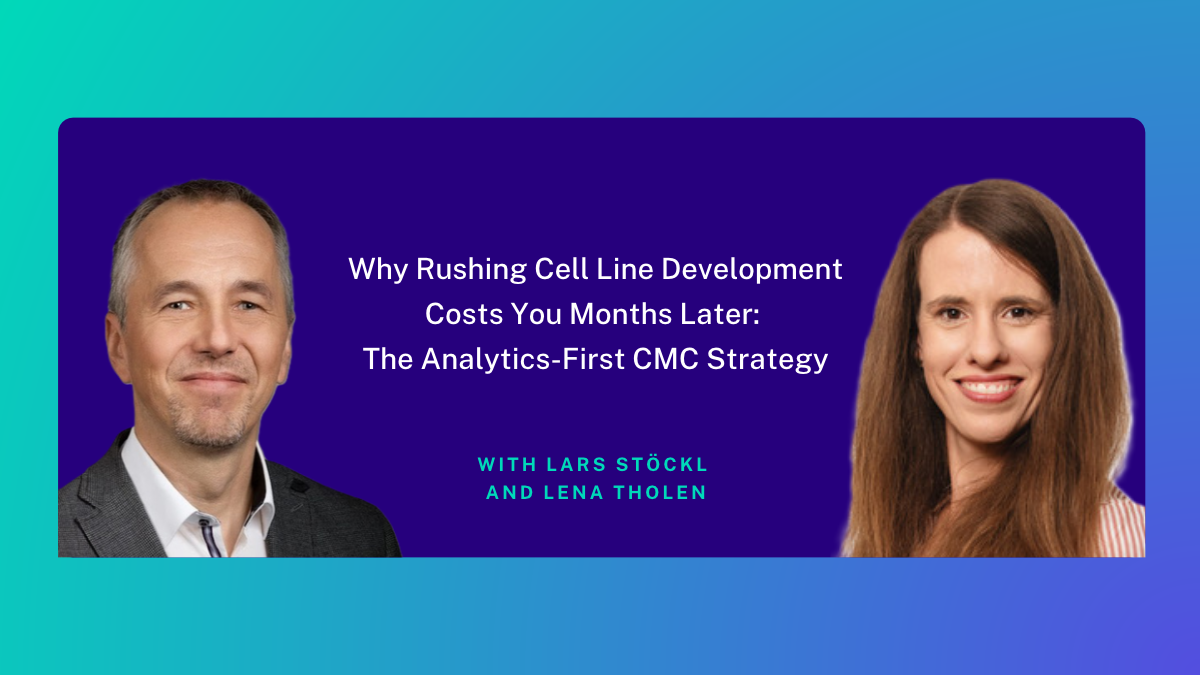
Biologic drug development today faces tough demands—balancing innovation, quality, and speed, all while leveraging external partners and not losing sight of critical early decisions.
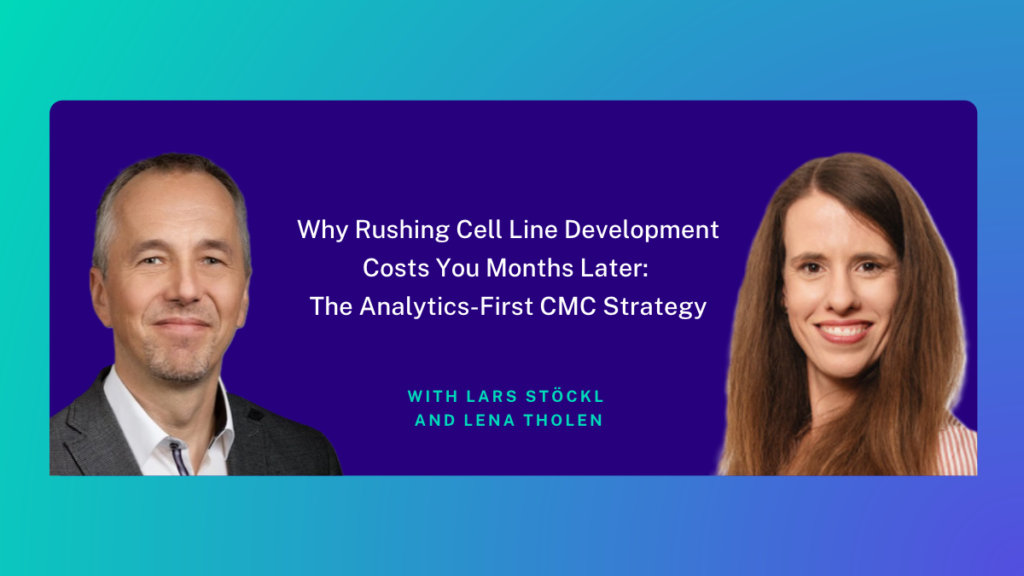
In this episode, David Brühlmann welcomes Lena Tholen and Lars Stöckl of FyoniBio GmbH—two scientists who’ve dedicated their careers to optimizing cell line and process development for biopharma clients.
Episode Highlights
- The trend toward outsourcing CMC development and the reasons behind it for both large pharma and small biotechs [07:27]
- How specialized CDMOs innovate and continuously improve cell line development platforms, giving clients access to new options and efficiencies [10:36]
- Real-world experience navigating project pitfalls from discovery to clinical studies—including differences between cell lines and processes [13:38]
- The importance of retaining key activity assays and critical knowledge in-house—and the risks of over-reliance on consultants [15:04]
- Key factors that help biotech companies thrive when partnering with CDMOs, including internal expertise, flexibility, and milestone planning [17:32]
In Their Words
We also see that we have increasing complexities of molecules which are coming in the cell line development. And I think time is not always the key because if we are investing like a little bit more time in the beginning, especially in terms of integrating analytics, for example, into cell line development, which sometimes requires a little bit more time in comparison to a short roadmap of a cell line development, then we will later on spend less time into improving the process when it’s already been, for example, in a clinical phase. – Lena Tholen
Podcast Transcript
David Brühlmann [00:00:31]:
Picture a small biotech team with a promising molecule, a tight budget, and a long list of decisions that all seem urgent. Which capabilities do you build yourself? Which do you hand to a partner? And which early choices shape everything that follows? Today, Lars Stöckl and Lena Tholen of FyoniBio join me to discuss how cell line development, process development, and analytics work together across the CMC journey, from clone selection to GMP manufacturing. Let’s dive in. Welcome, Lena and Lars. It’s good to have you on today.
Lars Stöckl [00:02:28]:
Thank you for having us. Nice to be here.
Lena Tholen [00:02:31]:
Thank you, David.
David Brühlmann [00:02:31]:
A pleasure. To start us out, share something that you believe about biologics development that most people disagree with.
Lena Tholen [00:02:41]:
I would think perhaps the relevance of the timeline, because generally I think everybody’s seeking for shortening timelines more and more and more. But we also see that we have increasing complexities of molecules which are coming in the cell line development. And I think time is not always the key because if we are investing like a little bit more time in the beginning, especially in terms of integrating analytics, for example, into cell line development, which sometimes requires a little bit more time in comparison to a short roadmap of a cell line development, then we will later on spend less time into improving the process when it’s already been, for example, in a clinical phase.
And also we will reduce the cost of goods there. That’s really a trend what you see. Everything is shorter more and more and more. And sometimes that’s not the way to go forward, I would say. That’s definitely a thing which is directly coming into my mind when thinking about what are trends in the cell line development and that stuff and what people are doing and what I think what might be definitely critical here.
Lars Stöckl [00:03:46]:
Maybe just a small thing to add up here is that even with some more weeks of research and development, you get maybe 30-40% more productivity or higher quality. And that counts out at the end so much. So we are kind of approached with short timelines which do not stand the reality because anyway, you need the protocols for the tox study and clinical trials, et cetera. That’s a good point.
David Brühlmann [00:04:09]:
Absolutely. I look forward to our conversation to unpack some of these topics. Before we dive into the technical conversation, I would love to hear your respective stories. Take us back to the beginning. What drew you into chemistry and biotech, and what were some interesting pit stops along the way?
Lars Stöckl [00:04:30]:
Maybe I can start here a bit. So I studied actually chemistry at the Technical University of Munich. I started that at a time when chemistry was quite bad, so the classical inorganic or organic chemistry, and I thought, okay, it goes in waves. But when I was finishing my studies 5 years later, still the wave was on the lower end of the possibilities. So at that time, there was a possibility to dive into biochemistry within that chemistry studies. So I took that chance. And because biochemistry at that time was really on the steep increase in possibilities, and it was end of the ’90s really starting off. So that was the first chance.
And the first thing I had in my PhD thesis, which I did in virology, was handling about the hepatitis B virus and the vaccine which was produced for maybe 10 to 15 years at that time, was produced in yeast, and that had mainly high-mannose structures on it with all its pitfalls and PK, et cetera. And my supervisor at the time already said, okay, that’s not the optimal way. So it was basically my first contact with glycosylated proteins. And of course, when I started then at the company Glycotope, everything was dealing with glycosylation on proteins and use in human therapeutics. So that then kickstarted all the discussion behind that. So maybe from my end.
David Brühlmann [00:05:56]:
Exciting. How about you, Lena?
Lena Tholen [00:05:58]:
So for me, I studied biotechnology at the Technical University of Berlin. And when I was in the end of my studies, I was really keen to have a look into applications. And then I jumped during an internship into bioprocessing. So I did an internship at KTH in Stockholm and we were working on high-cell-density perfusion processes with CHO cells. And cells were really growing into high, high cell densities, and we were always producing an antibody there already, always looking also into protein quality at that end. Because we know for antibodies, it’s really relevant to have a look to the N-glycosylation.
And N-glycosylation can have an effect on half-life time, can have an effect on immunogenicity. And so, we had a look there and did some lectin-based assays on that end. So, not really like high fancy stuff, but was really interesting to see that we already also saw changes during the process itself and saw changes in the glycosylation and how also cell densities and metabolites and everything around that can impact glycosylation and thereby also impact the quality of a product itself.
David Brühlmann [00:07:07]:
Very exciting. And spoiler alert, I love glycosylation. I did my PhD in glycosylation. More on that a bit later in our conversation. I’d love to dive into glycosylation. Let’s start with the bigger picture with your company. Your mission is you’re helping biopharma tailor development to their needs. And let’s look at the common trends. There is a trend that biopharma increasingly rely on CDMO partners or CROs for CMC development and analytics instead of building everything in-house. What are some of the reasons behind these trends?
Lars Stöckl [00:07:45]:
One thing certainly is that the platforms, what you need to really provide a robust therapeutic at the end, so the cell-based background, for example, that takes a lot of effort to build these and to improve these. Of course, if you have a large pharma, they have the financial background to build that up, but still kind of maybe not the quick emphasis or the focusing on these platforms to build up. So they might come up with just licensing in the standard cell line, but not taking care of the vector system. So that’s for large pharma. They could do it, but still do not do it because they see, they look around, they can compare platforms from different CDMOs. That makes it for large pharma much more easier to really outsource things, to have a very good turnover in terms of quality, productivity, whatever. So that’s the case for large pharma.
For small biotechs, of course, they cannot build up things, so they need to rely on companies out there who have developed, who have spent a lot of time and effort and money and brain to build up these different platforms. And I have Lena with me who kind of took care of one major platform in our company. So that is very important. And I think the trend is totally going towards outsourcing of not only biotechs, but as well these big pharmas, because they see the advantage in the platform quality, what you can buy outside, and to reduce cost on the end as well. Of course, that is a cost-efficient way to do things.
David Brühlmann [00:09:21]:
So it’s mostly a cost-efficient way to do it, and it’s more streamlined. And are there some other advantages?
Lars Stöckl [00:09:27]:
Yeah, as well quality. For example, if we go to what we are offering with our platforms, we have the classical CHO platforms, which we have optimized for high productivity, but not only one CHO platform. So K1, which is a commonly used mammalian manufacturing platform, but we have as well in-licensed CHO DG44 from another source, and then we have engineered our own CHO-GS knockout. So now a company can come to us and try their molecule in three different CHO cells. And if it is even not enough, they can as well try human platforms like the GlycoExpress platform, which we have generated during the Glycotope times.
Multiple platforms can be tested in one shot in two months. And to build it up in-house, it’s basically impossible. And on the other side, we know as well companies who are not only going to one CDMO, but doing the early steps at different CDMOs and then pick at lower financial burden. So what is the best quality and productivity which comes out? So many possibilities if you outsource, not only on the cost, but as well on productivity and quality.
Lena Tholen [00:10:35]:
I would add, the other thing is, if you outsource such a kind of service like a cell line development service, it’s mostly like the companies who are doing that kind of service also mostly working on innovation and development of the service itself. Are mostly seeking to even increase qualities as well as productivity continuously to be up to the market. And I think when you’re doing that, that always costs a lot of effort also.
And if you’re having in-house capabilities to do cell line development, for example, you might be not like having that capabilities also to improve the platforms in that speed that companies like us are doing it because we are really focused on our platforms and on our services and we want to improve it continuously. And finally, you need to have a commercially viable, reliable process in place, and that only happens when you have finally a product which is produced in a high quality as well as in a high productivity.
David Brühlmann [00:11:30]:
Yeah, definitely. CMC development has a lot of moving parts to it, a lot of complexity. I would just love to hear your perspective on, let’s assume I’m a CEO of a startup company and I see the value of working with a CDMO like yours because there is greater speed. You have done it in a lot of different projects. So it can be quite overwhelming and challenging for a startup. But on the other hand, there’s also some pitfalls. I mean, especially if, as a CEO, you don’t have a full understanding of CMC and the important decisions you have to make early on. So what would be your advice to a startup company, in particular small biotech? What are the important choices they should make?
Lars Stöckl [00:12:13]:
I started at Glycotope with 15 people at that time in 2005. It was a small biotech, having the idea to develop human therapeutics in an optimal way. And of course, until I left Glycotope, it was 17 years at that company at different stages. We’ve been to clinical trials, and that goes into every customer discussion what we have. So the experience, the history, what we did at that time, certainly of big value. And it’s not only doing a project, but always in the discussion on the project, discussion with the customer, what to include, what is needed, and what time point is what needed, not only from the regulatory aspect, but as well from the inflection point aspect.
So usually the small biotechs do have investors who want to see certain steps. And let me say, okay, you can spend this amount of money, you see already this effect, what is the productivity of cell, you have a certain insight on the quality as well. You can use that for your animal studies. If you have that proof, you have a big inflection point on the project. And then you can really get the next next bunch of money for the next steps, and you can outline what kind of money is needed on our end. Steps like this. It then goes to regulatory aspects. So what is needed for the dossier? What depth and quality is needed at what time point? What is needed for GMP? So good manufacturing practice, manufacturing, stuff like that.
Lena Tholen [00:13:38]:
I would also add, so especially when there is a small biotech and they might be really focused on their molecule itself and on the development. And before that, you have the whole discovery part before going to the CMC part and everything around this. And from our experience, what we saw with all the molecules we have worked on, there might be a lot of pitfalls coming in already, starting with the discovery part. And that is also, I would say, we generally like to discuss with the customer directly, having an open discussion, being a little bit educated from our experience, also what to add in the earlier part.
And when transferring from discovery to our cell line development, what is the requirement? What kind of changes could you see there? Still in that part because mostly discovery, for example, is working in HEK cells. And HEK cells are finally totally different to CHO cells. And mostly not in a fed-batch process, but in a transient transfection. A transient transfection is totally different to a fed-batch process itself. And we see sometimes the customer itself needs this information also to go efficiently forward. And we really like to have this open discussion and the kind of education and see from our experience and help with our experience to get successfully into finally the clinical study. That is what everybody wants to do finally.
David Brühlmann [00:14:59]:
And what are things a company should not outsource?
Lars Stöckl [00:15:03]:
I think kind of what might be good to have in-house if possible is kind of the activity assays, stuff like this, because it’s a lot of tweaking, knowing really what receptors to tackle. Maybe there are outcomes which do not show relevant but are relevant. So that is some kind of things what I think companies might, if possible, have inside. It is something which is quite expensive as well. So because a lot of hands-on work is needed, and that can at the end as well kind of stretch the budget quite intensively. Yeah, maybe one example. Maybe Lena, do you have another one?
Lena Tholen [00:15:41]:
I was currently thinking of if it’s not like a service part, but the decision and knowledge part, which can be also a point. I think I like also to have consultants integrated. That’s definitely a nice thing and also a trend because then you also integrate knowledge into that. But still, I think the people who are doing the development should have a really proper idea about what they are doing and where they are doing the decision. And that’s the thing I would definitely say that should not be completely outsourced. So to keep control about what’s happening and how decisions are done, because I think there are also digital companies available which are completely digital and they are doing only outsourcing and that’s definitely also possible to do.
Lars Stöckl [00:16:24]:
That’s a very good point Lena made. We had examples where we had consultants in processes which totally messed up the whole process. Maybe a year of delay due to totally messed up consultancy in this case.
David Brühlmann [00:16:38]:
And I asked the question on purpose because I’ve talked to a lot of different companies, and from my perspective, I would probably say it depends. I’ve seen companies, they’re 100% virtual. They just have the knowledge in-house. They’re very experienced CMC professionals. And then you have companies, they do most of the things in-house, and you have everything in between. But I agree with you that having some kind of knowledge, or to be decided obviously what it is, but at least try to have the critical knowledge in-house and not outsource that.
As you work with a variety of different companies, different clients, even in your work before Glycotope, what would you say are the key success factors that make a company succeed in this complex CMC environment as a biotech company that works with a CDMO? Because you have now the CDMO perspective and you see how different companies operate, what mindsets or what organization or skill sets have you found particularly helpful in order so that your clients actually succeed?
Lars Stöckl [00:17:47]:
I would think in the same direction as Lena just pointed out. If you have a customer who is knowledgeable on the other end, who has experienced people either on CMC or on pharmacology or on the molecule itself, which what they tend to develop, to know where it might be active, which indication, etc. If there’s an experienced team on the other end, that makes a lot of sense. And then if you have a company with maybe 10 people, mostly virtual, and it goes really well on that end.
Sometimes it gets a bit difficult if they just said before consultants are taking care of a certain step and yeah, maybe not so experienced. It is mainly the US, for example, that people are going to consultancy when they are laid off from their original jobs. And maybe there was a reason why they are laid off. Of course, often in the US, people are laid off because money is empty and then people have to go. But maybe then I think most or 50% to whom I work with in the consultancy space, they maybe not only were laid off because the money was empty, but because the quality was not as good as for these people than messing up projects, what I had before. So maybe one point to make here.
David Brühlmann [00:19:02]:
So that means choose your consultants wisely.
Lena Tholen [00:19:06]:
Yeah. Perhaps it’s also a little bit like flexibility and a smart selection of, for example, milestones integrated in a project. Because I think we generally also like to integrate somehow milestones because you do not always know if you are successful with a molecule in the beginning. You do not know how a molecule can be produced, if it has, for example, issues with aggregation, if it has other issues with the quality attribute, you do not know in the beginning.
So generally, it’s not predictable. It’s more going into the direction, I think, in future also in terms of prediction when integrating AI-based solutions or machine learning and such a kind of developments. But currently, a lot of stuff is more like evaluating and testing it. Therefore, you need to be flexible. So if you see at one step, for example, okay, we will get an issue with the molecule itself, so we need to have fast decisions. We need to go back at a distinct place or also do a decision for, okay, now fast, we need to develop the tweak on the USP level, the tweak on the DSP level. And if you have like a long term of discussions internally and then you always lose time. And I think that’s really necessary to be kind of flexible, be integrating milestones in a smart way and also do a kind of flexibility in decisions and also in suggestions a company is doing, because mostly companies which are offering services are experts in doing that and they know what they’re doing.
David Brühlmann [00:20:34]:
If there is one idea to take from this conversation so far, it is that product quality is designed in early through the choices you make about your cell line, your process, and your analytics. That is worth remembering the next time a decision seems small. Lars and Lena have more to share in part 2. If this episode was useful, please leave a review on Apple Podcasts or your favorite platform. Thank you for tuning in today, and I’ll see you in part 2.
Disclaimer: This transcript was generated with the assistance of artificial intelligence. While efforts have been made to ensure accuracy, it may contain errors, omissions, or misinterpretations. The text has been lightly edited and optimized for readability and flow. Please do not rely on it as a verbatim record.
Next Step
If you found value in today’s episode, take a moment to like, follow, and leave a review on Apple Podcasts or your favorite platform—it helps us reach and support more scientists like you.
Thanks for tuning in to the Smart Biotech Scientist podcast and being part of this journey toward bioprocess mastery. For more insights and practical tips, visit
About Lars Stöckl and Lena Tholen
Lars Stöckl is Managing Director at FyoniBio GmbH. With a PhD from the Robert Koch Institute in Berlin, he brings extensive experience in cell line engineering and spent 16 years as a leading scientist at Glycotope before joining FyoniBio in 2022.
Lena Tholen is a biotechnology scientist at FyoniBio GmbH, where she leads the cell line and bioprocess group. She previously worked at Glycotope and Fraunhofer IZ-BB and has taught life science management at HTW Berlin since 2022.
Connect with Lars Stöckl and Lena Tholen on LinkedIn.
Further Listening
If you enjoyed this episode you might also like listening to:
Episodes 117 - 118: Cell Line Development Secrets: Eliminating Critical Bottlenecks for Faster Timelines with Andrea Gough
Episodes 123 - 124: Manufacturability: Why Most Protein Candidates Fail (And How to Pick Winners Early) with Susan Sharfstein
Episodes 103 - 104: One-Stop Shop vs. Specialist CDMO: A Scientist’s Guide to CDMO Selection with Sigma Mostafa
Episodes 71 - 72: Effective Outsourcing: How Small Biotech Companies Can Thrive with Mark Melville
Want to Join?
Are you a CMC or biomanufacturing leader with hard-won lessons on process development, scale-up, or CDMO management? We’re always looking for practitioners with real execution stories to share on Smart Biotech Scientist.
Apply to be a guest or recommend someone:
David Brühlmann is a strategic advisor who helps C-level biotech leaders reduce development and manufacturing costs to make life-saving therapies accessible to more patients worldwide.
Hear It From The Horse’s Mouth
Want to listen to the full interview? Go to Smart Biotech Scientist Podcast.
Want to hear more? Do visit the podcast page and check out other episodes.
Do you wish to simplify your biologics drug development project? Contact Us