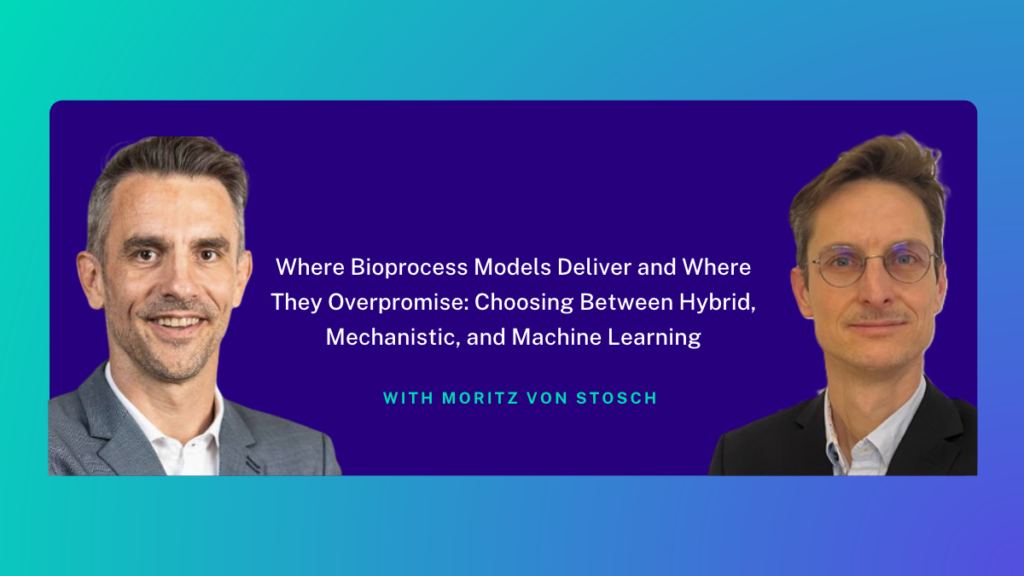
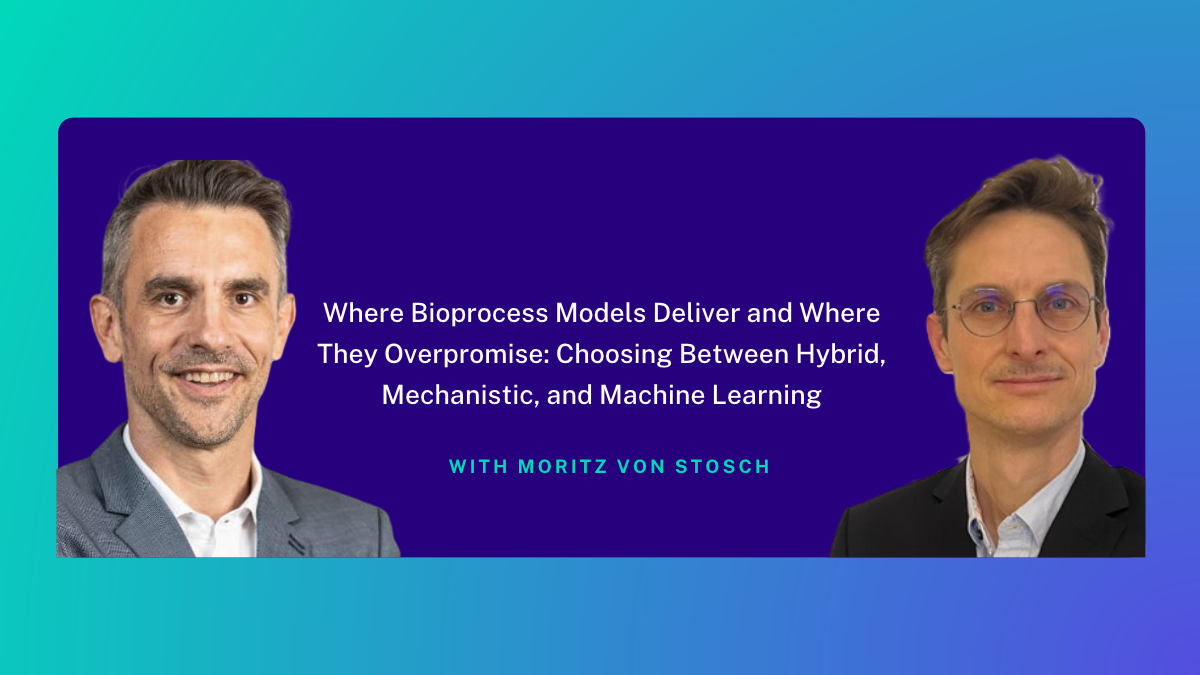
Many technically strong digital tools—no matter how powerful—end up sidelined in bioprocess development. Why is that, and what does it actually take for digital modeling to earn its place at the lab bench?
In this episode, David Brühlmann sits down with Moritz von Stosch of HINA Bioventures, a scientist-turned-investor who’s navigated both the technology provider and pharma end-user sides. Moritz von Stosch brings firsthand insights from building digital solutions, deploying them in pharma, and evaluating what actually sticks when the clock is ticking and the stakes are high.
Episode Highlights
- The importance of starting with your purpose when selecting a modeling strategy [03:00]
- Experimental design: when to use factorial versus random space-filling designs, and the inherent biases each can introduce [04:22]
- The future of agentic workflows, AI, and autonomous labs in bioprocessing, including the importance and challenges of sensor technologies [06:02]
- Practical hurdles to implementing fully autonomous laboratories, and the non-obvious value humans still bring [09:09]
- Adapting mindsets for the evolving role of the bioprocess engineer in a more automated, agent-driven workflow [11:48]
- Advice for biotech professionals on how to assess the real value in new technologies versus hype, and the role of proprietary algorithms and company stability [13:33]
- How cultural factors, not just technology, shape the adoption of modeling and digital tools in biotech [16:02]
- Strategies to help the bioprocess community adopt more innovation while ensuring compliance in regulated environments [17:14]
- Three key takeaways for staying relevant—including generating data for tomorrow’s questions and balancing curiosity, experimentation, and oversight [19:14]
In Their Words
Hybrid models are superior to other models under certain scenarios. For process optimization, hybrid models in many cases are better suited to answer the question at hand than pure machine learning models or mechanistic models. But if you really seek to understand the details of biology, the details of how things work, I think mechanistic models is the way to go to.
And then there is scenarios process monitoring where you have a ton of data, you’re anyways looking in a very local region. And your ambition is really to flag whether something deviates from the reference trend that you want to follow. And their statistical tools or also machine learning have a high value.
Podcast Transcript
David Brühlmann [00:00:39]:
A model fits your bioreactor data well, and then the next process decision is made the familiar way without it. Why do technically strong models so often stay outside routine decision-making? In this second part of my conversation with Moritz von Stosch, who’s a partner at HINA Bioventures, who has worked on both the technology provider and the pharma side, we look at choosing the right modeling approach, how it sits alongside experimental design, and what it takes for digital tools to earn their place at the bench. Check here part one of our conversation.
Let’s look at various models because modeling is quite a large area. We have hybrid models, we have mechanistic models, we have machine learning, we have experimental designs, and a lot more. It can be a bit confusing and overwhelming. How does someone choose the right type of modeling? Is there a strategy, a decision tree, or how do you go about that?
Moritz von Stosch [00:03:00]:
There was a great article published, I think it was in the ’90s or early 2000s, where I think the title of the article is called “Modeling for a Purpose.” And so what one should start with, as in so many things in life, is with what do you want to achieve? And once you are clear about what you want to achieve, this is when you essentially select the model that allows you to achieve that goal.
And so I think, yes, hybrid models are superior to other models under certain scenarios. For instance, for process optimization, hybrid models in many cases are better suited to answer the question at hand than pure machine learning models or mechanistic models. But if you really seek to understand the details of biology, the details of how things work, I think mechanistic models, for instance, is the way to go to.
And then there is scenarios, for instance, process monitoring, where you have a ton of data, you’re anyways looking in a very local region, and your ambition is really to flag whether something deviates from the reference trend that you want to follow. And there, for instance, statistical tools or also machine learning have a high value. And I mean, machine learning can also, of course, help you if you have no knowledge of the process whatsoever to at least describe the process, to a certain extent.
David Brühlmann [00:04:12]:
Should you still do factorial designs or that’s past now with AI and machine learning and so on?
Moritz von Stosch [00:04:56]:
I would say it depends on what you want to achieve. Should you still use them? There is scenarios where you can think that a factorial design might give you a better understanding of the process than, for instance, a random space-filling design like Latin hypercube sampling. So again, I would go to what do you want to achieve?
In my view, if you want to achieve a good understanding in a process region, and you’re not able necessarily to identify all the factors that you want to be looking at and/or there’s a large number of factors, then most likely random space-filling designs are the better choice to go to.
If you want a design where you can also mentally, at least to some degree, understand the results, a factorial design can help you to do that, right? We humans, we understand one-factor variations. We might be able to understand at least a bit of nonlinearity when you still vary 2 factors together, or when you have intermediate points where it becomes nonlinear. So I think in these scenarios, factorial designs are still a great choice.
You just need to be aware that if you choose factorial designs and you afterwards want to run, for instance, machine learning projects on them or hybrid modeling projects on them, or even you want to calibrate a mechanistic model, then the way you have performed your design biases the way that your machine learning model will perform, that your mechanistic model will perform. You just need to be aware of that bias. And by the way, the same true the other way around, right? If you run a random space-filling design and you try to develop a statistical model based on the results, you’re again biased by the quality of the data.
David Brühlmann [00:05:51]:
We live in exciting times with new technologies appearing pretty much every day. We speak now physical AI merging with robotics, and there’s a lot more going on. I would love to hear your perspective on the future of modeling, and also the agentic workflows and perhaps even these experimental loops a lot of people talk about, these learning loops? How will that evolve in the future?
Moritz von Stosch [00:06:17]:
If I had the answer to this, I think I would be very well positioned. I think that there’s several different views of how things could evolve, right?
On the one hand side, we see that a lot of tasks, even complex tasks, can be taken over by agentic AI, essentially by agents working together, solving the task, and maybe even we could be integrated into that agent workflow where we provide our input. And the current tendency of having a human in the loop seems to go into this direction.
So I think this kind of workflow will likely also apply to modeling, right? We no longer need experts to do the standard modeling workflows. They can be to a large degree executed by agents and we just supervise. And perhaps the few experts that we have on the topic can really provide the input where they’re best at looking critical at the results, critically looking at the modeling strategy that was chosen. So this human in the loop, I think short-term is for sure one of the ways to go to.
I think the iteration cycles, they will not go away. We need somehow a validation of our assumptions, right? We need a validation of the model that we have produced, of the workflow that we have set up. So we will need to do experiments. We will need to keep learning through these cycles.
Likely these cycles will become shorter because we can do better experiments, meaning they’re richer in information, and likely also we can transfer more knowledge across domains, because what is not possible with humans is we have this limited mental capacity to transfer knowledge. I mean, and therefore this is where agents excel, right? They can look at a large amount of literature, a large amount of documentation, and take that knowledge forward. So I think this is another possibility where we will see an acceleration through the agentic workflows.
And then of course, the incorporation directly with the lab, right, in terms of autonomous laboratory autonomous lights-out manufacturing. I think we can fully envision that. I think a very exciting development, which was recently also published, was this collaboration of Danaher together with Anthropic, where they’re working on the Model Hardware. I think it’s Standard or System or Setup. I don’t remember what the S stands for, where you can then imagine that the same agents are also able to interact with the laboratory equipment, with the sensors and so forth directly.
And that of course, provides an opportunity to reduce oversight errors where by chance we have put the wrong material in, by chance we have programmed the wrong recipe and so forth. And so to execute much quicker on what we have learned in the lab, to transfer the data much quicker back to the algorithm, and then to use that knowledge to accelerate the way we iterate through the different hypotheses.
David Brühlmann [00:09:02]:
What are the things that need to happen in order to move to a fully autonomous lab?
Moritz von Stosch [00:09:09]:
We already have autonomous labs partially, right? In the sense that we program what should be happening. And then for drug screening studies, for instance, these type of autonomous labs already exist. We fill the material lots or the material into the vials, right? The robot goes about it, puts all the different combinations, screens it then by all different kinds of assays and so forth, and gives the results back. So in terms of autonomous execution of the experiment, we are almost there.
And then of course there’s a lot of research, has been going on into forming a hypothesis, not us, but really the hypothesis being formed by the computer, by the algorithm, and then planning the experiments that are required to execute the experiments, translating that into the experimental protocol, getting the data back, modeling or cross-checking whether we could invalidate the hypothesis, and then iterating around us.
On the bioprocessing side of things, for instance, the Technical University of Berlin is one of the universities which is carefully looking at that, and which have taken approaches to answer to that question. And so I think we are on the way and we have partially done it.
What will be important and what is important is of course the data readout, because only what we see, hear, feel, sense, and so forth is then what we can also give back as information to the algorithms.
Perhaps one of the most funny anecdotes that I always like to tell is that I came into the lab one morning with one of the technicians and the technician was smelling and saying, I think we have a contamination. And you come to a lab, you just smell the odor of the lab, and you know that there’s a contamination. I mean, for me at the moment, it was incredible. And we took a sample, and then of course, a couple of days later when you actually have the readout, oh yeah, we had a contamination.
So this speaks to the requirement that you really need that sensor data to make a decision. And I don’t know where we are with electronic noses at the moment. I have for a long time not looked into that type of technology, but I think sensor development will be a really critical— together, of course, with all the automation and so forth to make autonomous labs a reality.
David Brühlmann [00:11:17]:
Yeah, this is an excellent point. There’s definitely areas where we as humans are still way better. I think, odor is one of the things I’m just curious more, it’s as we are going to be using increasingly more agents, agentic workflows, we’ll have new language models at our disposal. What kind of mindsets should we adopt or develop as bioprocess engineers as our work will change in order to stay competitive?
Moritz von Stosch [00:11:48]:
An excellent question. I’ve been recently reading a book about how different cultures behave and how different cultures approach problems. And so, as a German, and I’m originally from Germany, our approach is to plan first, to think about all the possible implications, complications, difficulties, and then set a plan to not encounter them, and then execute. That approach works really great in scenarios where the environment is stable and nothing is changing.
At the moment, we are at a point where things are moving very, very quickly. Things are changing quickly. And so, the plan that you did today, tomorrow is no longer the plan that you should execute on. And so, there’s cultures where trialing is much preferred over planning. And so, they just try what works and keep trying, and they don’t try to find the best approach from the very beginning.
And so, what can be shown is that when you have an environment that changes very fast, where things are very dynamic, this type of approaches are more suited to find solutions to the problems that we’re facing. The solutions, of course, are also short-lived, right? Because everything moves so quickly.
And as so many things, I would say, yes, it’s a bit in the middle. We should have some planning, but we should also trial. And so, let’s not overthink stuff. Let’s start doing stuff and then adapt to what’s going on. I mean, there is this book also, The Lean Startup, and it’s very much also around that philosophy that I think things should be done.
David Brühlmann [00:13:14]:
What advice would you give to someone working in biotech who is struggling with these new technologies to actually to understand what should they focus on? Because we have so many different things coming. And it’s sometimes difficult to differentiate whether this is true added value or it’s hype. So from your experience now as an investor, I imagine you look at a lot of different things, even perhaps before when you were at DataHow. What are the things that tell you, well, this is a technology you should focus on and perhaps a technology you think is not so relevant?
Moritz von Stosch [00:13:50]:
That’s another excellent question. So when I look at technology, I always try to understand what is the value, as you said. So what is the differential value in comparison to another technology? And it’s not always easy to grasp.
So if it is something that is similar to what I’m already using or doing, most of the times I wouldn’t bother changing because I have the feeling that the value I will be getting is less than the effort I have to put in to change. So that would be my approach when it comes to, for instance, whenever we have a new release of a model, I’m perhaps not one of the first adopters. I’m waiting for others to adopt and come back and tell me, look, this is the value. And then when I know what the value roughly is, I will adopt if the value is big enough. So that’s perhaps one way of going about it.
The other thing, when we look at technology and we try to understand, because software development essentially has become a commodity, right? You can develop softwares, you can develop apps so quickly. How do you know whether you should purchase a software or not? And the way we look at it is that, yes, software development has become a commodity. So what is the differentiating factor?
And what we see is that differentiating factors is either algorithms and technologies that cannot easily be copied. Because they are based on proprietary data. They are based on proprietary insight, which cannot just simply be obtained by running a couple of experiments and so forth. So that is one of which.
And then, of course, from a biopharmaceutical point of view and from an investor point of view, what can also not be copied is a market traction. So if you’re in the market, you have a good commercial performance in the market, it will be harder for a new company to go into that market, which, of course, for the biopharma end user is perhaps only mildly important.
Even so, of course, from a business continuity point of view, I think you still want to make sure that the company or that the tools that you are using to answer process-related questions, that these companies are actually around in 2, 3, 4 years because they are successful, right? You don’t perhaps want to solve a problem, particularly when it comes to manufacturing, with a company that is there for half a year and then no more.
David Brühlmann [00:15:57]:
What other question would you suggest I ask?
Moritz von Stosch [00:16:00]:
I think maybe a very important question that is many times addressed and overasked is the one around technology versus culture, where from a technology point of view, we are able to solve, I would say, all of the problems that we are facing currently in process development. But from an adaptation point of view, how do we adopt those into routine use, into process development and manufacturing, we’re very slow to go about it. That is true for sensor technology, that is true for digital technology, that is true for new bioreactors and so forth.
And so perhaps I think the question is, is culture more important or is technology more important? And honestly, I think both are important, but it would be hard for me to give a real answer to that.
David Brühlmann [00:16:46]:
And speaking of culture, what can we do as a community to help our peers take more risks and perhaps embrace new technologies faster and still make sure that at the end of the day in GMP manufacturing, it is controlled and it is compliant. But still, I think as a bioprocess industry, we can learn from other industries to adapt new technologies faster and take a bit more risks.
Moritz von Stosch [00:17:14]:
I think people are generally curious, right? And people are generally also eager to try out new technology, but they have very clear deadlines and very clear timelines, and they have very clear budgets. And so we can of course try to combine the two, or we can of course go after making an innovation project where we try to understand better how a certain technology works.
Yet in the application, in the timeline-critical application, we will always prefer technology where we know: I apply this technology, I will have the answer, and I will meet the deadline. So I think this type of setting for us, also when I was working at GSK, is a setting where we have to deliver.
If we look generally at the way that things have evolved, if I remember early 2000s is when Raman came up, right? Or when generally process analytical technology came up and was not very clear to people in the beginning or to the broad audience how these tools would be applied. And then you had to do this kind of calibration modeling and you would have to run calibration experiments and so forth. And then there were robustness issues. So the next thing was that people were solving robustness.
And if we look at how the technology is adopted today, it’s all about ease of use, right? So it’s very clear how to do the modeling. It’s very clear how to do the calibration and the easier it can be made from a user perspective, the faster we can adopt it. And by the way, if it is easy, then there’s also relatively low risk on applying it in a current project.
And so I think this holds true for sensor technology. It also holds true for process modeling. The easier it becomes to use, the more democratized it becomes, the more we will apply it also in projects. And I think, yes, we can as a society and as an industry try to make it easy to use. There will most likely always be this initial phase where there’s few users. We need to somehow figure out what is the factors that make it easy to use and what is important to have.
David Brühlmann [00:19:09]:
Moritz, what is the most important takeaway from our conversation?
Moritz von Stosch [00:19:13]:
The most important takeaway? I think there’s perhaps 3 takeaways, not one.
So, I would start with, first, don’t generate data to answer the question at hand. Generate data to answer the questions of tomorrow. That would be one, and I think it’s a key takeaway.
The second takeaway is, yes, be curious and try out things. Don’t plan too much, but also of course, have a little bit of oversight of how you could squeeze the value out of the tools that you’re curious of to investigate. So that would be my second one.
And the third one is let’s try to stay relevant for the future. And this, I don’t mean only as the industry person, but really as a general person and staying relevant. I think, yes, we can be this one person giving oversight to an algorithm. We can be the human in the loop, but we are more than that. So, there’s things I think where we still differentiate very much from what machines can do when it comes to creativity, when it comes to thinking orthogonally, and for the immediate future to the long future, I think this is where we should excel, and I hope I transmitted that it’s all for a purpose. So, let’s use the tools for a purpose and let’s, us humans, do the rest.
David Brühlmann [00:20:28]:
This is a great way to conclude our conversation. This has been fantastic, Moritz. Where can people connect with you?
Moritz von Stosch [00:20:35]:
On LinkedIn. I’m on LinkedIn, and if you type in my name, you should directly find me. And if you send a connection request, and even more if you enter a message, I’m happy to connect. And drop me a line if you want to discuss anything.
David Brühlmann [00:20:49]:
Moritz, always a pleasure to connect, to chat. This has been a lot of fun, very insightful, and thank you so much for being on the show today.
Moritz von Stosch [00:20:58]:
With great pleasure, David. Thanks so much for having me again.
David Brühlmann [00:21:01]:
Modeling does not replace scientific judgment. It sharpens it. Choosing the right approach, knowing its limit, and building it into how decisions are made is what turns a good model into a useful one. If this conversation gave you ideas for your own lab, please leave a review on Apple Podcasts or your favorite platform. Thank you for tuning in today. Until next time, keep developing your process the smart way.
Disclaimer: This transcript was generated with the assistance of artificial intelligence. While efforts have been made to ensure accuracy, it may contain errors, omissions, or misinterpretations. The text has been lightly edited and optimized for readability and flow. Please do not rely on it as a verbatim record.
Next Step
If you found value in today’s episode, take a moment to like, follow, and leave a review on Apple Podcasts or your favorite platform—it helps us reach and support more scientists like you.
Thanks for tuning in to the Smart Biotech Scientist podcast and being part of this journey toward bioprocess mastery. For more insights and practical tips, visit
About Moritz von Stosch
Dr. Moritz von Stosch works at the intersection of bioprocess engineering, digital technologies, and business innovation. As partner and co-founder of HINA Bioventures, he supports the development of enabling technologies for the bioprocessing industry. He is also interim Chief Operating Officer of OUAT!, bringing extended reality technology into biopharma facility design and operations training. His previous roles include Chief Innovation Officer at DataHow and leadership of the Process Systems Biology & Engineering Centre of Excellence at GSK Vaccines, where his work earned him an Innovation Performance and Trust award.
Connect with Moritz von Stosch on LinkedIn.
Further Listening
To keep exploring how modeling and prior knowledge can speed up process development, check out these related conversations:
Episodes 215 - 216: From Data Silos to Autonomous Biomanufacturing: Digital Twins and AI-Driven Scale-Up with Ilya Burkov
Episodes 05 - 06: Hybrid Modeling: The Key to Smarter Bioprocessing with Michael Sokolov
Episodes 173 - 174: Mastering Hybrid Model Digital Twins: From Lab Scale to Commercial Bioprocessing with Krist Gernaey
Episodes 277 - 278: Your Bioprocess Data Already Holds 35% More Yield: From End-to-End Models to Digital Twins with Ignasi Bofarull-Manzano
Want to Join?
Are you a CMC or biomanufacturing leader with hard-won lessons on process development, scale-up, or CDMO management? We’re always looking for practitioners with real execution stories to share on Smart Biotech Scientist.
Apply to be a guest or recommend someone:
David Brühlmann is a strategic advisor who helps C-level biotech leaders reduce development and manufacturing costs to make life-saving therapies accessible to more patients worldwide.
Hear It From The Horse’s Mouth
Want to listen to the full interview? Go to Smart Biotech Scientist Podcast.
Want to hear more? Do visit the podcast page and check out other episodes.
Do you wish to simplify your biologics drug development project? Contact Us