
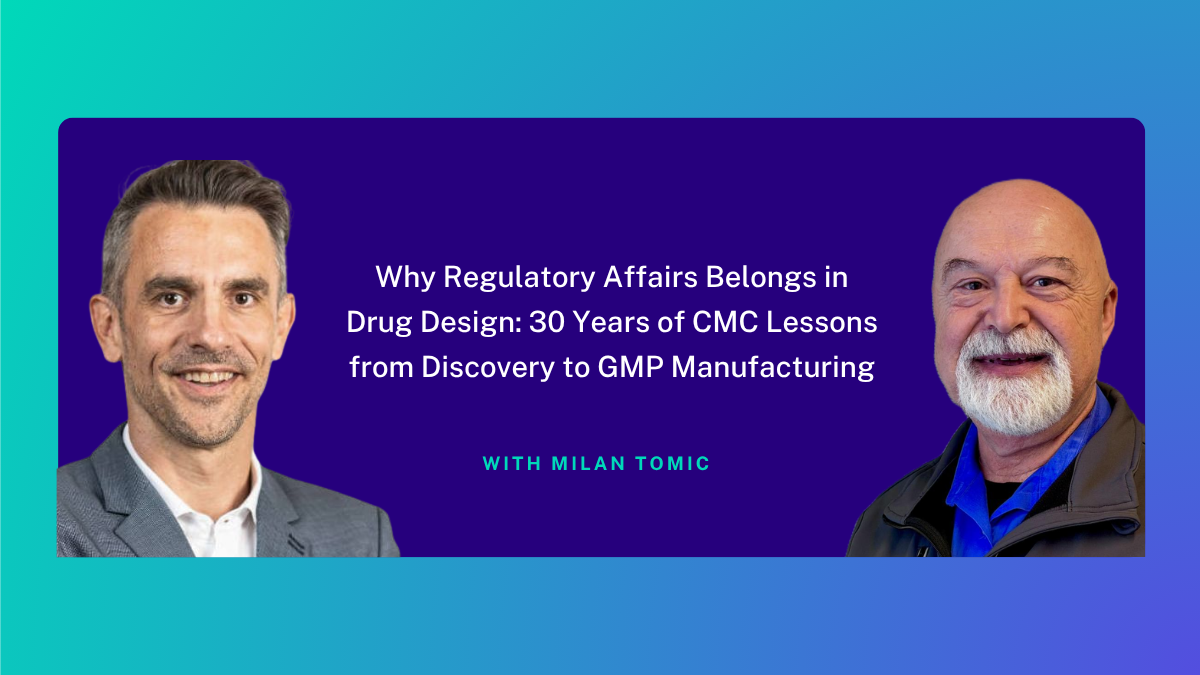
What happens between scientific discovery and clinical trials? For too many drug candidates, the answer is “failure”—not because the idea lacked merit, but because the critical handoff between discovery and IND-enabling studies gets overlooked, rushed, or under-resourced.
This episode features Milan Tomic, whose journey stretches from nucleic acid chemistry to leading GMP manufacturing and biodefense initiatives with hundreds of millions in US government support. Milan’s focus lies in streamlining drug development, from rapid molecule design to building manufacturing infrastructure, all grounded in holistic, systems-level thinking. He brings a perspective shaped by decades bridging the technical, operational, and strategic gaps that determine a therapy’s fate.
Episode Highlights
- Why so many promising programs fail between discovery and the clinic, and how to close this gap through early, iterative design and testing [02:52]
- The practical advantages and considerations of cell-free protein synthesis for rapid prototyping and testing during development [07:30]
- How to decide when to deploy cell-free production versus traditional CHO systems [08:29]
- Recommendations for resource-constrained startups: what to focus on first and why stability and documentation matter most [10:55]
- Consistent success factors across Milan’s experiences, from government contract projects to launching his own company—breaking goals into manageable, well-connected pieces [13:54]
- Candid stories of setbacks and lessons—such as the critical importance of safety in development and the impact of overlooked technical details like facility lighting [15:30]
- The importance of linking drug design decisions to target patient needs and regulatory considerations, thinking holistically, and using target product profiles to guide development [20:22]
- Milan’s top takeaway: remain curious and make the process enjoyable to drive learning and innovation [21:56]
In Their Words
Now we have a process where we can do very rapid redesign–build–test cycles. We can do an iterative process for drug development that is far beyond what we’ve had before. Now we can actually direct the site of activity, direct the solubility or aggregation potential that our molecules have, and test the molecule early in the stage.
And now, if you link that with what is the regulatory path, what is the design of the drug, and the mechanism of action that would be most efficient, now you have the ability to design that molecule to be much more effective and much more appropriate to fill that gap that you’ve identified you want to address.
Podcast Transcript
David Brühlmann [00:00:56]:
Welcome back to the Smart Biotech Scientist. We are in the middle of a conversation with Milan Tomic. In Part One, he walked us through the career arc that took him from nucleic acid chemistry to leading GMP manufacturing and biodefense programs at scale. Now in Part Two, we get into the substance: why scientifically compelling programs keep failing in the space between discovery and IND-enabling studies, what cell-free protein synthesis actually solves in early development, and where limited resources should be focused first to protect a candidate’s future.
Let’s continue. Now as we move a bit earlier—before you have this product that works, that is the right product and is developed the right way—there is this well-known gap in drug development, usually the space between early discovery and then IND-enabling studies. How are you closing this gap now with your current activities in your company?
Milan Tomic [00:03:16]:
This is where I really wanted to implement some processes that are at the cusp of where we are with the whole drug development paradigm. And this is a time, I think, when we have a lot of opportunities to change some of that prior perception of large amounts of failures in translational development stages—what you have referred to as the “valley of death” for a lot of projects. You know, some of what I’ve said previously was that, yes, you need to take into account the gaps or what you need and how you need to develop this drug to meet market demand that will help transition through the valley of death.
In my experience, I’ve seen people address those kinds of things too late in the process. Are they addressing formulation too late? Are they finding out that affinity or selectivity of a drug is not adequate or appropriate to meet what they need in a market, leading to higher doses, leading to side effects, and then leading to failure or ultimately dropping a project? If you take into account where it’s going, you might be able to choose more appropriately the molecule you’re developing, which would decrease this loss during that translational stage.
The part that I started with, however, is even deeper than that. Now we have a process where we can do very rapid redesign–build–test cycles. We can do an iterative process for drug development that is far beyond what we’ve had before. The engineering we applied, for example, with humanization of drugs or looking to make things less immunogenic, was only the start. Now we can actually direct the site of activity, direct the solubility or aggregation potential that our molecules have, and test the molecule early in the stage.
And now, if you link that with what the regulatory path is, what the design of the drug is, and what mechanism of action would be most efficient to have in the industry, you now have the ability to design that molecule to be much more effective and much more appropriate to fill that gap you’ve identified. It doesn’t mean your initial discovery was wrong. It just means your initial discovery opened the door to many more possibilities to enable you to get the right therapy into the right patients.
David Brühlmann [00:06:18]:
Let me reframe this in my words. What I take out of that, Milan, is you have to start with the end in mind—knowing what kind of patient you’re going to treat—and then also test as early as you can, not wait until the very last moment.
Milan Tomic [00:06:37]:
That is absolutely correct. What kind of patient you’re going to treat, what does that treatment involve, what kind of affinity you need for the molecule, solubility—all of those are key points. It’s not just anymore that you can do it or that you found something. It’s more that you can adjust that something to be most appropriate for what the need is. So your summary is very correct. I think we’re at a point where we really have those tools, and very importantly, the acceptance in the industry to take those steps to engineer those molecules to provide a much more efficient drug discovery and development process. This really is what drove me to set this in motion with Albrem—to look at the picture in a slightly different way and incorporate some of my experiences, like cell-free protein synthesis.
And I’ve actually seen some industry movement. There was a recent seminar from AbbVie, for example, that really talked about this design–build–test approach at an early stage in drug development. That was very heartwarming to see. It’s not universally adopted yet, but I think it’s going to be a very good pathway for developing new drugs and products.
David Brühlmann [00:08:16]:
At what stage do you generally start with cell-free production? Is that to generate tox material? Is that to develop the real manufacturing process? What is your strategy there?
Milan Tomic [00:08:29]:
The strategy there is really to develop the test molecule, if appropriate. If you look at it, it’s more: “What do you need? Does the molecule need to be glycosylated? Is it small? How much of it do you need?” And honestly, at this point, there is enough reliance on CHO-based development that you could make it quickly in CHO. There isn’t much of a gap there in terms of what you choose to make. And each process—whether CHO or cell-free—requires its own setup, its own nuances, and its own adjustments for every molecule.
So there is not much benefit at that stage for cell-free versus CHO. But when you get into this design–build–adjust phase, those things you worked out with cell-free can really pay off. They can provide not just test materials, but perhaps even toxicology materials or early-stage materials where you’re looking at mechanism of action to make sure your drug meets the need criteria, the gap, or the design criteria you’ve established. It is very useful in a design–build–test approach where you can make enough material to test either in a cell system or even in vivo or PK applications, where you really have a good idea at an early stage that you can tailor or engineer your drug appropriately. I think that is going to be key as we go forward—this iterative approach for developing new entities to fill unmet needs.
David Brühlmann [00:10:28]:
I would like to make this actionable, in particular for someone listening who is at a small startup. As you well know, in a startup you have limited resources. The question is: what should I focus on right now, and what can wait? What is your recommendation, Milan? What investment or analysis pays the highest dividend, and what should they absolutely focus on?
Milan Tomic [00:10:55]:
That is a very difficult thing to answer. There is an old quality assurance adage I commonly use for everything: it depends. It really depends on the drug, how much you know about it, how much you know about its mechanism of action, and its molecular characteristics. If you want to boil it down to one general aspect, the degradation or stability of the drug is one of the earliest tests or hurdles you can focus on. If there are ways you can stabilize the drug—make it more soluble, less prone to cleavage, or less prone to oxidation—then you have much more opportunity to move to the next stages of development. You also have a better chance of keeping retains stable for future use when you have more knowledge and tools available. That can be very useful for building or understanding the development pathway you’ve taken. It may also help bridge early results with later development outcomes.
So if I had to boil it down to one thing: make sure you document things well and save retains. For that, you will need stability work, formulation work, or molecular characterization and engineering work that helps your product move to the next stage of development.
David Brühlmann [00:13:02]:
This is very good advice. Thank you for making it actionable and simple, even though it’s very complicated. It’s important that people developing new drugs clearly understand what the critical quality attributes are, what is important, and what they need to focus on. I’d like to zoom out and look at your various chapters again. You upgraded a GMP facility, secured over US$150 million in U.S. government contracts, built quality systems from scratch, and now you’re building your own company. What are two or three success factors you have consistently seen across these chapters?
Milan Tomic [00:13:54]:
You know, that’s going to be something that is very personal. In a sense, you want to be able to drive improvement. Across these different chapters, that improvement tends to come from looking at things from your point of view, and hopefully others find it useful as well. So in looking at all of this, I think you said it very well: start with the end in mind, break your goal into manageable pieces, remain interested in how those pieces are connected and how they work, but also remain flexible.
There may be better ways to link those pieces to make them work more efficiently or appropriately. That is a key point—you won’t always succeed, but you should have a plan B, an alternate way forward. Things may not always be in a straight line, but you are still making progress. By breaking things into manageable sections, ensuring they are strongly and appropriately connected, and working through them step by step, you move forward effectively.
David Brühlmann [00:15:26]:
What is the hardest lesson you had to learn?
Milan Tomic [00:15:30]:
Most recent one—I think there have been numerous ones along the way. When I was working with one of the products, XOMA, it was a great anti-psoriasis product. Unfortunately, it was at the early stages of these immunosuppressive antibodies where it wasn’t recognized that additional testing was necessary, and several patients died from brain swelling. That was hard. Knowing that yes, you may have a great product, you may have everything done correctly, and you may have engineered things correctly—but you may not know everything. That was difficult.
What kept me going through that was that it was really helping a large number of cases, a large number of patients, but it wasn’t helping everybody. And so going into clinic with very careful dosing paradigms was an important part of what we did for multiple antibody programs. That, I think, is an important thing to remember: you don’t jump and skip early steps. Be safe in the development of this, because it can affect people adversely in ways you may never have thought through. That was one big learning in plant development.
Another very big learning is: do not ignore the lighting in the room, because it can leak. It can be a huge gap in your pressure cascade that you haven’t thought of before. That caused a delay in getting the plant up and running, and we had to innovate how to build new boxes to contain lighting fixtures that could be slid into the existing systems. So there is a bit of learning there—but “don’t ignore the lighting in the room” is the short quip at the end of it all. The broader lesson is also this: yes, you can delve into the science of things—the “how”, the connections—but it’s important to explain these to other people. It’s important to feel strong enough in your understanding to bring them into discussions, to have conviction. Because honestly, as I began this earlier, we talked about salesmanship. It will help your salesmanship, your drive, your conviction, your belief in yourself—and that will help you make things work.
David Brühlmann [00:18:25]:
Yeah, that’s definitely true—salesmanship. And what also resonates with me is that small details matter. Long story short, we once did tech transfer, and the lighting was different between the two labs, which led to different product quality. So small details matter.
Milan Tomic [00:18:43]:
Small details matter. That actually connects to your question about process. You can design a plant to be flexible within limits, but you have more ability to design the process to fit the plant than to force a plant to accommodate a poorly designed process. That includes resins that are hard to source, hard to qualify, or hard to pack into a column. All of those are things you should consider when developing a process. You want things to be robust and dependable, but that can also come from including those choices early in development—choosing resins that are easier to pack, columns that are easier to scale, or processes that require less water, for example, than you might initially think. Those kinds of decisions are very important to fit your product into the overall development plan.
David Brühlmann [00:19:49]:
As we are wrapping up, Milan, what questions should I have asked?
Milan Tomic [00:19:55]:
Honestly, there is so much. I’ve already filled in some gaps in terms of the “how”—my curiosity-driven path, which may look like a random walk but isn’t. What’s interesting to me is how different scientists or entrepreneurs view their path. That can lead to failures because we don’t always consider things like the Target Product Profile (TPP), which is key to driving a product. Including Regulatory Affairs or Medical Affairs early in drug design is also critical. I look at things holistically—not just one element, but how everything is linked and works together. Those connections are hugely important in both thinking and product development.
David Brühlmann [00:21:10]:
Think holistically, look at the big picture.
Milan Tomic [00:21:13]:
Yes—and then you are guided by the TPP and the path forward. That helps tremendously reduce the significant failure rate in drug development. It’s not that the drugs are inherently wrong—it’s that they may not be fully appropriate for how they are developed or what they are. They may need adjustment, and incorporating those factors as early as possible is very helpful for success.
David Brühlmann [00:21:46]:
Well, this has been great. Milan, with all that we’ve discussed today, what is the number one takeaway you want our listeners to walk away with?
Milan Tomic [00:21:56]:
That’s really tough—there are many things. But I think the number one thing is: remain curious and have fun. Whatever you do should be enjoyable, and curiosity will drive learning.
David Brühlmann [00:22:15]:
That’s a great way to conclude—stay curious and have fun. Milan, where can people get a hold of you?
Milan Tomic [00:22:23]:
Oh, thank you—that one is a lot easier. Other questions were a lot harder. www.albrem.com is up and running, so that’s one way. Milan@albrem.com is a simple way to connect with me. And LinkedIn works as well.
David Brühlmann [00:22:41]:
Excellent. Smart Biotech Scientists, you’ll have the links in the show notes. Milan, thank you so much for sharing your passion and very importantly your learnings. It’s been a huge pleasure to have you on the show today.
Milan Tomic [00:22:56]:
Thank you, David. It has been a real pleasure to be here. I very much appreciate it.
David Brühlmann [00:23:04]:
The Valley of Death isn’t a mystery. It’s a collection of strategic decisions made too late, under-resourced, and without enough structural thinking. Milan Tomic has spent three decades on both sides of that gap. The principles he shared today—rigorous characterization, quality as architecture, scientific honesty about failure—are as relevant at a five-person startup as they are at a global manufacturer.
Disclaimer: This transcript was generated with the assistance of artificial intelligence. While efforts have been made to ensure accuracy, it may contain errors, omissions, or misinterpretations. The text has been lightly edited and optimized for readability and flow. Please do not rely on it as a verbatim record.
Next Step
If you found value in today’s episode, take a moment to like, follow, and leave a review on Apple Podcasts or your favorite platform—it helps us reach and support more scientists like you.
Thanks for tuning in to the Smart Biotech Scientist podcast and being part of this journey toward bioprocess mastery. For more insights and practical tips, visit
About Milan Tomic
Milan Tomic is an experienced biotechnology leader specializing in CMC development, GMP manufacturing, quality systems, and biologics commercialization. With a Ph.D. in Biochemistry from the University of California, Berkeley, he has held leadership roles at Bayer and XOMA, where he directed quality engineering, manufacturing upgrades, and antibody co-mixture development programs. His expertise spans early-stage development through Phase 2 support, operational strategy, biodefense programs, and post-market product support.
Connect with Milan Tomic on LinkedIn.
Further Listening
If you enjoyed this episode you might also like listening to:
Episodes 189 - 190 : Why Smart Biotech Founders Plan CMC First (While Competitors Burn Cash Later)
Episodes 123 - 124: Manufacturability: Why Most Protein Candidates Fail (And How to Pick Winners Early) with Susan Sharfstein
Episodes 213 - 214: From Developability to Formulation: How In Silico Methods Predict Stability Issues Before the Lab with Giuseppe Licari
Episodes 231 - 232: From IND to BLA: The Biologics CMC Decisions That Determine Regulatory Success with Henri Kornmann
David Brühlmann is a strategic advisor who helps C-level biotech leaders reduce development and manufacturing costs to make life-saving therapies accessible to more patients worldwide.
Hear It From The Horse’s Mouth
Want to listen to the full interview? Go to Smart Biotech Scientist Podcast.
Want to hear more? Do visit the podcast page and check out other episodes.
Do you wish to simplify your biologics drug development project? Contact Us