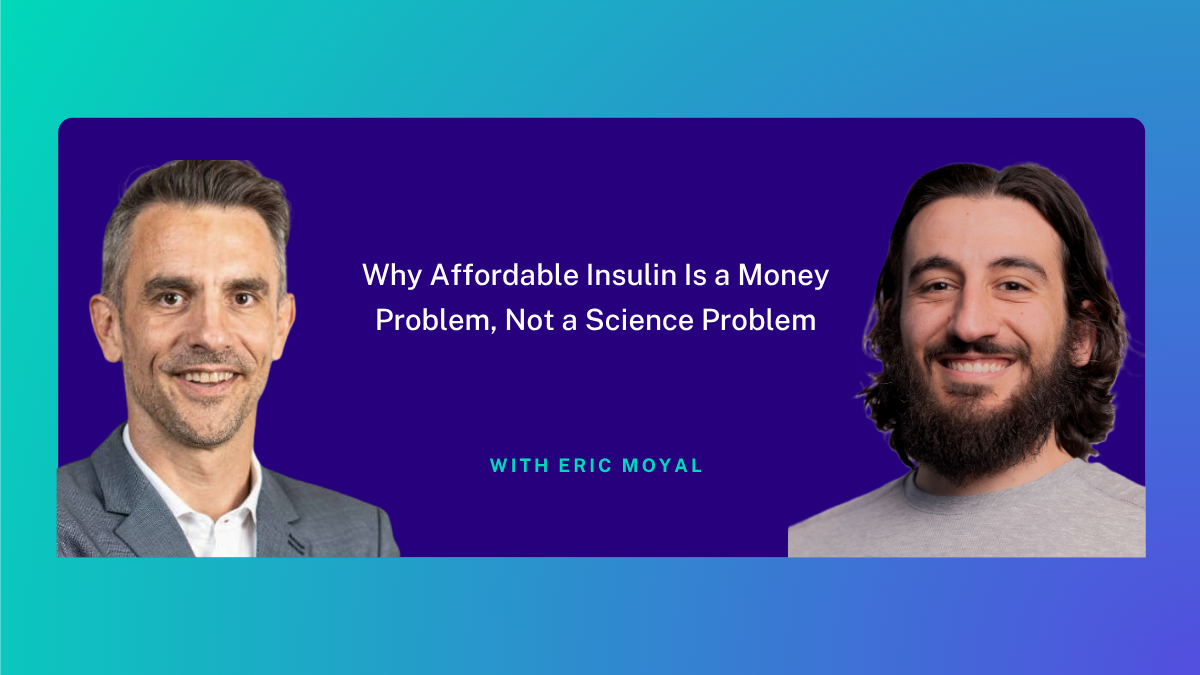
What if affordable insulin isn’t a scientific hurdle—but a financial and distribution puzzle no one’s been motivated to solve?
In this episode, Project Insulin founder Eric Moyal lays bare the paradox facing millions of people with diabetes in the U.S.: a therapy discovered over 100 years ago remains out of reach for 1 in 5 insulin-dependent patients. Why? The answers cut through biotech conventions, venture capital dogma, and the structural maze of U.S. drug distribution.
Episode Highlights
- The origins of the insulin affordability crisis and the impact of profit-driven healthcare systems [04:27)]
- How over a million Americans are forced to ration their insulin every month, and the broader impact on patients’ lives [06:37]
- The advantages and challenges of approaching drug development with a background outside of biotech [08:37]
- The fundraising-focused strategy for overcoming scientific and technical hurdles in developing biosimilar insulin [09:17]
- Technical details on Project Insulin’s development process, including selection of CDMOs, importance of analytical data, and process challenges like reverse-phase cleaving and crystallization [11:16]
- The impact of recent FDA regulatory changes on the development and approval pathway for biosimilars in the U.S. [15:45]
In Their Words
I run a nonprofit called Project Insulin. We’re making our own biosimilar insulin glargine, and we’re going to sell it directly to patients at cost, regardless of insurance status. Our mission is to ensure that everyone who depends on insulin has access to it.
When I started it, the main concept was that making insulin affordable is not a scientific problem — it’s a money problem. People know how to make insulin. It’s one of the first molecules people work with when they’re in undergrad, a Master’s program, or a PhD in the sciences. So it’s not like finding someone who can do the drug development work would be that hard.
Really, the issue is fundraising. Can we raise enough money to actually make an insulin that is affordable and available to anyone who needs it?
Podcast Transcript
David Brühlmann [00:00:46]:
One in five insulin users in the US ration their supply — a full century after the molecule was discovered. Why is something this essential still out of reach for so many?
Today, Eric Moyal, founder of Project Insulin, joins us to take that question apart. We trace his path from nonprofit fundraising into biotech and start unpacking what it actually takes to build an affordable biosimilar insulin.
Let’s get into it. Welcome, Eric. It’s good to have you on today.
Eric Moyal [00:02:35]:
Thank you. Great to be here. Thanks, David.
David Brühlmann [00:02:37]:
To start us out, let’s start with this controversial question. Share something that you believe about bringing medicines to patients that most people disagree with.
Eric Moyal [00:02:48]:
Interesting. So my first thought would have been that everyone should have access and medicines should be affordable. But I think most people actually do agree with that. In fact, many people I meet in the biotech space firmly believe that. So I would say my hot take, so to speak, would be: a nonprofit could make life-saving medications.
David Brühlmann [00:03:07]:
And we’re going to talk more about that. I’m very excited to see how that could play out. How did you actually get attracted to science? What was the spark? What drew you into the world of drug development? And eventually, what were the pit stops along the way to now developing insulin?
Eric Moyal [00:03:28]:
It’s a long road filled with twists and turns.
I am not a scientist. I don’t have a background in any of the scientific fields — biochemistry, neuroscience, anything like that. I went to university, got a business degree, ended up in university fundraising, and eventually ended up in life sciences because I was looking for a way to make a change in healthcare.
The opportunity to do so appeared in the form of creating an affordable medicine, using my skills as a fundraiser to fund a project, and then hopefully using the skills of scientists — hiring people to actually do the drug development work itself.
David Brühlmann [00:04:06]:
What intrigued me is when I came across your endeavor to develop insulin and the first thought that crossed my mind was: wait a minute, insulin has been around for more than a century, but yet there’s still an affordability crisis, particularly in the U.S. Am I missing something? What is the problem there? Tell us.
Eric Moyal [00:04:27]:
It’s interesting. Insulin was originally discovered over 100 years ago, and the original patent was sold for a dollar. The researchers famously said, “Insulin does not belong to me; it belongs to the world.”
So how do you get from a place that started off with such good intentions to a place where now it is so unaffordable for so many people, and people are rationing insulin? How we got here, I’m not sure. As far as the full details, I couldn’t tell you. I’m not an anthropologist.
But what I can tell you is that the most recent versions of insulin — another word for them is synthetic analogues — are the insulin analogs. The most recent versions of insulin were invented in the late 1990s, and the patents for those have expired. There are a few things that contribute to the high prices.
First, there are investors. Businesses have a fiduciary duty to their investors. That means that anyone making a drug literally has to make as much money as they can because that is the agreement they have with their investors. They have a fiduciary duty to those people.
Inherently, the model is focused on profit. A secondary focus is people’s health. Some of the major pharmaceutical companies do include improving people’s health as one of their main goals in their financial statements every year. But again, it has to be secondary.
And then I think in the U.S., we do not have a single-payer system. It’s not government-based healthcare; it’s a privatized system. As a result, there are quite a lot of middlemen organizations involved in the insulin distribution process.
We already talked about manufacturers, but there are wholesalers, insurance companies, pharmacies, and other middlemen organizations that all need to make a profit on the journey of getting insulin from a manufacturer to a patient.
Each of those extra steps adds to the cost. So it’s a combination of issues leading to high prices, but I would say the two major pieces are for-profit, shareholder-based companies and a complicated distribution system.
David Brühlmann [00:06:30]:
And today, how many patients in the U.S. can’t afford insulin, and how big is that problem?
Eric Moyal [00:06:37]:
The statistic that’s out there is that 1.3 million Americans ration their monthly insulin supply. So that’s 1.3 million Americans who don’t use as much insulin as they are prescribed to use in a month.
Part of that is due to how expensive it is. For others, it’s about not having access. But a large part is because of cost. The current statistic continues to change, but on top of that, it doesn’t include people who are buying their insulin but making other sacrifices. They’re not eating healthy, they don’t have the means to get a better education, or they can’t leave a job because they have good insurance at their current job but they hate the job.
There are other things that count toward affordability and access that aren’t necessarily just: “I literally can’t pay for this.” So the number is 1.3 million. But I think a much larger group also includes that portion. Unfortunately, I’ve gotten emails — we’ve been doing this for five years now — and every couple of months I’ll get an email or two saying:
“Hey, my insurance — I can’t afford it this month.”
Or:
“I got laid off and now I don’t have insurance.”
Or:
“I’m 27, so I’m off my parents’ insurance now,” which is a major issue here.
There are a whole lot of stories that I hear all the time. And if you go to our social media, our most recent posts, a lot of people have commented about how they’ve struggled.
David Brühlmann [00:08:00]:
1.3 million — help us understand how much that is in perspective compared to the total number of patients. What percentage is that?
Eric Moyal [00:08:08]:
There are about 8 million insulin-dependent patients in the U.S. Not everyone with diabetes uses insulin. But of the 8 million who are insulin-dependent, it’s 1.3 million. So it’s about 20%.
David Brühlmann [00:08:20]:
That’s a big number, definitely.
So tell us, since you have a unique background and you’re not coming from the biological or biotechnology side, how did your work from fundraising and nonprofit leadership actually influence the way you’re developing a biosimilar insulin?
Eric Moyal [00:08:37]:
First, there is something to be said about coming from a different field. Not having the preconceptions and notions of what can and can’t be done in life sciences or pharmaceuticals is a strength. There are a lot of weaknesses too — I didn’t know anything about anything. So that took time to learn. But there is value there.
The value is having no preconceived notions. So I can ask: why can’t it be done this way? I run a nonprofit called Project Insulin. We’re making our own biosimilar insulin glargine, and we’re going to sell it directly to patients at cost, regardless of insurance status. Our mission is to ensure that everyone who depends on insulin has access to it. That would be the sound bite.
When I started it, the main concept was: making insulin affordable is not a scientific problem — it’s a money problem. People know how to make insulin. It’s one of the first molecules people work with when they’re in undergrad, a Master’s program, or a PhD in the sciences.
So it’s not like finding someone who can do the drug development work would be that hard. Really, the issue is fundraising. Can we raise enough money to actually make an insulin that is affordable and available to anyone who needs it?
That was the original thesis.
Of course, over time I’ve learned how scientifically challenging it is and all these other pieces. But that main idea — that if we can raise money, we can tackle this problem — has been consistent. Even if it is more complicated to make insulin than I thought, if you have the right people, it’s still more than feasible.
I’d say fundraising is really the driver of this whole thing. The idea that if I can raise the money, we can actually make an insulin and get it to patients has driven and continues to drive us forward. I think my background in fundraising is incredibly important and is the only reason why I even thought I could tackle this.
I’d wanted to be in healthcare previously and realized that I really am passionate about healthcare on a more general level. A lot of things require research, and I’m not a scientist. I’m not a researcher. So finding an opportunity like insulin really was exciting for me because I could use my skills to do something that would impact a lot of lives in healthcare.
David Brühlmann [00:10:49]:
Raising funds is challenging, no doubt about that, especially nowadays. Besides that, the technical development you alluded to is also challenging. Even though insulin has been around for quite some time, and as you well know, smart biotech scientists, developing a biosimilar is a challenge.
Can you tell us a bit about how you approach the technical side — from strain and process development through analytics? What is your strategy there?
Eric Moyal [00:11:16]:
My strategy was: hire someone really good. I’ll share some details, but I can’t give you everything.
We hired a Chief Scientific Officer once we were far enough along in the fundraising process that we could offer someone a respectable salary. She has 18 years of experience working at Merck, specifically with biosimilar insulin development. So I found the best person for the job, and I got really lucky. Hiring her was a huge benefit for the technical side, which had previously been a few advisors guiding me and giving me a 20-minute YouTube degree in the life sciences.
The way we’re building it is that we’re hiring a CDMO to actually do the drug development work. We’re not building our own lab space and doing everything internally. We’re working with a CDMO. We need to ensure that we have the right metrics we’re asking for throughout the development process.
Given our Chief Scientific Officer’s background — her name is Allison, so I’ll just refer to her as Allison — I feel very strongly that she’ll be able to oversee it well. To answer your question on the technical metrics: titer is important. How pure we can make it is important.
And I know you have a more technical audience, so I apologize in advance for simplifying things, but this is how I’ve learned it. I’ve learned it through people who know it well. The goal is ensuring that it’s pure and that we can get as much titer out of the molecule as possible. That downstream leads to more insulin per bioreactor, which brings down our costs. Those are the bigger pieces we’re looking at when it comes to the variables. Additionally, we picked a CDMO with a very strong analytical track record, and that was intentional.
We wanted to ensure that, given the FDA’s more recent approach where biosimilars are being treated more similarly to generics — which was not previously the case in the U.S., although Europe had a different approach — our goal is interchangeability. It’s showing biosimilarity and then eventually interchangeability with the original product, the reference product.
Having strong analytical data is a huge part of submitting to the FDA. So:
A) Hire the right Chief Scientific Officer — that’s obviously a huge step toward making a strong product.
And then:
B) Look at the bigger picture.
It’s not just making the drug. Anyone can make it — well, anyone with the correct bioreactors and equipment can. But you have to think ahead: it’s not just about manufacturing it. It’s about demonstrating a robust analytical package to give the FDA confidence in approving the product.
And if we have strong analytical and preclinical data, our clinical work is shorter as well. All that is to say: finding the right people and the right teams will help reduce costs in the long run while also ensuring we have the highest quality product. Because at the end of the day, this is something going into patients, and we’re very, very aware that we only get one real shot to make this happen.
David Brühlmann [00:14:14]:
And if you can share the details or the way you produce insulin, is that similar to traditional processes out there, or is it a fundamentally different approach you’re choosing?
Eric Moyal [00:14:26]:
Again, I’m not the scientist, so you’ll probably have to have a follow-up with Allison. But it’s an E. coli-based product, so it’s simple in that sense. However, there is a reverse-phase cleavage step that is technically harder and difficult to scale. It won’t be hard at the pipette level, but it will be challenging once we get to 10- and 100-liter scales. I think that’s one of the bigger pieces that is a little more unique for insulin — that reverse-phase cleavage step. There’s also a crystallization step, but I can’t tell you a whole lot about that.
I know that’s another thing we’re thinking about: can we crystallize it and then ship it to the fill-finish site, and then later reconstitute it into a liquid? That way, we could potentially reduce shipping costs. We’re thinking about all these different pieces because at the end of the day, it’s about affordability.
There are unique challenges for insulin. Reverse-phase cleavage and crystallization are kind of like a wish-list item, but there are these unique pieces. Overall, though, it’s a pretty standard E. coli-based drug development process. We’re using E. coli; we’re not using yeast or any of the other platforms.
David Brühlmann [00:15:30]:
You mentioned that the FDA recently changed the regulatory pathway, so there’s definitely a great opportunity there. Perhaps tell us a bit more about what changed, because I think not everyone listening is familiar with what exactly changed.
Eric Moyal [00:15:45]:
Absolutely. And I think this is an important part of our story — timing is everything. In 2010, there was an FDA rule that came out where biosimilars would essentially receive a pathway similar to generics. I don’t remember the official pathway name, but that pathway was introduced in 2010 and then rolled out more broadly later. I started working on this in 2021, and when I started, that pathway already existed.
That meant the economics of making biosimilar insulin made a little bit more sense because a full clinical investment would not necessarily be required. That’s the basic version of the FDA pathway. Again, I surround myself with very good people, so you’d have to ask regulatory experts for the full details. But at a high level, they made biosimilars more similar to generics in the sense that the clinical trial pathway is much shorter.
It would typically involve a shortened Phase 1 study. If that data is strong, you may not need to do a Phase 2 or Phase 3 study. You would then move to the PPQ batch — the Process Performance Qualification batch — which is more about demonstrating manufacturing consistency at scale than proving the clinical viability of the drug.
David Brühlmann [00:16:57]:
This new pathway opens new avenues for what you’re doing — developing a much cheaper biosimilar, especially in areas where we have well-documented data and a lot of clinical experience.
Eric Moyal [00:17:11]:
Exactly.
David Brühlmann [00:17:12]:
We’ve covered a lot of ground with Eric Moyal already, from the roots of the affordability crisis to the realities of building an alternative insulin. And there’s still plenty more ahead. In part two, we keep the conversation going and dig further into how Project Insulin turns its mission into practice.
Disclaimer: This transcript was generated with the assistance of artificial intelligence. While efforts have been made to ensure accuracy, it may contain errors, omissions, or misinterpretations. The text has been lightly edited and optimized for readability and flow. Please do not rely on it as a verbatim record.
Next Step
If you found value in today’s episode, take a moment to like, follow, and leave a review on Apple Podcasts or your favorite platform—it helps us reach and support more scientists like you.
Thanks for tuning in to the Smart Biotech Scientist podcast and being part of this journey toward bioprocess mastery. For more insights and practical tips, visit
About Eric Moyal
Eric Moyal is the Executive Director and founder of Project Insulin. Prior to launching the organization, he led major fundraising initiatives at Brandeis University, helping raise more than $2 million through Giving Tuesday campaigns. Eric also serves on the board of the Reflex Sympathetic Dystrophy Syndrome Association and is a passionate advocate for people living with chronic illnesses. In 2020, he delivered a TEDx talk exploring the importance of allyship within chronic illness communities.
Connect with Eric Moyal on LinkedIn.
Further Listening
If you enjoyed this episode you might also like listening to:
Episode 136: 5 Roadblocks to Affordable Biologics (And How to Overcome Them)
Episodes 57 - 58: Crafting a Solid CMC Strategy: Key Factors and Common Pitfalls with Matthias Müllner
Episodes 103 - 104: One-Stop Shop vs. Specialist CDMO: A Scientist's Guide to CDMO Selection with Sigma Mostafa
David Brühlmann is a strategic advisor who helps C-level biotech leaders reduce development and manufacturing costs to make life-saving therapies accessible to more patients worldwide.
Hear It From The Horse’s Mouth
Want to listen to the full interview? Go to Smart Biotech Scientist Podcast.
Want to hear more? Do visit the podcast page and check out other episodes.
Do you wish to simplify your biologics drug development project? Contact Us