
What separates labs with truly connected, AI-ready data from those drowning in digital chaos? Hint: it’s not just about buying the latest shiny software or plugging in a few robots. True digital transformation takes more than hype—it demands a commitment to the fundamentals: data quality, thoughtful automation, and the kind of data governance that actually serves scientists instead of slowing progress.
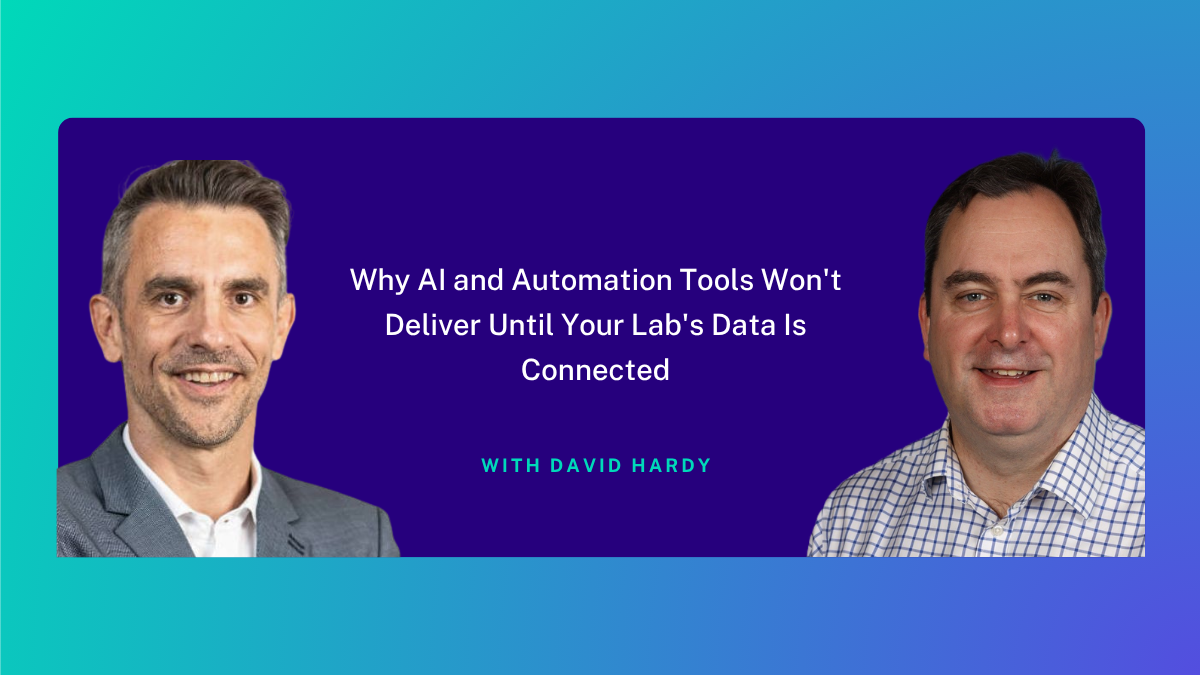
For today’s episode, David Brühlmann is joined by David Hardy, a leader at Thermo Fisher Scientific. With years spent guiding automation and digital lab transformation projects around the globe, David’s perspective is equal parts pragmatic and visionary. He’s watched automation go from pilot to scale, advised on the messy realities of lab data, and seen firsthand what separates science fiction from science fact in fully connected labs.
Episode Highlights
- Bottlenecks in lab automation, especially the challenge of scaling data volume and adapting processes [02:26]
- Differences between machine learning (ML) and generative AI in lab contexts, and why ML remains central to value extraction [04:17]
- The key requirements for successful AI adoption: quality data, robust data checking processes, and a cyclical approach to model training [05:25]
- The vision for an AI-enabled, fully connected lab and the role of predictive maintenance and data quality checks [07:24]
- Data governance strategies: balancing access and security, and the case for data democratization within organizations [09:32]
- How data standardization paves the way for better AI and smoother connectivity [11:25]
- The necessity of treating digital transformation as an ongoing journey, not a one-time project [12:15]
In Their Words
Any kind of digital transformation and automated digital lab initiative is always going to have a cost associated with it. Understanding the ROI and making sure that leadership within the organization is very clear about that is important. This is a longer-term play. It’s not something that will deliver everything in the short term. This is a commitment.
Podcast Transcript
David Brühlmann [00:00:18]:
Welcome back to Part Two with David Hardy from Thermo Fisher Scientific. In Part One, we mapped the connectivity problem, where fragmentation hurts most, and what holds automation projects back. Now we turn to what actually works: what a connected lab looks like in practice, the shortcuts teams regret, what good data governance looks like day to day, and where AI fits once the foundational work is done. Let’s get into it.
Before moving into AI, I would like to touch upon automation. You mentioned it because this is also part of data connectivity. There’s a lot of effort around automation, especially on the analytical side, but also in other areas in bioprocessing, such as cell line development or screening. What are some of the bottlenecks you’ve come across in automation projects?
David Hardy [00:02:26]:
The bottlenecks around data really stem from the sheer volume. When you move toward an automated approach for your lab or your bioprocessing workflows, it’s simply the amount of data being generated. They’re going to be working 24/7, so that’s when the approach you’ve taken really has to scale. The data produced will be similar to what you’ve been generating before, but it will just be on a much larger scale. On top of that, you may also have things like log information coming out of the automation.
But this in itself is useful. Running instruments that create data, and then the process of running them creates data as well. That information is also extremely valuable for optimizing the lab, ensuring that the lab is running efficiently, and ensuring that the bioprocess is running efficiently. We’re back at this exponential curve again, where the data volume just keeps accumulating.
David Brühlmann [00:03:19]:
So it’s mostly around the quantity of data that’s the biggest bottleneck around automation, correct?
David Hardy [00:03:24]:
I think so, because we’re not automating something that is drastically new. They would have piloted that process, perhaps at a smaller scale. The data output will be very similar. Obviously, as they scale with automation, there might be some changes with the equipment. So we’re back to the ability to adapt. But in essence, the processes they’re carrying out are going to be largely very similar.
David Brühlmann [00:03:49]:
Now moving on to AI. Many people are excited about AI, no doubt about that. The question is always whether AI and machine learning deliver, whether they really make a difference, and how do we integrate them? What do you think separates organizations that are able to extract real value from AI and machine learning from those that are still waiting for it to deliver?
David Hardy [00:04:17]:
It’s interesting that you phrase it as machine learning, because everyone these days — when you mention AI — immediately thinks, “Oh, we’re talking about generative AI.” But traditional machine learning, the predictive AI, so to speak, is still the backbone of AI. Obviously, that’s where you need the data volumes, depending on the AI model you’re using. But that will give you much better-quality value — maybe a classification or something along those lines. Then we’re back to data quality and data volume, in order to train those models and perform that analysis. Going back to what we anticipated: we want predictive AI, machine learning, to actually provide an answer. It’s very cyclical and a fully intertwined process.
David Brühlmann [00:05:07]:
And what do you think is important to make the best use of AI? Also, not knowing where it’s heading, or perhaps trying to play around with new features, what do you think is the right way to approach that?
David Hardy [00:05:25]:
Traditional kind of machine learning, those models require data to train the model, and then the data quality has to be good. So you really need to put something in place to check that quality as the data is being ingested. And going back to the question: how do you know what data you need in order to create the model, run the model, etc.? Again, we’re back in the chicken-and-egg scenario. Sometimes you might have acquired data over a couple of years for a particular process, and then someone thinks: “Actually, we could simplify this by using AI — maybe running fewer tests by making predictions on certain key results.”
But that might involve going back to the original data and re-extracting certain parameters or values that may not have been captured at the time. I think that’s pretty normal. That’s what data scientists and data wranglers have been doing for years already. You can never fully predict the future questions that might come up, which then relate back to: “what values and results do we need in order to train this model and answer that business question?”
David Brühlmann [00:06:28]:
So what I’m hearing, David, is that the value of real machine learning is much clearer than it would be with generative AI because the models are better understood, and as long as you have good data, you’re very likely to get something valuable out of it.
David Hardy [00:06:45]:
Yeah, it’s really due to the nature of the fundamentally algebraic equations that are ultimately under the hood. Predictive AI, given the same inputs, should give you exactly the same output. Generative AI is probabilistic, so the output may vary. Machine learning — predictive AI — is deterministic. There’s still a lot of merit in doing that, and obviously you need the data in order to do it. But not everything is GenAI.
David Brühlmann [00:07:12]:
I would love to have your view on the ideal future — in a couple of years or in five years. How does this fully connected, AI-enabled lab look like to you?
David Hardy [00:07:24]:
I think the fully AI-enabled lab — what does that look like? I think obviously AI is going to have a huge impact in terms of the tools and the processes that are carried out in the lab by users, by scientists, and by the people running the instruments. I think everyone is in agreement that things like predictive maintenance — the ability, for instance, to run self-diagnostics, identify problems, and flag issues early to users — are going to be important. People have been talking about that for a long time, and it’s almost becoming a given. I think, going back to some of the topics we’ve discussed today, there’s also the role of using AI to potentially go back, reevaluate that data, perform quality checks, etc., and bring in this additional layer of information. I think that’s the kind of thing we all talk about. But then there’s also all this peripheral technology that really enables the day-to-day processes and makes the use of AI even easier. That’s the power — and I guess the excitement — that AI brings into the lab.
David Brühlmann [00:08:28]:
According to you, are we far away from a fully connected lab or not?
David Hardy [00:08:33]:
No, I don’t think we are. Thermo Fisher Scientific, for example, has several customer experience centers around the world where customers can come in and see that type of lab today. It’s evolving, but the end-to-end workflow — from having a thought, an idea, a hypothesis (probably the better scientific term), through to taking that idea, running it through an automation system, generating results, and then feeding that back into a pool of information and knowledge — all contextualized with the right metadata — is something we can very much do today. That information can then help with the next round of experiments and the next hypothesis-driven question. That’s something we can demonstrate today, and it’s really exciting.
David Brühlmann [00:09:18]:
Coming back to the data: in order to have this level of connectivity and tap into the full potential of AI, we need good data governance. What are the main pillars of good data governance?
David Hardy [00:09:32]:
Data governance is key. Actually, there are two schools of thought here. Obviously, good-quality data is essential. You can’t get anywhere with the old “garbage in, garbage out” analogy. But then, in terms of governance within organizations, there are definitely two perspectives. One is: yes, we need to make sure that certain users can access this data, that it isn’t used to train LLMs, and that the wrong people cannot see it, etc. That’s been there for years — things like audit trails for access and data management.
An interesting one is this notion of: actually, let’s democratize data. Let’s say that if you’re within an organization, what are we hiding? Let’s make sure that data is available for the whole organization to use. You then get into issues where people are sensitive about their data and protective of it, and all the rest of that. But there are kind of two schools of thought. Going back, I mentioned knowledge graphs earlier, and that whole concept is around democratizing data. It’s always better to share, I would say.
David Brühlmann [00:10:36]:
So that means it’s always better to share, always better to collaborate, and have as many people working on that, right?
David Hardy [00:10:42]:
Yeah, I mean it’s very analogous to open-source projects, but within your organization. Just to clarify, there will be instances where certain data needs to be secure, and that will happen. But for large chunks of data, yes — why are you keeping it secret from your colleagues? The company has invested a lot of money in that data, both in terms of people, instruments, reagents, etc. So should that data, that knowledge, that insight, be available to everyone within the organization?
David Brühlmann [00:11:13]:
And it seems to me that brings us also back to the connectivity aspect — the better and easier data is accessible, the better we can use it, and the more we get out of AI.
David Hardy [00:11:25]:
Yes, we’re very much back at data standardization. That’s where organizations like Allotrope, for example, with their Simple Model (ASM), work really well. It’s something that companies like Thermo Fisher Scientific try to do as well — outputting data in standardized formats at the source. But there’s a lot of work we can still do. Then there are organizations like the Pistoia Alliance, for example, who help create ontologies around certain types of data that everyone can use. Standardization is the key to enabling AI. If you don’t standardize, it becomes just another barrier you have to overcome. But we like to keep things as simple and fast as possible.
David Brühlmann [00:12:06]:
David, as we’re wrapping up, what additional questions should I have asked, or is there any aspect we should have covered that you think is important?
David Hardy [00:12:15]:
I think we’ve covered most things. Any kind of digital transformation and automated digital lab always comes with a cost. Understanding ROI and making sure leadership within organizations is clear about that is important. This is a longer play — it’s not something that happens in the short term. It’s a commitment.
David Brühlmann [00:12:34]:
Excellent. With all that we’ve covered today, David, what is the most important takeaway you want our listeners to walk away with?
David Hardy [00:12:41]:
The most important thing — and I think I’ve covered this several times — is that good-quality, standardized data is key to efficiency within the lab. It enables you to move faster and answer future questions, etc. But it always comes back to that commitment. This is not something you do once and then it’s complete. It’s a long journey. I think we’ve pretty much covered that quite a lot over the course of the conversation.
David Brühlmann [00:13:08]:
Excellent. So, smart biotech scientists, there you have it. Digital transformation is a long journey. You have to be committed, and you also have to be able to adapt to constantly changing technology. Thank you very much, David, for taking us into the world of digital transformation and connectivity. Where can people get a hold of you?
David Hardy [00:13:30]:
Sure. I’m on LinkedIn, so you can find me there. Happy to take any questions. If people want to reach out and connect, I’m more than happy to respond and stay in touch.
David Brühlmann [00:13:40]:
Fantastic. David, thank you so much for being on the show today and sharing about digital connectivity and digital transformation.
David Hardy [00:13:49]:
Thank you, David. Thanks everyone.
David Brühlmann [00:13:51]:
Connectivity isn’t a technology problem waiting on better tools. It’s a foundation problem that determines whether automation and AI deliver value or stall out. The labs making real progress are the ones doing the unglamorous integration work first. If this episode shifted how you think about that, please leave a review on Apple Podcasts or your favorite platform.Thank you so much for tuning în …and I’ll see you next time.
Disclaimer: This transcript was generated with the assistance of artificial intelligence. While efforts have been made to ensure accuracy, it may contain errors, omissions, or misinterpretations. The text has been lightly edited and optimized for readability and flow. Please do not rely on it as a verbatim record.
Next Step
If you found value in today’s episode, take a moment to like, follow, and leave a review on Apple Podcasts or your favorite platform—it helps us reach and support more scientists like you.
Thanks for tuning in to the Smart Biotech Scientist podcast and being part of this journey toward bioprocess mastery. For more insights and practical tips, visit
About David Hardy
David Hardy helps shape the future of connected laboratories through innovation strategy, digital transformation, and data-driven solutions. With extensive experience across analytics, software, and scientific data ecosystems, he works with pharma and biotech organizations to improve lab efficiency, accelerate discovery, and unlock the value of integrated data.Passionate about the intersection of science and technology, David focuses on building practical digital solutions that support evolving laboratory needs. He advocates for long-term transformation approaches that combine strong data foundations, automation, and change management to create sustainable impact.
Further Listening
If you enjoyed this episode you might also like listening to:
Episodes 215 - 216: From Data Silos to Autonomous Biomanufacturing: Digital Twins and AI-Driven Scale-Up with Ilya Burkov
Episodes 233 - 234: Why Most Bioprocess Automation Projects Fail Before the Robot Is Even Ordered with Anthony Catacchio
Episodes 153 - 154: The Future of Bioprocessing: Industry 4.0, Digital Twins, and Continuous Manufacturing Strategies with Tiago Matos
David Brühlmann is a strategic advisor who helps C-level biotech leaders reduce development and manufacturing costs to make life-saving therapies accessible to more patients worldwide.
Hear It From The Horse’s Mouth
Want to listen to the full interview? Go to Smart Biotech Scientist Podcast.
Want to hear more? Do visit the podcast page and check out other episodes.
Do you wish to simplify your biologics drug development project? Contact Us