
Getting an NDA signed shouldn’t feel like waiting for FDA approval. If your CRO needs weeks just to kickstart paperwork, your project’s clock is already ticking in the wrong direction.
In this episode of the Smart Biotech Scientist Podcast, David Brühlmann welcomes Dr. Ron Najafi of Emery Pharma for an in-depth conversation on CRO partnerships, analytical challenges in biologics, and his learnings from decades as an entrepreneur.
Episode Highlights
- How to tell if a CRO’s workflow is robust—or just rigid [05:51]
- The importance of method validation and product stability testing [07:27]
- Managing expectations and trust-building in client relationships [08:29]
- Entrepreneurial lessons: raising capital, team-building, and finding the right partners [10:00]
- The hidden costs of public vs. private biotech ventures [12:31]
- Reducing bioanalytical costs in biologics through mass spectrometry [13:23]
- The future of analytical workflows and personalized medicine [14:48]
In Their Words
One of the things that I would say: if a CRO takes more than 48 hours to get an NDA signed, it’s the wrong CRO, we’re going to have a problem. If they say we’re going to have six months before we get your project started, if they’ll take two weeks to give you a proposal, one of the things I’m very proud of is we turn around NDAs in 48 hours, often less, and we promise to develop a proposal within 48 to 72 hours.
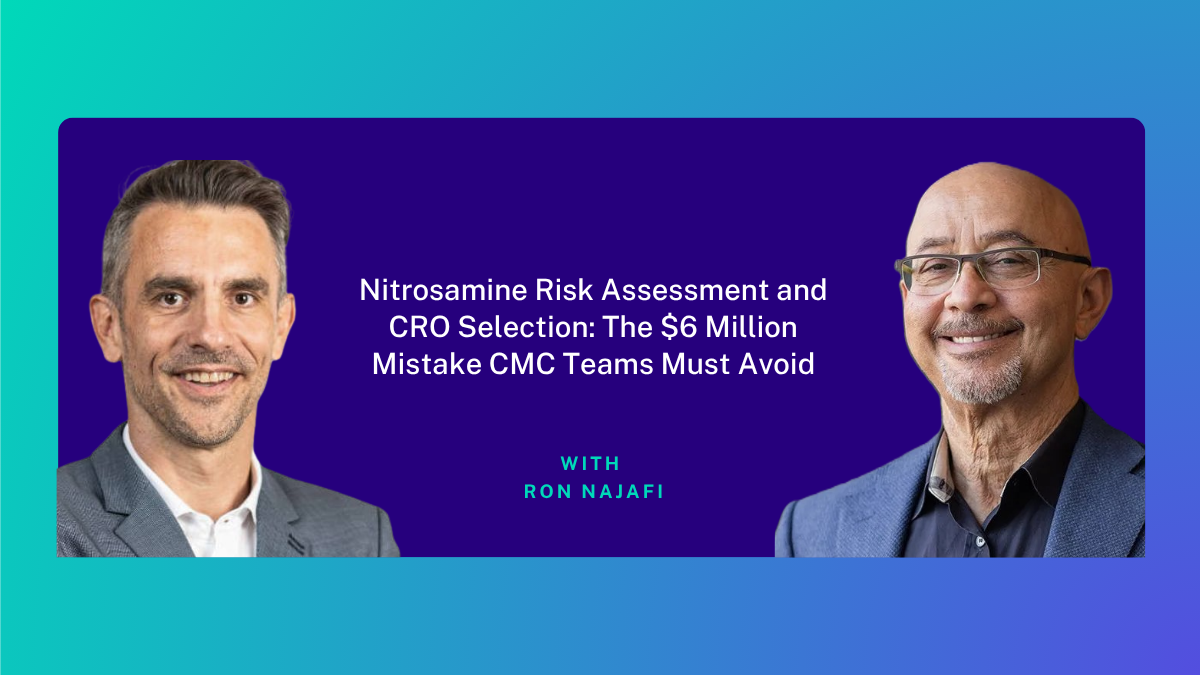
Nitrosamine Risk Assessment and CRO Selection: The $6 Million Mistake CMC Teams Must Avoid – Part 2
David Brühlmann [00:00:32]:
Welcome back. In Part One, Ron Najafi walked us through a career built on scientific rigor and entrepreneurial conviction. Now we go deeper into the practical questions that matter for your work: how to structure a productive CRO partnership, what separates a boutique specialist from a full-service organization, and what the future of pharmaceutical analytics actually looks like. Ron also shares the hard-won lessons that three decades of building companies tend to produce.
Besides the impurities now, as you’re working with various clients, what other challenges do you see in the analytical field where you help your clients, as a CRO?
Ron Najafi [00:02:31]:
Some of the things that we’ve gotten involved in include doing pharmacokinetics. For example, for a small molecule, it’s relatively straightforward. But if you’re doing pharmacokinetics in the eye, in the vitreous humor—which is the liquid inside the eye, roughly about one or two milliliters—you need to develop a method, you need to be able to validate that method, and you need access to the vitreous.
So we’ve actually been involved in that kind of activity where we bought vitreous humor from an eye bank and got involved in doing that. We actually published that work with a company called Rayner Surgical. If you search Rayner Surgical and Emery Pharma, you’ll find that we have significant expertise in ophthalmological pharmacokinetics. And that goes back to my experience with NovaBay as well, where we were involved in ophthalmology.
I have a lot of ophthalmological key opinion leaders—ophthalmologists near me who are friends of mine—and we’ve been getting calls from them wanting to work with us on different projects. As a result, we have a lot of experience there.
Another challenging area is assessing proteins. For example, if a gene therapy company is trying to silence a gene and therefore trying to see whether a certain protein level goes down or up in a very systematic fashion in an animal study, we’ve actually done that.
And these are not your average pharmacokinetics, David. You have to take the blood sample, get to the plasma, basically trypsinize everything. Before you do that, you have to know the sequence of your protein, perform an in silico analysis of what peptides would be generated as a result of trypsin digestion, identify several peptides, and then use those peptides as surrogate markers for the entire protein.
Then you synthesize the peptide, develop a reference standard of the peptide, and use it for a calibration curve. It’s much more involved and much more sophisticated than small molecules. Biologics have their own challenges, and we have established a very extensive, thoughtful workflow—a systematic workflow that gives us what we want.
So if there is a small change in the gene therapy, we are able to detect it. Does it work? Does it not work? All of that is done through pharmacokinetic studies.
David Brühlmann [00:05:20]:
You work in different fields, you do impurity testing, you do pharmacokinetics testing, and a lot of other services. I’m just wondering, if Smart Biotech Scientist is looking for a CRO, what are some factors they need to consider to understand which CRO is a good fit for them? Because there are big ones, there are smaller ones, there are more diverse ones. What is the advice you’re giving them?
Ron Najafi [00:05:51]:
Well, I would say you want to have a CRO that is big enough to have the resources, but small enough to move quickly. Some of the larger CROs are very bureaucratic. They have a lot of turnover. They have workflows, but they don’t have the expertise to figure out, if something didn’t work in that workflow, why it didn’t work. They use technicians for the most part to conduct some of the activities.
One of the things that I would say is if a CRO takes more than 48 hours to get an NDA signed, it’s the wrong CRO, we’re going to have a problem. If they say we’re going to have six months before we get your project started, if they’ll take two weeks to give you a proposal, one of the things I’m very proud of is we turn around NDAs in 48 hours or less, often less, and we promise to develop a proposal, if we have all the key information we need, within 48 to 72 hours, we have a proposal to the client, and a very extensive proposal.
One of the things that our clients are very impressed with is how extensive our proposals are and how we lay things out. Of course, we also do more sophisticated activities.
We do peptide mapping and then we validate it. We do GLP-type activities, and that can be submitted to the agency, for example, for GLP toxicology studies if they need the data. Definitely, one of the things that I would always say is when you develop an analytical method, the method needs to be validated. Even if it’s not GLP, you want to validate the method because there is a reason why the FDA requires validation. We want to make sure the method is robust. For example, if you get a frozen sample, have you tested the stability of your compound when frozen? Have you done that? They often have no idea. So you want to check the stability of your product in frozen conditions. Basically, do freeze–thaw stability, do room temperature stability. All of those things point to a good analytical method.
David Brühlmann [00:08:07]:
I would like to ask you about how do you develop a good relationship with your customers? Because when you’re choosing a CRO, or the same applies for a CDMO, this is a relationship you establish that will go on sometimes for several years. So it’s almost like a marriage. So how do you go about that?
Ron Najafi [00:08:29]:
I think managing expectations is the number one thing. I always tell my team to make sure if we have any challenges in analytical methodology, or if we’re going to have delays, if an instrument breaks down or needs to be serviced, we maintain a close, honest relationship with our clients. We work as if we’re part of their operation, part of their team.
From the moment the proposal gets signed and goes into our chemistry group, biochemistry group, or biomarker group, we assign a scientist who the client can reach out to, and that scientist updates the client sometimes once a week, sometimes twice a week. So we maintain a very close relationship, a very honest relationship, and we collaboratively try to solve problems. At the end of the day, we need to develop trust, and that trust comes from demonstrating our experience and expertise, utilizing that experience, and consistently managing expectations. That’s how trust is built.
David Brühlmann [00:09:37]:
Yeah, absolutely. But developing trust is key in any customer relationship or in any entrepreneurial endeavor. I would like to go back to your entrepreneurial story and just ask you: what were, I’d say, the number one or two main key lessons you have learned as an entrepreneur?
Ron Najafi [00:10:00]:
Well, I’ve had multiple chapters. If you asked me about fundraising from the days that I raised money for NovaBay, I raised $100 million from private and public investors, and I brought in $100 million in partnership revenue that came through NovaBay.
On that front, I will say: raise more money. When you have an opportunity to raise money, when money is offered to you, don’t negotiate too hard on valuation and so forth. Take the money, because having that money will be more important than not having it. You don’t know what’s going to happen as you go through clinical studies—you could have hiccups, you could have challenges.
So number one: raise more money than you need.
Number two: make sure you bring on board good people—people who are creative, flexible, hardworking, and smart. In the absence of knowing where you’re going, if you’re lost, smart people are the best thing to have. If you’re lost in a desert, it’s better to be with a bunch of really smart, entrepreneurial, creative, positive-minded people.
So those are two things that come to mind from my experience at NovaBay.
The third thing I would say is: when you have an asset and you want to partner that asset, make sure you have the right people helping you with mergers and acquisitions and partnering. You need the right skill set to actually find those partnerships. It took us a while to get that, but that’s really, really important because that creates a lot of value for you down the road—partnership opportunities.
Now in the next chapter, which is really different, I don’t have any investors at Emery Pharma. It goes back to the team. We have to make sure the team has the skill set, has the equipment they need, the right attitude, morale, and environment. All of that is really important. I think this is also true in any company—even in my previous chapter—but not having investors is a blessing in this chapter of my life because I don’t have to deal with investors or fundraising, and I can go to bed a lot easier.
David Brühlmann [00:12:24]:
That’s good to hear. I imagine you have a lot more freedom and independence.
Ron Najafi [00:12:31]:
I tell you, one of the things I would say is: if you don’t have to take a company public, don’t take the company public. Having a public company and running a company is like having two different entities. You have to deal with the public company, you have to deal with investors, you have to deal with institutional investors, and then you also have to run the company. It’s a lot of work, a lot of challenges.
I enjoyed it. Would I do it again? I probably wouldn’t. I much prefer the private enterprise where you can focus on the company, its goals, and its success.
David Brühlmann [00:13:06]:
I’d just like to look ahead a few years and I’m curious about your vision of how you see biologics evolving. According to you, Ron, what are the biggest unmet analytical challenges in biologics?
Ron Najafi [00:13:23]:
Let me tell you—this actually came up in a recent meeting we had with a government entity that is trying to develop a product for government use. One of the biggest costs in developing biologics is bioanalytical testing. For this product, the analytical portion was several million dollars.
The reason is they used old-fashioned ELISA techniques. They had five or six different biologics, and they needed to measure all of them using ELISA. Each ELISA needs to be validated, and each requires separate testing. Mass spectrometry cuts through a lot of that.
We think we can reduce the cost of the bioanalytical portion of biologics by probably 50%. That’s going to be a major breakthrough for biologics development.
Now, for personalized medicine, that’s still a tall order. We still need to develop methodologies for testing and qualifying and controlling some of those biologics. But for larger products that are commercialized through traditional pathways, I think bioanalytical testing costs can come down significantly.
David Brühlmann [00:14:48]:
Wow. And this is just because the technology will evolve and we will develop better workflows?
Ron Najafi [00:14:54]:
Absolutely. The technology is already here. We’ve actually been doing this at Emery Pharma. We’ve shown various government partners that this can be done and that costs can be lowered. So I say that with confidence.
We can test a mixture of six antibodies in blood in one run using mass spectrometry—one run versus six different runs, six different validations, and so on. We can perform one validation, one run, and obtain data that is more accurate than traditional ELISA techniques.
David Brühlmann [00:15:30]:
Well, Ron, we have covered a lot of ground today. What is the most important takeaway you want our listeners to walk away with?
Ron Najafi [00:15:40]:
There is a lot of excitement and enthusiasm in biopharma, biotech, and biologics. There are many peptides being developed—whether GLP-based or other types of peptides—for a wide range of indications.
We have a broad range of clients developing peptides for many applications, and I think the speed of development can be improved. I still believe people need a better understanding of how the FDA operates—how to interact with the FDA effectively. That experience and expertise is important.
Overall, I’m very enthusiastic about the future. If your listeners would like to reach out, they can connect with me via LinkedIn. My email is ron@emerypharma.com. Having my email helps ensure successful connection on LinkedIn. We also have a YouTube channel, Emery Pharma, where we host a speaker series similar to one I previously created. It features guests, including yourself, and other experts.
One more thing, David: I have my digital twin available on our website. Essentially, it’s a digital twin of me, and you can ask it any questions about what we do and how we do it. We’ve spent significant time training it using the content on our website so it can provide detailed information.
David Brühlmann [00:17:30]:
Excellent, Ron. There you have it. Smart Biotech Scientist listeners, you can use Ron’s digital twin—but also feel free to reach out to him and his team. You’ll find the links in the show notes. Ron, thank you very much for being on the show today. It has been a huge pleasure.
Ron Najafi [00:17:49]:
Thank you, David. The pleasure is all mine, and I look forward to working with you.
David Brühlmann [00:17:54]:
Nitrosamines, CRO selection, and the future of analytics—Ron covered it with the precision you’d expect from someone who has lived these challenges firsthand. If you work in drug development, there is something here worth reflecting on.
And if today’s episode was useful to you, please leave a review on Apple Podcasts or your platform of choice. Thank you for tuning in today, and I’ll see you next time.
All right, smart scientists, that’s all for today on the Smart Biotech Scientist Podcast. Thank you for tuning in and joining us on your journey to bioprocess mastery. If you enjoyed this episode, please leave a review on Apple Podcasts or your favorite podcast platform. By doing so, we can empower more scientists like you. For additional bioprocessing tips, visit us at smartbiotechscientist.com. Stay tuned for more inspiring biotech insights in our next episode. Until then, let’s continue to smarten up biotech.
About Dr. Ramin (Ron) Najafi
Dr. Ramin (Ron) Najafi is a veteran pharmaceutical scientist and entrepreneur known for bridging innovation, safety, and regulatory science. As the Founder of CP Lab Safety, he has championed safer laboratory environments and sustainable practices across the industry.
He is also the Founder and CEO of Emery Pharma, a science-driven CRO recognized for its deep expertise in CMC and advanced bioanalytical testing. Through Emery Pharma, Dr. Najafi and his team support PK, PD, and TK studies with a strong commitment to scientific rigor, patient safety, and regulatory excellence.
Connect with Ron Najafi on LinkedIn.
Further Listening
If you’re interested in this topic, check out these episodes on building a robust scale-up strategy. To get it right, you need to view the process from multiple angles—regulatory, digital, and operational.
Episodes 23 - 24: Strategies for Success: Master CMC Development with Gene Lee
Smart Biotech Scientist Toolkit
Below, you’ll find a curated collection of resources, technical guides, and regulatory links shared by our guest.
- Ron’s digital twin on Emery Pharma‘s website
- Emery Pharma’s YouTube channel
David Brühlmann is a strategic advisor who helps C-level biotech leaders reduce development and manufacturing costs to make life-saving therapies accessible to more patients worldwide.
He is also a biotech technology innovation coach, technology transfer leader, and host of the Smart Biotech Scientist podcast—the go-to podcast for biotech scientists who want to master biopharma CMC development and biomanufacturing.
Hear It From The Horse’s Mouth
Want to listen to the full interview? Go to Smart Biotech Scientist Podcast. Want to hear more? Do visit the podcast page and check out other episodes.
Do you wish to simplify your biologics drug development project? Contact Us