
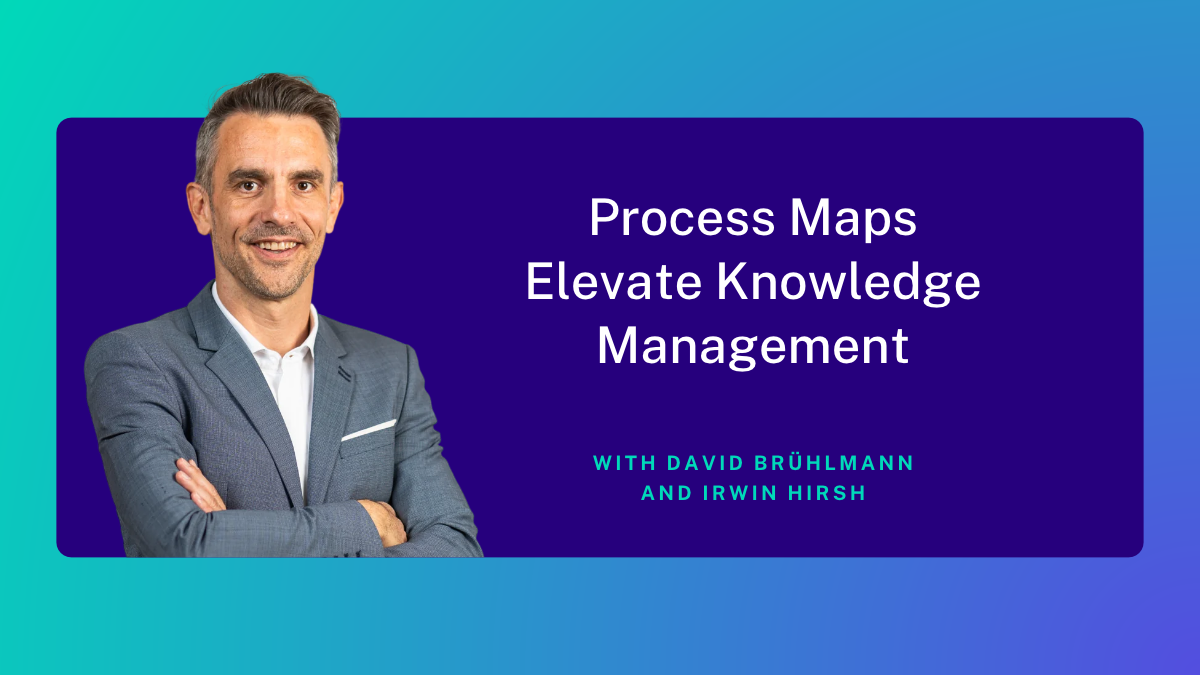
Effective knowledge management isn’t just a “nice to have”; it’s essential. In this article, biotech consultant and industry veteran Irwin Hirsh explains how process mapping offers a practical way to streamline workflows, maintain institutional memory, and keep organizations agile in a constantly evolving field.
Drawing on his extensive experience, he shares proven strategies for preserving critical know‑how, boosting operational efficiency, and minimizing the chaos that often plagues busy labs.
This concept is discussed in greater detail in an episode of the Smart Biotech Scientist Podcast, hosted by David Brühlmann.
Early Career and Transition to Consultancy
Irwin Hirsh began his biotech journey in the 1980s when he pivoted from a theater major to studying microbiology. Initially fueled by a love of brewing and the ancient art of fermentation, he became fascinated by the power of microbes to transform materials into everything from beer to medicines.
After working in agricultural biotechnology, he eventually moved into therapeutic development and became a consultant due to family circumstances and a desire for professional flexibility.
Observing Industry Challenges
Irwin Hirsh has witnessed numerous obstacles that can stand in the way of smooth bioprocess development and manufacturing, including:
- Scope Creep and Shifting Priorities: Projects can change direction frequently, which disrupts lab work and research plans.
- Uneven Skill Levels: Some development teams feature highly experienced senior scientists alongside junior researchers who may underestimate complexities (the Dunning–Kruger effect).
- Lack of Systematic Approaches: Without a consistent framework, teams often struggle to keep processes on track and prevent confusion or frustration.
Why Process Mapping Matters
Irwin Hirsh emphasizes that process mapping is not limited to bioprocessing alone; it can be applied to any development work—small molecules, advanced therapy medicinal products (ATMPs), or other fields. Process mapping involves creating a clear, visual representation of the steps in a workflow to ensure common understanding and reduce confusion.
The Core Benefits
- Reflection and Standardization: Mapping starts by looking carefully at current practices. It helps teams identify what they do, how they do it, and what the standard or “platform” steps should be. When processes are clearly defined, continuous improvement becomes more straightforward.
- Visual Communication: Visual representations bridge language barriers and reduce ambiguity. They capture implicit knowledge—often locked in experts’ heads—and turn it into explicit, widely accessible information.
- Knowledge Preservation: When processes are mapped, organizations safeguard themselves from the “knowledge bleed” when people change roles, leave a company, or switch projects. A well‑crafted map ensures that crucial insights do not disappear.
- Systemic Efficiency: Effective process mapping ties multiple processes together under a unified system. Gaps become more visible, continuous improvement cycles are easier to implement, and teams can deliver better results under real‑world constraints like time, budget, and regulatory requirements.
Example: SIPOC and Working Backwards
Irwin Hirsh recommends SIPOC mapping (Suppliers, Inputs, Process Steps, Outputs, Customers) as a starting point. Scientists can work backward from their deliverables—such as a particular report or data set—to identify the steps and required inputs. He also points out the value of tackling mapping in “bite‑sized chunks” so the effort does not overwhelm people who must focus on daily lab tasks.
Knowledge Management in a Fast‑Changing Industry
The Shift Beyond Traditional Methods
In today’s biotech environment, traditional ways of sharing know‑how—like relying on a single veteran scientist—often cannot keep pace with rapid developments and job mobility. Irwin Hirsh highlights how “tribal knowledge” can vanish if key people move on, leaving critical information undocumented.
Modern knowledge management seeks to:
- Capture business processes (the “how” of doing the work), not just technical data (e.g. pH readings, yields).
- Make crucial information accessible in digital or visual formats.
- Prevent scattered or incomplete documentation from creating roadblocks during scale‑up or global collaboration.
Digitizing Process Knowledge
Organizations are exploring tools that store knowledge in dynamic databases rather than static PDFs or spreadsheets. This helps maintain “living” information across different departments and over long development timelines. However, Irwin Hirsh warns against digitizing a system that is not well understood or has not been standardized, as it can lock flawed procedures into place and accelerate failure.
Linking Quality Risk Management (QRM) to Project Success
Irwin Hirsh separates quality risk management—focused on ensuring that products meet patient safety and efficacy requirements—from broader business or project risks such as volumes, cost of goods, or market strategy. Although these intersect, QRM zeroes in on delivering consistent, validated products that comply with regulatory standards.
Tools for Aligning Process Capabilities with Product Requirements
He notes that early digital QFD (Quality Function Deployment) attempts and massive Excel “houses of quality” often proved cumbersome. Fortunately, new, user‑friendly software solutions can store and track risk assessments, product attributes, and process capabilities in a shared environment.
Practical Tools for Process and Knowledge Mapping
Irwin Hirsh cites swim lane diagrams and SIPOC mapping as accessible ways for scientists to document how tasks are performed and where handoffs occur. Smaller teams may have an advantage in this process due to less organizational sprawl.
He recommends two focal points for digitizing knowledge in a small company:
- Core Competencies: The specific area that generates revenue or intellectual property.
- Essential External Partners: Key services or suppliers must align seamlessly with internal processes.
Creating standard digital references for these critical functions can prevent miscommunication and downtime.
Identifying and Resolving Gaps
When process mapping reveals a gap—an unspoken assumption, missing resource, or unclear responsibility—teams can address it immediately. For instance, if a lab’s communication with a modeling department is disjointed, the solution might involve clarifying handoffs, introducing regular review meetings, or adding concise checklists.
Key Takeaways
- Process Mapping: Establishing visual, standardized workflows helps preserve knowledge, reduce confusion, and drive continuous improvement.
- Knowledge Management: Capturing essential business processes prevents “tribal knowledge” from disappearing and aids collaboration in dynamic environments.
- Quality Risk Management: Aligning project goals with product quality and safety standards reduces risk and sets the stage for smoother scale‑up and regulatory compliance.
- Small Companies’ Advantage: Less hierarchical complexity can make coordinating with key individuals and centralizing information simpler.
- Digitization with Caution: Digital systems magnify strengths and weaknesses in a company’s processes, so teams should standardize and validate their workflows before digitizing.
Final Remarks
Irwin Hirsh underscores that becoming more efficient in biotech development does not mean replacing creativity or job‑specific expertise. Instead, process mapping and systematic knowledge management let scientists focus on innovation rather than repeatedly re‑solving the same organizational hurdles. By balancing operational urgency with strategic reflection, teams can stay resilient as technology and market demands evolve.
About Irwin Hirsh
Irwin Hirsh has nearly 30 years of pharma experience with a background in CMC encompassing discovery, development, manufacturing, quality systems, QRM, and process validation. In 2008, he joined Novo Nordisk, focusing on quality roles and spearheading initiatives related to QRM and life cycle approaches to validation. Subsequently, he transitioned to the Merck KGaA Healthcare division, where he held director roles within the biosimilars and healthcare business units.
In 2018, he became a consultant concentrating on enhancing business efficiency and effectiveness. His primary focus involves building process-oriented systems within CMC and quality departments along with implementing digital tools for knowledge management and sharing.
Connect with Irwin Hirsh on LinkedIn.
Further Listening
If you enjoyed this episode you might also like listening to:
Episode 243: Turn Tech Transfer from a Gamble into a Managed Process: The 6-Pillar Biologics Scale-Up Framework
Episodes 233 - 234: Why Most Bioprocess Automation Projects Fail Before the Robot Is Even Ordered with Anthony Catacchio
Episodes 199 - 200: Mastering Quality by Design: From Product Failures to Commercial Success in Biologics CMC Development
Episodes 57 - 58: Crafting a Solid CMC Strategy: Key Factors and Common Pitfalls with Matthias Müllner
Want to Join?
Are you a CMC or biomanufacturing leader with hard-won lessons on process development, scale-up, or CDMO management? We’re always looking for practitioners with real execution stories to share on Smart Biotech Scientist.
Apply to be a guest or recommend someone:
David Brühlmann is a strategic advisor who helps C-level biotech leaders reduce development and manufacturing costs to make life-saving therapies accessible to more patients worldwide.
Hear It From The Horse’s Mouth
Want to listen to the full interview? Go to Smart Biotech Scientist Podcast.
Want to hear more? Do visit the podcast page and check out other episodes.
Do you wish to simplify your biologics drug development project? Contact Us