T cell therapies promise life-changing outcomes for cancer patients, but their personalized, patient-specific nature throws a wrench into the classic centralized manufacturing playbook. These aren’t one-size-fits-all treatments; they’re batch-of-one, demanding fresh thinking on every front—from process development to regulatory approvals and global access.
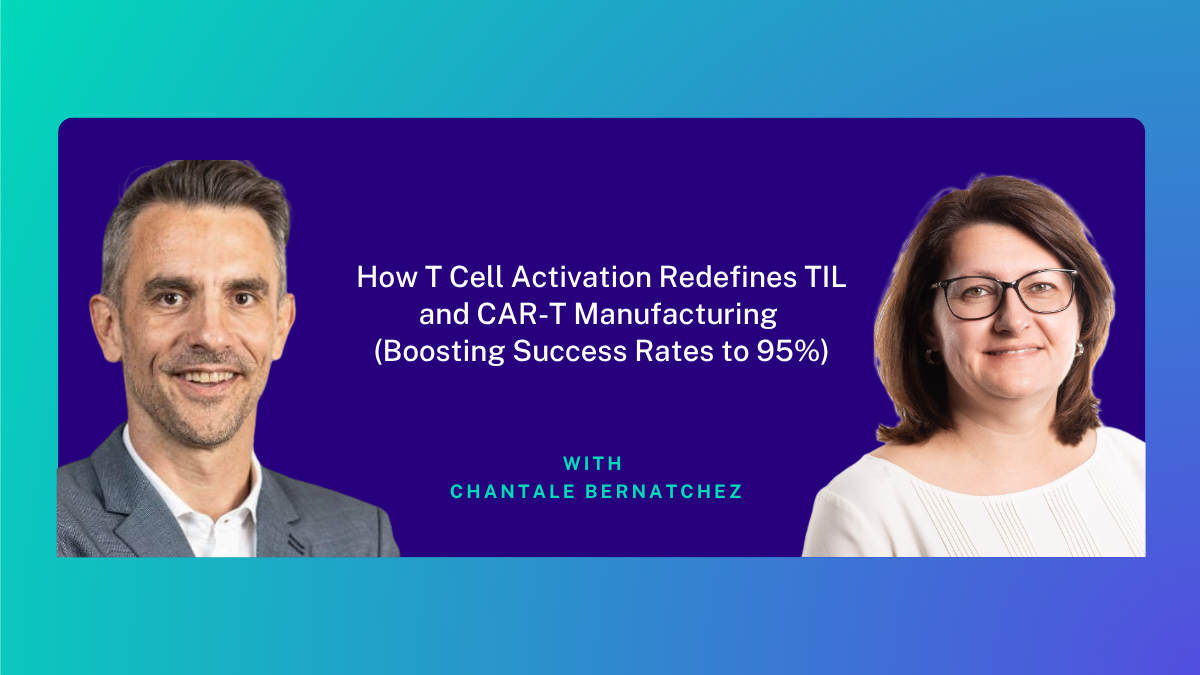
In this episode of the Smart Biotech Scientist Podcast, host David Brühlmann is joined by Chantale Bernatchez from CTMC, a joint venture between Resilience and MD Anderson Cancer Center. Building on their previous discussion, the conversation delves into the intricacies of cell therapy manufacturing, the importance of local models to ensure global access, and the evolving landscape of next-generation therapies.
Episode Highlights
- How close collaboration with MD Anderson accelerates clinical development and regulatory readiness [03:08]
- CTMC’s approach to process development and adapting to innovative technologies [05:15]
- The value of partnership-based models versus traditional CDMO-driven approaches [06:24]
- Global technology transfer: building alliances to expand access to cell therapies, with a case study in Brazil [07:35]
- Key barriers and solutions for cell therapy manufacturing in new regions [09:41]
- Practical advice for scientists starting in GMP manufacturing and process development [10:46]
- Future directions in CAR T and TIL, including logic-gated CARs, engineered TILs, and in vivo therapies [12:24]
- The importance of continued innovation and collaboration to expand global patient access [17:39]
In Their Words
Cell therapies are different from typical pharmaceutical products, where one batch can be used to treat many patients. In cell therapy, one batch is needed for each patient. Because of this, a centralized manufacturing model—where a single facility supplies the entire world—does not function well.
Cell therapies benefit from more localized manufacturing. Accessibility to these therapies in many parts of the world has been challenging. We believe that we can transfer our technology to centers in different regions that currently lack access to cell therapy, and support them every step of the way to help make these treatments more available globally.
Podcast Transcript
David Brühlmann [00:00:45]:
Welcome back. In Part One, Chantale Bernatchez from CTMC—a joint venture between Resilience and MD Anderson Cancer Center—walked us through the science and complexity behind T cell therapies, and how CTMC builds processes that respect biology rather than fighting it.
Now we go further. We’ll talk about next-generation cell therapies, the realities of global technology transfer, and the manufacturing barriers that still stand between these treatments and the patients who need them.
Let’s pick up where we left off.
I’d like to zoom out now, Chantale, and look at how you operate. You work in a unique setting—you embrace a patient-adjacent manufacturing model that is directly embedded within MD Anderson. Can you tell us how this changes the way you develop processes, and how it enables you to move faster into the clinic?
Chantale Bernatchez [00:03:08]:
Yes. I would say that our close collaboration with MD Anderson Cancer Center is key. We are physically in close proximity, and we also have strong collaboration with the clinical teams there, as well as with regulatory interactions with the FDA.
For first-in-human studies, our regulatory team files the IND on behalf of MD Anderson in electronic format with the FDA. We’ve had multiple touchpoints with the FDA across different products—filing pre-INDs, INDs, and IND amendments for both engineered and unengineered TILs, as well as different CAR-T modalities.
This has helped us understand, from a process perspective, what the FDA expects at different stages of clinical development. Because of our history in T cell therapy development at MD Anderson—and the fact that many members of our team transitioned from MD Anderson to CTMC—we are essentially continuing work that started there.
We’ve also built strong logistical workflows with MD Anderson for acquiring starting materials, such as apheresis products or tumor tissues, and returning the final product. This allows us to accelerate study activation timelines after IND clearance.
From a process development standpoint, we’ve accumulated experience across multiple platforms tailored to different products. This makes it easier to evaluate the needs of a new product and adapt existing platforms to accommodate it.
Having worked with diverse patient populations and cell therapy modalities, it becomes easier to navigate new challenges. At the same time, we need to stay current with innovations in instruments and reagents to enable next-generation therapies.
At CTMC, we focus on what we call “bioinnovation”—tracking new trends and identifying technologies that can improve our processes and support our partners. For example, many of our products use retroviral transduction, which can be advantageous for process closure. However, retroviruses require actively proliferating cells for efficient integration. Achieving that level of activation in a closed system can be challenging.
We’ve collaborated with innovative partners who have developed solutions to these challenges, and we’re now incorporating these technologies into updated versions of our platforms. Overall, it’s been very exciting to work closely with technology and biopharma partners to continuously improve the quality of the processes we deliver.
David Brühlmann [00:06:12]:
What are the key success factors for this model? Is it the close proximity that allows faster development? Access to knowledge? Or something else?
Chantale Bernatchez [00:06:24]:
It’s a combination of factors. We’ve developed a model that is somewhat different from a traditional CDMO. It’s highly collaboration-based. We aim to actively add value to the products we work on.
For that reason, we often collaborate with smaller companies that may not yet have fully defined processes. We can help them navigate process development challenges so they don’t have to reinvent the wheel.
We have deep expertise in both TIL and CAR-T manufacturing. So when a new product comes in—for example, a TIL or CAR-T therapy involving gene addition or gene knockout—we can usually integrate it into an existing platform process.
This allows us to save significant time in transitioning from a research-grade process to a GMP-compliant process suitable for early-phase clinical trials. Because of our experience in bringing these types of products from research to clinical proof of concept, we can help accelerate development timelines quite effectively.
David Brühlmann [00:07:26]:
In addition to that, you are working on an alliance that aims to transfer cell therapy manufacturing knowledge globally. How does that work?
Chantale Bernatchez [00:07:35]:
Yes, this program really stems from the realization that cell therapies are fundamentally different from traditional pharmaceutical products. As I mentioned before, one batch is needed for each patient. Because of this, a centralized manufacturing model—where one facility supplies the entire world—does not work well.
Cell therapies benefit from local manufacturing. While in the U.S. there are multiple CAR-T products approved, and now a TIL therapy product as well, access to these therapies in other parts of the world has been much more limited.
We believe that we can transfer our technology—our platform processes for TILs, for example—to centers in different regions that currently do not have access to these therapies. We already have a first partner in this alliance in Brazil, and we intend to work very closely with them to understand their specific needs. These collaborations are highly customized depending on each center. We are equipped to transfer both our manufacturing processes and analytical methods. We can assess where a partner stands and support them in engaging with their local regulatory authorities, which may have less experience reviewing cell therapy applications compared to agencies like the FDA.
We can help define a regulatory strategy, support interactions with regulators, and provide hands-on training in both process development and analytics. Essentially, we aim to support our partners every step of the way, with the goal of making these therapies more accessible globally. We’ve seen strong interest in this model, and we hope to expand it to additional centers over time.
David Brühlmann [00:09:31]:
What are you seeing as you work on this model? What are the biggest manufacturing and process barriers that currently limit patient access?
Chantale Bernatchez [00:09:41]:
The global alliance network is really designed to expand access to these therapies.
What we’re seeing is that many centers recognize the clinical benefits of cell therapies and want to adopt them, but they are often unsure where to begin.
TIL therapy, in particular, involves more complex manufacturing compared to CAR-T. As I mentioned earlier, it requires longer production timelines and much larger cell numbers. This makes it more challenging to implement. Many centers don’t know how to set up the process, what infrastructure is needed, or which reagents are critical.
This is where we can help. Over the years, we’ve developed optimized methods to grow cells even from heavily pre-treated patients—something that took significant time and experience to achieve.
By transferring these established processes, we allow partner centers to bypass many of the initial challenges and accelerate their ability to successfully manufacture these therapies from the start.
David Brühlmann [00:10:38]:
For smart biotech scientists who are unsure where to start, what is one piece of advice you would give them?
Chantale Bernatchez [00:10:46]:
I think for someone starting out, one important aspect is gaining exposure to GMP manufacturing environments.
In my team, I have the privilege of working with scientists who understand the realities of GMP manufacturing because they have that background. For a process development scientist, it is extremely valuable to understand the constraints of that environment.
What may seem feasible or straightforward in a research or process development lab may not be suitable for a GMP setting. So it’s important to keep those constraints in mind at every step when developing a new process.
Beyond that, challenges will inevitably arise. The key is to be patient but persistent—there is always a way to overcome them.
We’ve brought several processes into the clinic that encountered difficulties at some point, required further optimization, and went through iterative cycles of improvement. It’s very much a back-and-forth process.
Every product is different, and new technologies require new adaptations. For example, in the CAR-T space, there are now very innovative approaches, such as logic-gated CAR-T cells that can target more than one antigen.
These are likely to be the next wave of successful therapies in the clinic. But each new generation requires corresponding adaptations in process development to meet these new biological and technical realities.
David Brühlmann [00:12:08]:
Speaking of the future, Chantale, how do you see the future of CAR-T therapies? We’re hearing about second- and third-generation TIL and CAR-T approaches—what does that mean, and where is the field heading?
Chantale Bernatchez [00:12:24]:
Yes, so for CAR-T specifically, we’ve already seen several generations of these therapies. As you mentioned, the constructs have been iterated over time—starting with enhancing signaling through the CAR molecule in second-generation designs, and then adding additional elements to improve function within the tumor microenvironment.
More recently, we are seeing approaches aimed at broadening the range of antigens targeted by CAR-T cells while incorporating safety mechanisms. As I mentioned earlier, one of the main challenges is finding a single antigen that is exclusively expressed on tumor cells and not on normal tissues.
To address this, newer “logic-gated” CAR-T designs are being developed. These cells can recognize multiple antigens but will only become fully activated when specific combinations of antigens are present—typically those found on tumor cells.
For example, companies like Link Cell Therapies are developing CAR-T products that target two antigens—ENPP3 and CA9—which are co-expressed on renal cell carcinoma tumor cells. While each antigen may also be found individually on normal cells, they are not co-expressed there. The CAR-T cells are designed to become fully activated only when both antigens are present together, which helps restrict cytotoxicity to tumor cells and reduce off-target effects.
These next-generation designs aim to minimize toxicity while expanding the range of patients who could benefit from CAR-T therapies.
On the TIL side, the currently approved therapy is still unengineered and relies on the natural ability of T cells to recognize tumors. However, next-generation TIL therapies involve genetic engineering to further enhance their function.
At CTMC, we have a long-standing collaboration with Obsidian Therapeutics, which is developing a membrane-bound IL-15 engineered TIL product. The goal is to eliminate the need for high-dose IL-2 administration, which has traditionally been required to support TIL engraftment and persistence but is associated with significant toxicity.
By engineering T cells to express IL-15, the cells can support their own survival and function without external cytokine supplementation, potentially reducing toxicity and improving efficacy. Early data are promising, although studies are still based on relatively small patient numbers.
Another example is KSQ Therapeutics, which is developing CRISPR-edited TIL products. In this approach, genes that limit T cell activity are knocked out to enhance their function. For instance, they are targeting genes such as SOCS1 and Regnase-1, which act as negative regulators of T cell activity.
Overall, the field is clearly moving toward enhancing the functionality of infused T cells—both in CAR-T and TIL therapies. For CAR-T, shorter manufacturing processes that preserve T cell fitness are a major focus and appear very promising.
Another emerging concept is in vivo CAR-T, where the ex vivo manufacturing step is eliminated entirely. Instead, patients are infused with a viral vector that directly engineers their T cells inside the body.
While this approach is very promising, it also presents challenges. With traditional ex vivo manufacturing, we can tightly control key parameters—such as cell dose, number of viral integrations, and product purity. These safety controls are more difficult to implement with in vivo approaches.
Although strategies are being developed to target the viral vector specifically to T cells, it still needs to be demonstrated that off-target cells—or even tumor cells—are not inadvertently engineered.
So while in vivo CAR-T is an exciting and potentially transformative approach, there is still a lot to learn before it can become a mainstream therapeutic option.
David Brühlmann [00:16:48]:
Before we wrap up, Chantale, what burning question haven’t I asked that you’re eager to share with our biotech community?
Chantale Bernatchez [00:16:58]:
I think CAR-T and TIL therapies are here to stay as treatment modalities. I’m very hopeful for the future. We are seeing increasingly effective therapies, and I think the future is bright. Having worked in this field for quite some time, I’m very excited to see these therapies coming to fruition and achieving so much success. I’m not sure what question I would ask you.
David Brühlmann [00:17:25]:
Excellent. This has been great, Chantale. We’ve covered a lot of ground today. If our listeners had to take away just one single thing, what would that be?
Chantale Bernatchez [00:17:39]:
I think the field has come a long way. We now have regulatory approvals for both CAR-T and TIL therapies, and many major hurdles have been overcome. I see strong interest in expanding access to these therapies into other geographies, and I truly hope that in the coming years we see acceleration in global availability—so that patients everywhere can benefit from these treatments.
David Brühlmann [00:18:09]:
Where can people connect with you and learn more about your work—and hopefully also get inspiration from your novel model?
Chantale Bernatchez [00:18:20]:
We can connect on LinkedIn. I’m happy to chat about our model. People are also welcome to stop by in Houston at CTMC. We’re always open to connecting and exploring how we can help develop new cell therapy products or share insights about our approach. I believe the model we are developing—based on comprehensive partnerships with early-stage cell therapy developers—is something the field really needs.
The traditional fee-for-service model has limitations. Our approach can help early developers avoid missteps, accelerate development, and ultimately reach patients faster by enabling earlier clinical testing of new therapies.
David Brühlmann [00:19:08]:
There you have it, Smart Biotech Scientist. Take this opportunity to reach out to Chantale—you’ll find the links in the show notes. And thank you very much, Chantale, for being on the show today and sharing your passion for cell therapies and your perspective on where the field is heading.
Thank you so much.
Chantale Bernatchez [00:19:28]:
My pleasure. Thanks for having me.
David Brühlmann [00:19:30]:
From next-generation cell therapy approaches to global manufacturing networks, Chantale Bernatchez has given us a clear-eyed view of where this field is heading and what it will take to get there.
Disclaimer: This transcript was generated with the assistance of artificial intelligence. While efforts have been made to ensure accuracy, it may contain errors, omissions, or misinterpretations. The text has been lightly edited and optimized for readability and flow. Please do not rely on it as a verbatim record.
Next Step
If you found value in today’s episode, take a moment to like, follow, and leave a review on Apple Podcasts or your favorite platform—it helps us reach and support more scientists like you.
Thanks for tuning in to the Smart Biotech Scientist podcast and being part of this journey toward bioprocess mastery. For more insights and practical tips, visit
About Chantale Bernatchez
Chantale Bernatchez is an immunologist and leading expert in T-cell therapies with over 20 years of experience spanning academia and biotechnology. She joined MD Anderson Cancer Center in 2007, where she specialized in tumor immunology and became deeply involved in adoptive T-cell therapy research. Chantale has overseen the GMP production of tumor-infiltrating lymphocyte (TIL) therapies, contributing to clinical studies in metastatic melanoma that demonstrated strong and durable patient responses. She later directed a research laboratory focused on improving TIL expansion and function.
Since 2020, she has transitioned into a biotech-focused role and now serves as Head of Process Development at CTMC, a joint venture between MD Anderson and National Resilience. In this role, she leads a multidisciplinary team advancing CAR T and TIL therapies through innovative process development and manufacturing strategies, holding multiple patents in adoptive cell therapy.
Connect with Chantale Bernatchez on LinkedIn.
Further Listening
If you’re interested in exploring further the concepts we touched on—such as cell therapy manufacturing, process control, and scaling living therapies—take a look at these related discussions:
Episodes 105 – 106: From Proteins to Cell Therapy: Why ATMPs Aren’t Just Complex Biologics with Oliver Kraemer
Episodes 109 – 110: Spinning Like Earth: Designing Low-Shear Bioreactors for Better Cell Culture with Olivier Detournay
Episodes 125 – 126: How to Enhance Cell Engineering Using Mechanical Intracellular Delivery with Armon Sharei
David Brühlmann is a strategic advisor who helps C-level biotech leaders reduce development and manufacturing costs to make life-saving therapies accessible to more patients worldwide.
He is also a biotech technology innovation coach, technology transfer leader, and host of the Smart Biotech Scientist podcast—the go-to podcast for biotech scientists who want to master biopharma CMC development and biomanufacturing.
Hear It From The Horse’s Mouth
Want to listen to the full interview? Go to Smart Biotech Scientist Podcast.
Want to hear more? Do visit the podcast page and check out other episodes.
Do you wish to simplify your biologics drug development project? Contact Us