Despite advances in data, automation, and modeling, many scientists still find themselves repeating experiments, wrestling with complexity, and reinventing the wheel.
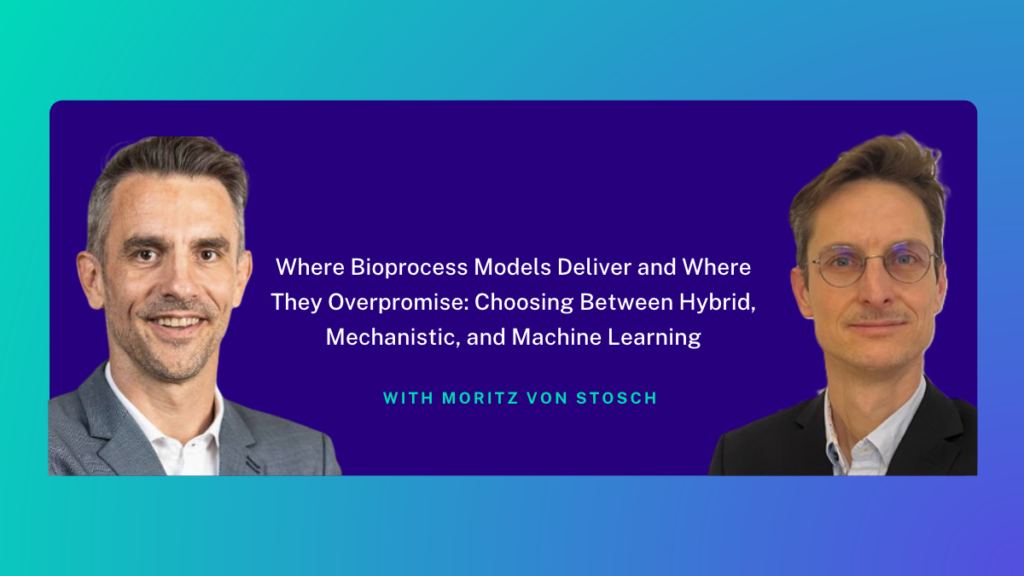
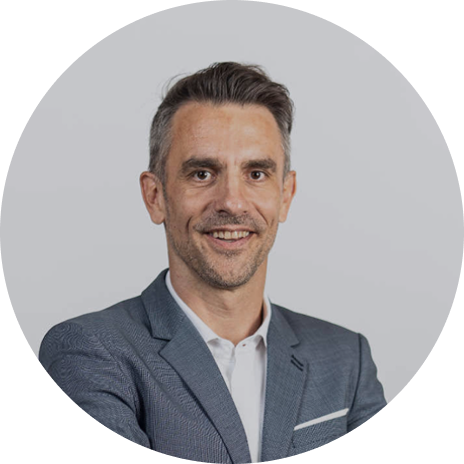
In this episode, David Brühlmann welcomes Moritz von Stosch, partner at HINA Bioventures and a pioneer in digital bioprocess development. Spanning roles from academic research in hybrid modeling to solution design at DataHow and now biotech investment, Moritz von Stosch’s journey traces how mechanistic, hybrid, and machine learning models have (and haven’t) changed process development over the last two decades.
Episode Highlights
- Moritz von Stosch’s career: from early interest in modeling to investment in digital bioprocess tools [03:36]
- The reality and limitations of platformization and knowledge reuse in large pharma [07:37]
- Historical context and effectiveness of QbD (Quality by Design) and PAT (Process Analytical Technology) initiatives [10:24]
- Where modeling can reliably deliver value today in process and clinical development—and where it still overpromises [12:17]
- The importance of starting to build models early and collecting data that can be reused and repurposed across the process lifecycle [14:17]
- Approaches to transferring learning between molecules, cell lines, platforms, and the fundamental limitations of this transfer [16:40]
- Opportunities and difficulties in transferring process knowledge across scales (from microtiter plates to large bioreactors) [18:31]
In Their Words
Transferring knowledge across scales is much harder when heterogeneities, for instance, bioreactor, start appearing, which you haven’t seen before. It becomes much more difficult if you go to different dimensions or you go from a shake flask to a bioreactor, from a bioreactor to a shake flask, or even from a microtiter plate. And in these cases where it’s not so evident how to scale the process, there is opportunity to use modeling because in principle, if things are complex, this is where modeling really excels.
Podcast Transcript
David Brühlmann [00:00:28]:
Picture this: a new molecule enters development, the platform process exists, the historical bioreactor data is archived, and a model could in principle shrink the experimental plan. Yet most teams still start close to scratch. What can process models reliably deliver today, and where do they still overpromise? I’m joined by Moritz von Stosch, who is a partner at HINA Bioventures and a leading voice in digital bioprocess development, to explore how modeling and prior knowledge fit into real process development. Welcome, Moritz. It’s good to have you on today.
Moritz von Stosch [00:02:28]:
Thanks so much for having me, David.
David Brühlmann [00:02:30]:
It’s a huge pleasure, Moritz. Share something that you believe about bioprocess development that most people disagree with.
Moritz von Stosch [00:02:39]:
That’s a hard one. So if we look at bioprocess development, perhaps the statement that I think is most important when it comes to modeling in particular is about data.
And so the statement that I would give, which is perhaps not so controversial, is still that if you have all the data to reproduce your experimental results, then you also have all the data that are required to model the process in principle. Not all type of modeling applications, just as a disclaimer, but in principle you have everything you need.
David Brühlmann [00:03:10]:
Would be great to have your feedback, Smart Biotech Scientist. What do you think about this? Before diving further into data modeling and a lot more, let’s start with your story, Moritz. Tell us what sparked your interest in bioprocessing. What were some interesting pit stops along your long career, and what are you doing now? What is your current role?
Moritz von Stosch [00:03:36]:
So as an American, you would start, of course, from the current role, and as a European, we would start at the very infant state. I’ll start somewhere in the middle.
So during my studies, there was an article in a German newspaper which was speaking about the future trends, the future industries, and the bioprocessing industry was named as one of the major future industries. And so during my studies, I took a bioprocessing course with professors Wirtz and Büchs in Aachen. Indeed, I found it very interesting, but I also realized that all the knowledge and all the modeling that we would do in all of the other courses was highly underrepresented in bioprocessing. So that was one of the points in my career where I thought, okay, can we not do more? Can we not translate more in terms of modeling?
And then at the same time, I came across machine learning, which I had not came across during my studies. And I was highly interested in machine learning. It’s another application of mathematical modeling. And so my ambition really was that I wanted to use this in either a thesis or something I would be doing in the future.
And I remember very well that I reached out to Professor Marquardt, who was also a professor at Aachen University back at the time, and told him, look, I really want to go into the direction of machine learning. And he told me, look, you have studied chemical engineering now for almost 5 years. You don’t want to throw all that knowledge away. Try to combine it. Try to do hybrid modeling. And hybrid modeling really is the combination of what you know, with machine learning tools, which then take into account all the part that you don’t know and you need to explore from data.
And so this is really how my way forward was designed. So I was looking into hybrid modeling applications in bioprocessing, and Portugal was the destined place to do this kind of research. There was Rui Oliveira and Sebastião Feyo de Azevedo who were doing research on that topic. I joined them as a PhD student, and this is where really the foundation of my career was laid in hybrid modeling on solving bioprocessing problems. So, I think that was the starting point of everything.
I continued in bioprocessing a little bit towards systems biology and synthetic biology during my postdoc, then went to Newcastle University where I really had the chance to apply hybrid modeling and then also already transfer learning technologies to biopharma process development problems and manufacturing problems. Then I had the chance to apply those technologies in reality with GSK Vaccines in Belgium.
And after 3 years, I realized that I want to go on the solution provider side to essentially provide solutions that allow scientists to solve these problems right away. And this is when I joined DataHow. I think that was in 2020. And then of course, I’ve been doing prototyping of algorithms and software at DataHow for almost 6 years as a Chief Innovation Officer.
And then last year, I decided that after 20 years in bioprocess modeling, I’ve done enough bioprocess modeling in my career. I want to do something new. And when I went to people, spoke to people about a possible career change, the opportunity came up to co-found an investment company, HINA Bioventures, and with HINA Bioventures, we really look at investing in digital tools that again enable faster process development, more cost-efficient manufacturing. That’s where I am today.
David Brühlmann [00:06:57]:
I love that you’ve seen various parts of the industry, academia, large biopharma, then the solution provider, and now even a different hat in investing. I’d be curious, Moritz, because my observation is, especially in large pharma, that many people think they’re innovative and they say they reuse platform knowledge, they transfer learnings. But when you look closely, especially in portfolio teams, I often see that people start almost from scratch, or at least from the beginning, and reinvent the wheel oftentimes. So, why do you think is that, and why does this keep happening in our industry?
Moritz von Stosch [00:07:37]:
That’s an excellent question. I’m sure I don’t have the answer to the problem. Maybe just a couple of reflections on it, right?
If we look at monoclonal antibody production and the way it evolved, I think one of the major keystones in making human monoclonal antibody what it is today was the platformization, right? So rather than developing everything new every single time, companies were focusing on certain hosts, predominantly CHO, developing cell lines, which were much better characterized, and then also developing cell line platform media. So not changing the media all the time. And then this kind of platform process where you know in principle when and how to feed, and you know in principle how and when to harvest and so forth. And to speak of the upstream, right?
But of course, as you say, every monoclonal antibody is different. So the platform process doesn’t always deliver the same kind of results. And in particular, if you have difficult-to-express antibodies and/or proteins, then of course you need to deviate from what you see. And the challenge becomes even bigger when you move away from antibodies towards single-chain fusion proteins or all these kind of things, because they’re no longer so standard.
And of course, the industry has realized that and tried to nevertheless put a platform around it. There was this Quality by Design initiative, I think originally fueled by the Process Analytical Technology initiative of the FDA back in 2004. And as part of this QbD, what industry was really trying to do, what we were really trying to do at GSK is to generate this body of evidence, this body of knowledge that would allow us, when a new molecule came along, to develop the process based on the knowledge that we had.
And so essentially what we would do is extensive studies on the current process to really understand in detail how does the process behave if we change all the raw materials or the process parameters. And if we had understood that, to write it down, to provide the data evidence so that in the future for a new molecule, we could reuse it. Here, of course, we again run into the scenario that not everything behaves similarly, so you still have to characterize stuff. And so we came— we, the industry, came up with the ranking of critical quality attributes, critical process parameters, which then are restudied every single time that we have a new molecule.
So I think there is some platformization. There is the need to do certain type of things over and over again just because biology is not fully understood, and so we have to run experiments. But what I also believe is that first, if we find better ways of reusing that knowledge, because at the moment it’s highly manual, right? We document, we read it. If we find better ways of using that knowledge, and of course with AI, that nowadays is a capability, we might reduce the experimental effort that we need to put in and we are able to move faster.
David Brühlmann [00:10:24]:
QbD and PAT have been around for 20 years and the industry are using them, but what has really changed? Because I remember these conversations a long time ago when people were very excited about QbD, and then it seemed almost as if it disappeared. You didn’t hear so much about it anymore at conferences. So what has actually materialized?
Moritz von Stosch [00:10:49]:
There were a couple of initial submissions right around QbD. I think there was one by Roche, which was also publicized a lot. And as you said, then it somehow was a bit off the radar.
I think people nowadays use the QbD strategy where it makes sense for them, where it helps them to reduce the amount of experiments and/or to answer questions at hand, but they rarely use it comprehensively. And I think the reason for that is that it is very expensive to have a comprehensive approach to QbD, to have a comprehensive approach to answering all the questions in a systematic way. And so essentially we are not taking shortcuts, but we are accepting certain assumptions, certain shortcuts to make process development faster.
And I think what is important to mention that these shortcuts are not shortcuts when it comes to drug quality. So in particular process characterization, which you typically do before you run into manufacturing and in the late stage and development where it’s really all about product quality. I think this is where people do not take shortcuts, where also no shortcuts are possible and where people use QbD very extensively.
David Brühlmann [00:11:56]:
Looking at modeling as a whole, what is the opportunity we have in process development and then in clinical operations and commercial operations? What can actually modeling reliably do for these activities? And what are perhaps some areas where what we hear is still overpromised?
Moritz von Stosch [00:12:17]:
It’s a very interesting question. I would answer twofold.
So I think on the one hand, we are doing modeling at the moment, not necessarily mathematical modeling. What we are doing is that we as humans, we understand how the process behaves. So we have a mental model how it is and we take it forward, right? And then we complement this mental model that we have with statistical tools, trying to answer a specific question at hand.
And what I see at the moment is that we have a shift from this kind of workflow or work procedure towards a procedure where we use mathematical models to help us inform how certain tasks, for instance, process optimization, should be done. And so we put together the data package that we need to build the model for process optimization. We iteratively optimize the process and we answer the question at hand.
And what we ultimately should be looking at is a much more comprehensive approach to modeling and to process development. The same comprehensive approach, by the way, that we take when we build our mental models. And that means for me that we start with building the model very early on in the process workflow, so screening experiments. And it means that we take all that knowledge that we gain during that time and at very small scale towards a large scale, towards clinical manufacturing, towards ultimately manufacturing of the drug product.
So it’s really an end-to-end view from early lifecycle or early development phase to a lifecycle approach where you reuse that knowledge over and over again. And what of course that means as well is that no longer will you only produce the data to answer the question at hand, but you need to produce the data to answer the questions that you might have— be having further down the line.
David Brühlmann [00:14:03]:
And what is the best way to go about this? Because I’m a big believer of end-to-end. That’s exactly the way to go. But the question is then, where do you start and how early do you start?
Moritz von Stosch [00:14:17]:
So I think it’s never too early to start. I think every data point is ultimately valuable. The more data points we have on a specific molecule, on a specific cell line, on a particular media, on a particular feeding strategy, the more understanding we have around that, the more local understanding, and the better we get in predicting for the variations that we have seen.
And I think there is 2 different approaches to take here. One is really a focused approach on the particular molecule, on the cell line, on the medium, on the feeding strategy, and on the general platform conditions where we get better and better the more data we get.
The other approach which we can take is the across-project approach, meaning we have data from various scales, from various feeding strategies, from various strains on our previous molecule. And now we use that data together with small-scale data from our current molecule, which we have with the current cell line, maybe some variations, and we try to infer from that very few data together with that past data, how will our cell line behave on different media with different feeding strategies in manufacturing scale? And in that way, hopefully we can use that data to go much faster.
And then I would say we cannot start early enough because the more data we bring in from early development phases, from early screening phases, the earlier we can take decisions. And by the way, the way we’ve done development in the past is highly biased, right? We make selections early on that completely bias the way we can later on develop the process.
Imagine you’re not screening the cell line at the right process conditions in the beginning, and you pick a cell line which performs well in the screen conditions, but overall you would have a cell line which would perform much, much better had you tried different screening conditions. So all of our data is biased. All of our approach really relies on this selection bias that we’re currently applying.
David Brühlmann [00:16:10]:
To someone who’s a bit less familiar with modeling, this transfer of learning or from one project to another may seem a bit counterintuitive. Can you elaborate on what are the current limitations of the capabilities? Because we have now a lot more new technologies at our disposal, but perhaps what can modeling do and what can’t modeling do today?
Moritz von Stosch [00:16:40]:
Perhaps answering on the questions what can modeling do?I think if you have, in particular, a platform process, or if you have a process where you always work with CHO, with monoclonal antibodies, I think there is now a large body of evidence showing that you can transfer knowledge across these projects and across these molecules. Of course, every project, every cell line is slightly different.
But for instance, if you look at CHO, the general behavior is always similar, right? It will grow. And then at some point it will start dying and viability goes down and it will consume glucose. It might produce lactate, it might consume lactate. So there’s this general behavior, which is fairly similar no matter what you’re looking at.
And so I think if you transfer this general behavior, then you don’t have to learn it, right? So you only have to really learn the specifics of the project that you’re looking at. And that means you only need data to understand the specifics of the project that you’re looking at. And that means for a large number of CHO monoclonal antibodies, similar processes, you can transfer knowledge. And by the way, we have done studies on that which are published, where we look at how much experiments are needed to transfer knowledge, what is the best knowledge transferring learning approach or knowledge transfer approach.
I think where it becomes much more difficult is when you want to go from E. coli recombinant protein production to a CHO production. Is it possible to transfer knowledge there? Might be. I have never looked into that. At this moment, from a gut feeling point of view, I would say it’s much harder, right? The profiles look different. The biology is likely different.
So I think this is at the moment where the transfer breaks down, and it breaks down because we don’t have enough knowledge on all the biology that is underlying. So maybe if we were able to deconstruct the biology, right, to look into the pathways, to really understand pathway functioning, then we could transfer knowledge. But with the current understanding, I think it’s not possible.
David Brühlmann [00:18:31]:
To what extent can you transfer knowledge across scales?
Moritz von Stosch [00:18:34]:
Ah, that’s another excellent topic. So transferring knowledge across scales, I think, is super straightforward when the limiting condition stays similar and when, for instance, the reactor content is ideally mixed, right? And when generally the conditions are similar, also dimensionally similar.
Of course, transferring knowledge across scales is much harder when heterogeneities in the, for instance, bioreactor start appearing, which you haven’t seen before. It becomes much more difficult if you go to different dimensions or you go from a shake flask to a bioreactor, from a bioreactor to a shake flask, or even from a microtiter plate.
And in these cases where it’s not so evident how to scale the process, there is, of course, the opportunity to use modeling. Because in principle, if things are complex, this is where modeling really excels. So I believe, and what we have seen is that modeling can help in scaling up processes where it’s non-intuitive because it’s too complex.
And I mean, there’s also different approaches here, right? One is scale-up supported by CFD where you do a characterization, you understand much better how your bioreactor is performing, and thereby you can take informed decisions of what you should be looking at. And then of course there’s also the approach where you try from an experimental point of view to characterize everything better. By getting more data and getting particular evolution data and then using machine learning approaches and/or hybrid models to do that.
And both approaches are needed and both approaches are successful. And I think they look at different aspects and so they’re fully complementary.
David Brühlmann [00:20:07]:
A model is only as useful as the knowledge behind it and the judgment applied to it. Whether mechanistic, machine learning driven, or hybrid, it has to earn trust through data you know you can compare and reuse. If this episode sharpens how you think about modeling in your own process development, please leave a review on Apple Podcasts or your favorite platform. Thank you for tuning in today, and I will see you in part 2.
Disclaimer: This transcript was generated with the assistance of artificial intelligence. While efforts have been made to ensure accuracy, it may contain errors, omissions, or misinterpretations. The text has been lightly edited and optimized for readability and flow. Please do not rely on it as a verbatim record.
Next Step
If you found value in today’s episode, take a moment to like, follow, and leave a review on Apple Podcasts or your favorite platform—it helps us reach and support more scientists like you.
Thanks for tuning in to the Smart Biotech Scientist podcast and being part of this journey toward bioprocess mastery. For more insights and practical tips, visit
About Moritz von Stosch
Dr. Moritz von Stosch is an expert in digital bioprocess development and operations, with a strong background in innovation and process systems engineering. He is a partner and co-founder of HINA Bioventures, a growth capital company investing in enabling technologies for bioprocessing. He also serves as interim Chief Operating Officer at OUAT!, which develops extended reality solutions for biopharma facility design and operations training. Previously, he was Chief Innovation Officer at DataHow and led the Process Systems Biology & Engineering Centre of Excellence at GSK Vaccines, where he received an Innovation Performance and Trust award.
Connect with Moritz von Stosch on LinkedIn.
Further Listening
To keep exploring how modeling and prior knowledge can speed up process development, check out these related conversations:
Episodes 215 - 216: From Data Silos to Autonomous Biomanufacturing: Digital Twins and AI-Driven Scale-Up with Ilya Burkov
Episodes 173 - 174: Mastering Hybrid Model Digital Twins: From Lab Scale to Commercial Bioprocessing with Krist Gernaey
Episodes 277 - 278: Your Bioprocess Data Already Holds 35% More Yield: From End-to-End Models to Digital Twins with Ignasi Bofarull-Manzano
Episodes 05 - 06: Hybrid Modeling: The Key to Smarter Bioprocessing with Michael Sokolov
Want to Join?
Are you a CMC or biomanufacturing leader with hard-won lessons on process development, scale-up, or CDMO management? We’re always looking for practitioners with real execution stories to share on Smart Biotech Scientist.
Apply to be a guest or recommend someone:
David Brühlmann is a strategic advisor who helps C-level biotech leaders reduce development and manufacturing costs to make life-saving therapies accessible to more patients worldwide.
Hear It From The Horse’s Mouth
Want to listen to the full interview? Go to Smart Biotech Scientist Podcast.
Want to hear more? Do visit the podcast page and check out other episodes.
Do you wish to simplify your biologics drug development project? Contact Us