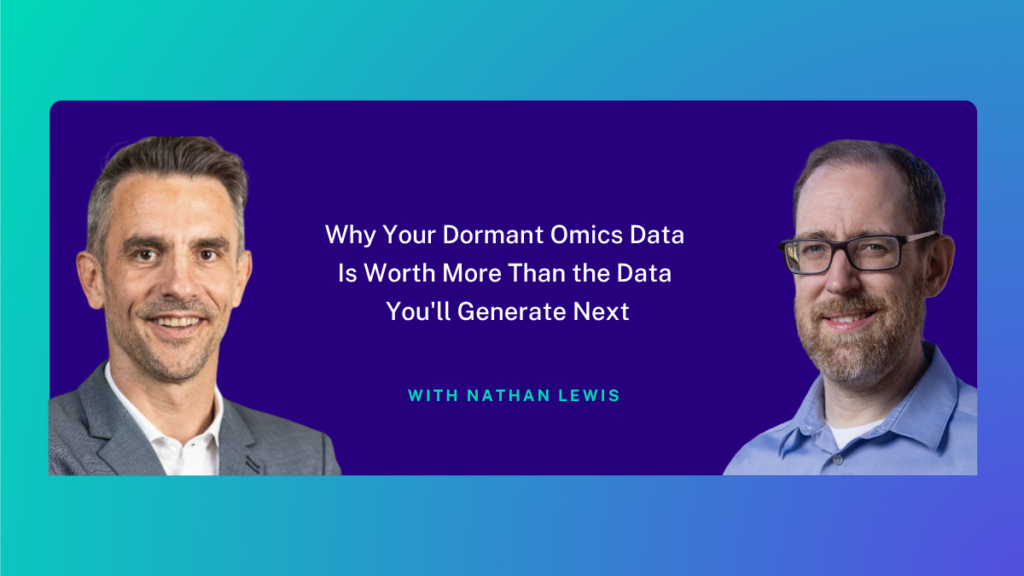

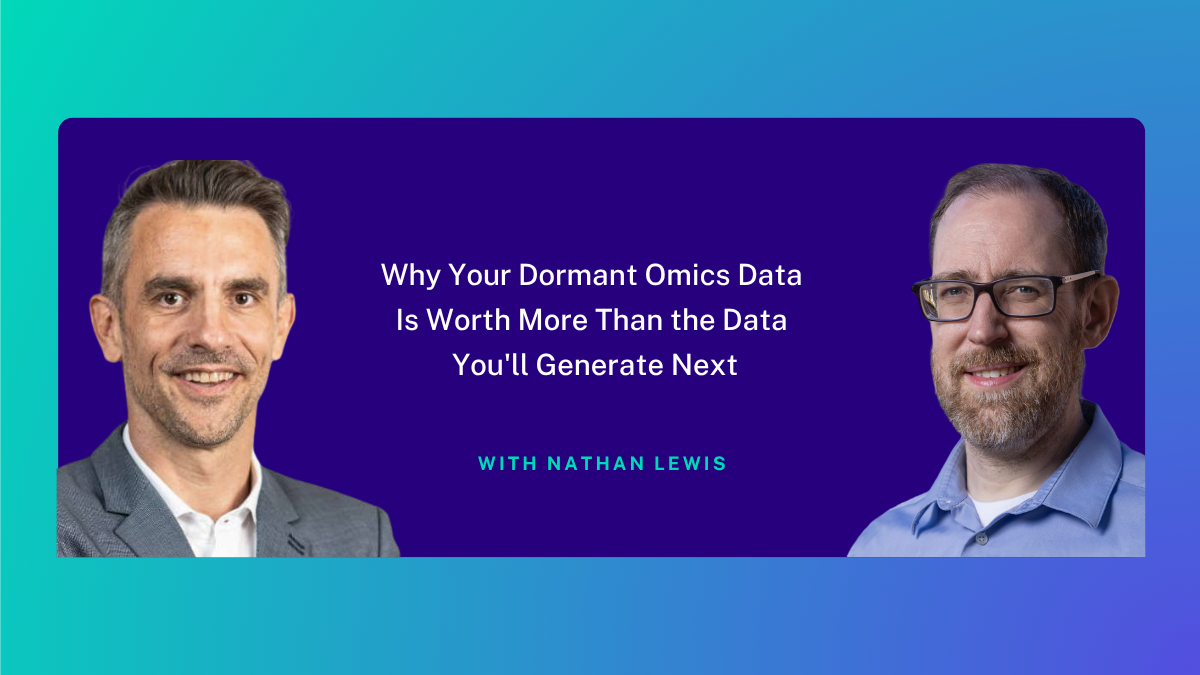
Biotech’s ambitions are often limited not by vision, but by the real-world bottlenecks of host cell lines and the unpredictability of post-translational modifications. In this episode, we peel back the layers of bioprocessing complexity and spotlight new strategies that make tomorrow’s therapies possible.
Nathan Lewis, GRA Eminent Scholar at the Center for Molecular Medicine, Complex Carbohydrate Research Center, and Department of Biochemistry and Molecular Biology at the University of Georgia, has made a career out of asking impossible questions about glycosylation, cell line selection, and the hidden machinery at work inside every productive cell. He’s moved beyond academic curiosity—translating discoveries into applications and even launching a company, Augment Biologics, that’s taking glycoengineering from theory to practice.
Episode Highlights
- A proximity proteomics approach to identify supporting machinery for challenging-to-express proteins like rituximab [02:36]
- Findings from expressing the full human secretome in CHO cells, and the correlation between host cell gene expression and protein productivity [05:00]
- Clarifying when host cell characteristics matter more than the protein construct itself [05:46]
- Emerging evidence that protein sequence and structure influence glycosylation patterns (contrary to previous dogma) [06:49]
- Engineering point mutations to precisely tune glycan features for improved therapeutic efficacy [09:25]
- The vision and activities of Augment Biologics in custom glycosylation control for drug discovery [10:32]
- The importance and barriers to open data sharing in bioprocessing, and thoughts on overcoming them [11:11]
- The shifting landscape as technology advances and the need for high-quality, annotated data [13:54]
In Their Words
It’s always been assumed that these glycans, which are basically polymers of sugars that form specific structures, branching structures and such, that when they’re being synthesized in the cell, that there’s not a template. It’s basically, we want to say there’s not a template is that we’re very comfortable with the central dogma of molecular biology, which is DNA to RNA. So in other words, DNA is a template for RNA. RNA is a template for proteins. And then glycans are just tacked on by a bunch of biochemical reactions. That’s the idea, is that there wasn’t a clear template.
Podcast Transcript
David Brühlmann [00:00:31]:
We’re back with Nathan Lewis, who’s a professor at the University of Georgia, and the conversation keeps opening new doors, from host cell selection for difficult-to-express proteins, to secretory bottlenecks, all the way to designing glycosylation directly into a protein sequence, rather than chasing it through media tuning. Nathan Lewis also shares what pushed him to spin his glycoprofile prediction work into a company. If you are building toward AI-ready bioprocessing, this half of the conversation is where the practical roadmap comes into focus.
I’d like to touch upon another area of your research, Nate. You’ve done a lot of work with difficult-to-express proteins. Tell us what exciting discovery you found there?
Nathan Lewis [00:02:36]:
There’s a number of different approaches that we’ve taken, and many of these are not unique. Other people are doing similar stuff, but a few of them that we’ve gone into with, I’d like to say, I think we’ve taken different approaches than your standard person. We took this method that came out of Francis Collins’ lab, the previous head of the NIH, where you could basically take some cells, permeabilize them, fix them and permeabilize them, lay on an antibody and biotinylate everything in proximity to any protein of interest.
So, if you had a CHO cell line that was producing rituximab, what we did is we did exactly that. We permeabilized them, took an antibody that had a horseradish peroxidase and biotinylated everything in proximity to the rituximab. Now we did this for a large number of different clones to see, well, you had a range of low, medium, and high-producing clones. What was different about what was interacting with the rituximab? Are there proteins that are holding back the amount? Are there proteins that are needed to support the production of the protein in a per-cell manner.
And then we were able to take that, do proteomics on it, and figure out what’s the supporting machinery for rituximab. And through that process, we were able to identify several supporting machinery that is needed for high titers of rituximab. And we’d also taken this, did it on a very, very poorly producing vaccine candidate, and we were able to identify machinery that was needed.
And so the idea here is we can take these approaches and not—if we’re not looking at correlations like genes that co-express, we’re looking at physical interactions and on how to properly chaperone these biologics through the cell. And that’s an interesting approach that we’ve taken and it’s been fun to do. Still needs a lot more optimization. And I think that if we can scale this up, start looking at a large number of different proteins, you can figure out what is the machinery that’s private to individual proteins, which one’s very public. Which ones, which supporting machinery is needed for which protein domains.
So if you engineer a protein, you can say, okay, I think we need to make sure that our cell line has this to be able to make it produce well. That’s somewhere I would like to see us take that technology to be able to connect whatever your product is to the core machinery needed to produce it. So that’s one thing that we’ve done.
Another thing we’ve done is we did, working with Mattias Uhlén, Johann Rockberg, and those guys out at KTH, they went through and they produced the whole human secretome in CHO cells. And we were able to go in and do a bunch of omics on that and identify that, with all else things controlled, we found that the biggest correlation with productivity, well, the host cell gene expression correlated stronger with productivity than anything else, even protein structural features.
And so there is this inherent need of host cell machinery that’s potentially chaperoning all these different proteins through on that. Now, we did that analysis about 6 or 7 years ago. I really want to go back and reanalyze all of it with a lot of the protein language models and stuff like that to see maybe there’s more in the protein, because I do think there’s probably more. I think our study probably undercaptured the protein effect, but it was interesting to see how much of the cell line expression correlated with the productivity.
David Brühlmann [00:05:46]:
That means, in other words, that actually your host cell line is much more important than the construct itself, correct?
Nathan Lewis [00:05:54]:
Well, I would say these are all natural human proteins. These are proteins that evolved to express at the levels that they needed to express at in humans. And then we put them into CHO cells. And so in our controlled setting, yes, that was the case. Now, once you start thinking about engineered proteins, I do think that we as humans are unknowingly putting in garbage sequences that could lead to aggregation and so forth. And so at that point, proper protein design is going to be absolutely essential. I do think that’s going to be a problem that’s going to be solved a lot faster than the cell line side. And so I think that we will get a point where, again, the cell line, how it’s behaving, how it’s responding, is going to be absolutely critical to productivity.
David Brühlmann [00:06:35]:
I’d like also to circle back to your teaser at the beginning about glycosylation. Tell us a bit more on what are you currently working on there and these findings you alluded to at the beginning of our conversation.
Nathan Lewis [00:06:49]:
Definitely. So glycosylation is one of many post-translational modifications that are important for protein function. It just so happens these glycans are big and they are found on the vast majority of proteins that are secreted or membrane proteins. And historically, they’ve been largely ignored because, just, they’re hard to study. You have to be an expert in a number of biochemical techniques. And even still, you might figure out how glycan structure on one protein influences some protein interaction, but does that translate to any other proteins? I mean, and so it’s been really difficult to study.
And it’s always been assumed that these glycans, which are basically polymers of sugars that form specific structures, branching structures and such, that when they’re being synthesized in the cell, that there’s not a template. It’s basically, when I say there’s not a template is that we’re very comfortable with the central dogma of molecular biology, which is DNA to RNA. So in other words, DNA is a template for RNA. RNA is a template for proteins. Then glycans are just tacked on by a bunch of biochemical reactions. That’s the idea, is that there wasn’t a clear template.
However, if you look at any given protein, you will see that reproducibly, when you produce it in different clones, there seems to be preferences of different glycan structures at different locations. We know that part of it is going to be, okay, which amino acid was attached to it? Was it an asparagine or was it a serine? Whether it’s N-linked or O-linked. However, that’s going to be whether a glycan is added or not. But what about the glycan structure itself? All the branching. And you do see somewhat reproducibility for an individual site.
And so we were looking at that and said, well, there’s got to be something controlling it. Now, if you have a protein that’s folded in a certain way, yeah, you can block certain glycosyltransferases from getting in and making their modifications. And that’s nothing new, but we’re wondering how predictable was that?
And so I had an outstanding student, Ben Kellman, who was insistent that he wanted to look more into this. So he gathered data. This is data that had been collected by other people, but he went through, did some further curation and brought in some more data. That said, for a given protein structure, what were the glycans at individual locations? And he did a full analysis of the correlation of protein structure, protein sequence to glycan structure. And he found that there actually was a pretty significant correlation there.
And we’ve been able to go on and identify point mutations that seem to change glycosylation that lead to various diseases. We also went in, and this is something—we spun out a company called Augment Biologics, and we’ve been able to identify individual point mutations, for example, that change, that dial core fucose up and down, which is important because fucosylation can, for a number of biologics, for a number of antibodies, can change the efficacy of the therapeutic by sometimes orders of magnitude.
And so we can go in now and add individual point mutations and change the fucose levels in a very controlled manner, or change branching on the glycans or sialylation and things like that. And so, in a way, we found that there is now the sequence encoded in the protein sequence, there are influences on the glycans that are not only based on what the cell has to add on based on its machinery, but of what the protein can accept.
And so it gives a new paradigm for us to where we can now start to control glycosylation in early drug design. So it’s an exciting new area that we’re working on and we’ve been doing in my lab, but also now at Augment Biologics.
David Brühlmann [00:10:26]:
So now at Augment Biologics, your focus is to specifically tune glycosylation in drug discovery?
Nathan Lewis [00:10:32]:
Yeah, exactly. And you can think of some applications. If you can get it constrained to a smaller window of the glycans it can accept, then you also have better control inherently in a biologic to be able to keep a glycan feature if you find that glycan feature is important for function.
David Brühlmann [00:10:52]:
Excellent. This has been great, Nate. What additional questions should I have asked?
Nathan Lewis [00:10:59]:
It’s a good question. I think one of the biggest questions that I still ask is, bioprocessing is a very complex science, an engineering field. And one of the things that we’ve seen that has really benefited other fields to be able to leverage the best technologies has been the openness and willingness to share of communities. And my question that I have is, how do we make the bioprocessing field more open to sharing?
As I mentioned, if we can bring in data from multiple places and even figure out ways to anonymize it or protect critical IP, but be able to bring it in and build foundation models, there is so much more we can do to accelerate the development in bioprocess optimization, but also to drive down costs. And I think that’s one of the key things that many of us are thinking about. How do we make these therapeutics more accessible to everybody?
And so I think the question to ask is, how do we engage people in a way that they feel safe enough that they can talk to their legal teams and say, oh no, it’s not going to be an issue because we’re going to be just structures in place and, yeah, other people are going to get ideas and learn from our data, but we’re going to learn from everybody else’s data. And so it’s a kind of a give and take. Yeah. So how do we do that?
David Brühlmann [00:12:21]:
This is a very good point, Nate. And I think this is a point also that has become more important, especially with the large datasets we need. And that’s also the question I have. How can we justify that cost? That’s to generate more data or better data. I think that goes hand in hand, right?
Nathan Lewis [00:12:40]:
It does. And I think that as we drive down the costs in data generation, data curation, like using a lot of these agentic workflows for properly annotating data so that the human just has to go through and double-check the output, I think that this will make it where the costs will decrease and people worry less about it. But there might be, with that, you’re also releasing more data and so people might be even more concerned.
So I think that’s probably the harder problem right now, as opposed—less of a technology and more of a shift in mindset for companies and legal departments and so forth to realize that we can really benefit ourselves and others, our companies and other companies by being more open. Of course, this is an academic saying. This is easy for me, right?
David Brühlmann [00:13:26]:
No, I agree with you. Even in the industry, we should find ways to be more open and to share. And here, perhaps it would be also interesting to have our listeners’ ideas. So, smart biotech scientists, if you have an idea, please reach out to us. I think especially in this data time or AI and hybrid modeling season that we need to find ways to share data much more openly. In a nutshell, what is the most important takeaway?
Nathan Lewis [00:13:54]:
Technology’s moving fast and we need to be embracing a lot of new technologies and they’re going to be changing a lot in very good ways. So there’s a level of a little bit of anxiety from, like, how do we keep up? But a lot of excitement about what can be done if we are going through and I think making sure that we’re bringing them to get the highest quality data and then properly analyzing it. So, yeah, it’s an exciting time. I think that’s the biggest takeaway. Yeah, that’s what I get out of it.
David Brühlmann [00:14:23]:
So no doubt about that. It’s exciting times. Nate, where can people get ahold of you, learn more about your research? And if somebody wants to fund your work, where can they go to?
Nathan Lewis [00:14:35]:
I’m at the University of Georgia. You can always Google my name and find my email address. It’s out there. I highly recommend people reach out with questions, interests, so forth. Some of our other technologies, such as glycoengineered CHO cell lines that we use for production, if you’re interested in those, reach out to our company, NeoImmune. And, or if you’re interested in our protein engineering stuff, where we’re controlling glycosylation in the protein itself, reach out to us at Augment Biologics. Yeah, I would say reach out to us wherever and whenever, and I’m always happy to jump on a call or answer an email and so forth.
David Brühlmann [00:15:10]:
There you got it, smart biotech scientists. You’ll find the links in the show notes. Please reach out to Nate Lewis and his team. And Nate, always a pleasure to reconnect, talk about science. Thank you so much for being on the show today.
Nathan Lewis [00:15:25]:
Thanks for having me. It’s been great. Thank you.
David Brühlmann [00:15:27]:
The teams that win here won’t be the ones with the most data, but the ones who know which data actually drives a decision. That’s Nathan Lewis’s clearest message from this conversation. Whether you’re weighing a digital twin or just trying to justify your next data investment, there’s something here to act on. If you found value in this conversation, please leave a review on Apple Podcasts or your favorite platform. And thank you for tuning in today, and I’ll see you next time.
Disclaimer: This transcript was generated with the assistance of artificial intelligence. While efforts have been made to ensure accuracy, it may contain errors, omissions, or misinterpretations. The text has been lightly edited and optimized for readability and flow. Please do not rely on it as a verbatim record.
Next Step
If you found value in today’s episode, take a moment to like, follow, and leave a review on Apple Podcasts or your favorite platform—it helps us reach and support more scientists like you.
Thanks for tuning in to the Smart Biotech Scientist podcast and being part of this journey toward bioprocess mastery. For more insights and practical tips, visit
About Nathan Lewis
Nathan Lewis is a biotechnology and computational biology expert specializing in mammalian cell engineering and biologics manufacturing. At the University of Georgia, he leads research focused on understanding and engineering metabolism, protein secretion, and glycosylation in production cells. His previous work includes major contributions to CHO genomics and the development of systems biology and AI tools for engineering improved production hosts.
Connect with Nathan Lewis on LinkedIn.
Further Listening
If you enjoyed this episode you might also like listening to:
Episodes 263 - 264: Why AI and Automation Tools Won't Deliver Until Your Lab's Data Is Connected with David Hardy
Episodes 173 - 174: Mastering Hybrid Model Digital Twins: From Lab Scale to Commercial Bioprocessing with Krist Gernaey
Episodes 169 - 170: Why Your DNA Is a Terrible Disease Predictor (And How Multi-Omics Changes Everything) with Mo Jain
Episodes 77 - 78: Cell Factories Explained: How Synthetic Biology and AI Revolutionize Protein Production with Mauro Torres
If you'd rather follow the glycosylation thread, check Episodes 69 - 70: Glycoanalytics Explained with Róisín O'Flaherty
Want to Join?
Are you a CMC or biomanufacturing leader with hard-won lessons on process development, scale-up, or CDMO management? We’re always looking for practitioners with real execution stories to share on Smart Biotech Scientist.
Apply to be a guest or recommend someone:
David Brühlmann is a strategic advisor who helps C-level biotech leaders reduce development and manufacturing costs to make life-saving therapies accessible to more patients worldwide.
Hear It From The Horse’s Mouth
Want to listen to the full interview? Go to Smart Biotech Scientist Podcast.
Want to hear more? Do visit the podcast page and check out other episodes.
Do you wish to simplify your biologics drug development project? Contact Us