Building scalable vaccine platforms shouldn’t mean choosing between speed, cost, and global impact.
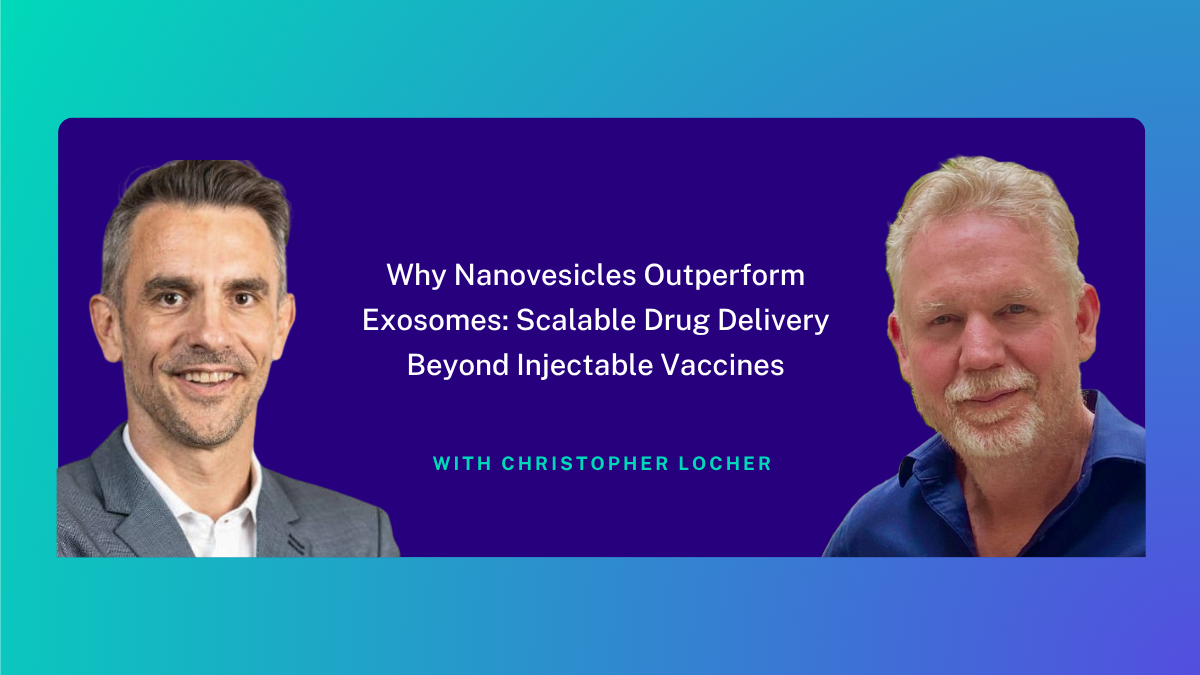
Christopher Locher, CEO and co-founder of Versatope Therapeutics, joined the Smart Biotech Scientist Podcast to reveal how recombinant extracellular transport vesicles could disrupt traditional vaccine delivery—and open the door for broader, more durable immunity.
Episode Highlights
- How basic scientific curiosity and the inspiration from teachers sparked Christopher’s career in biotechnology [03:39]
- The unmet needs in vaccine development for infectious and parasitic diseases, especially in regions below the equator [04:17]
- Engineering nanovesicles as immunomodulators and drug delivery vehicles, using microbial bioreactors for production [06:38]
- Co-producing proteins and vesicles in a single process, and the flexibility of the platform [08:28]
- Key benefits of Versatope’s platform, such as cost efficiency, stability, and commercial scalability compared to mammalian exosomes [09:53]
- Prospects for multi-specific vaccines and the future direction for scalable bioprocessing [11:47]
- Adapting manufacturing processes and overcoming logistical challenges—from COVID-related shutdowns to supply chain bottlenecks [12:21]
- Strategies for navigating evolving regulatory requirements with agencies like the FDA, and experience with fast IND allowance [14:53]
- Analytical and characterization challenges of complex nanovesicle-based products versus simpler platforms like antibodies [17:30]
- The vision for decentralized or local vaccine manufacturing, especially in resource-limited settings [19:12]
In Their Words
These tools need to be applied empirically so we understand what’s going to be the best system for the best target. It’s not something that we can predict necessarily right off the bat. We have a sense of what direction to go in. So what we generally do is make a lot of different clones, screen them for protein expression, solubility, and having the right shape. And once we have that, we can scale it up and use it as a master cell bank.
Podcast Transcript
David Brühlmann [00:00:33]:
Today, we’re exploring a new approach to vaccine delivery: recombinant extracellular vesicles. Christopher Locher, who is the CEO and co-founder of Versatope Therapeutics, joins us to unpack this nanovesicle platform, how it differs from traditional vaccine delivery, and what it could mean for broader, more durable immunity. Christopher brings drug discovery experience from Vertex Pharmaceuticals, Opsona Therapeutics, and Maxygen. Let’s get into it.
Welcome, Christopher. It’s good to have you on today.
Christopher Locher [00:02:23]:
Thank you, David. A pleasure to be here.
David Brühlmann [00:02:25]:
Let’s start our conversation with perhaps a bit of a controversial question. Share something that you believe about bioprocess development that most people disagree with.
Christopher Locher [00:02:38]:
So one of the things I found out in the process—I didn’t do this early on—is that one can actually make a clinical batch for Phase 1 human studies early on by using a simple process, and it doesn’t have to be GMP. This is especially true if one does a clinical study overseas. The FDA in the United States is getting on board with this approach where you just take a handful of subjects, but you don’t need all the bells and whistles and millions of dollars that go into the process for a Phase 1 clinical study. That can be done concurrently or later when one raises more money for a specific program.
David Brühlmann [00:03:15]:
That’s interesting. That’s the first time I hear about that. Very interesting approach indeed. Before we dive further into drug development, let’s start with your story, Christopher. Tell us what the initial spark was that drew you into biotech, and what were some interesting pit stops along your long career leading to co-founding a company.
Christopher Locher [00:03:38]:
So there were several milestones. I think early on, I was always inspired by my teachers, as early as high school. I had very dynamic, engaging, and entertaining science teachers who kept my interest and focus on learning about chemistry and biology. My interests have waxed and waned over the years, but I think overall it was my teachers who inspired me to study biology. I think it was also my active imagination about what it would be like to work in infectious diseases and tropical medicine over the years. That’s why I got into vaccines to begin with, because there still remains a huge unmet need for vaccines for parasitic diseases, for example. Not so much in the developed world—in Europe and North America—but below the equator, I think it’s still problematic.
There are control measures that are being used that are still pretty antiquated. I know mosquito bed nets are still the best prevention for diseases like malaria. We can apply new scientific tools to solve these problems. In the United States, a lot of research has been focused on this, and there has been quite a bit of effort. The United States once had problems with diseases like yellow fever and malaria, but we’ve since eradicated them largely through engineering measures and by putting screens on windows.
But my point is that there’s still an unmet need all over the world. I was inspired to start the company because I had been in industry for a while, and I still saw problems with drug delivery. We tend to have a Cartesian view of deconstructing everything down to the atomic level, which was great when I worked at Vertex Pharmaceuticals, because we did structure-based drug design. There, you modify specific atomic groups, rearrange atoms and molecules, and alter functional groups to improve binding to a target. That’s all well and good, but there’s another element: getting that drug to the target and making it stay on target is often accomplished with vesicles such as exosomes or nanovesicles in the body.
Things are gobbled up and spit out, and the microbiome in the human gut also delivers vitamins and nutrients to our bodies. It can also deliver disease. So when I first saw the Versatope technology, I was inspired largely by nature because these little nanovesicles can be engineered as immunomodulators to bolster the immune response or attenuate it. So inflammation and anti-inflammation are really two sides of the same coin.
And by using genetic programming, we can program them to be either pro-inflammatory or anti-inflammatory. Having my background in biotechnology and working in these different disease areas, I think, gave me the insight to see the opportunity—not only for vaccines, but for immunomodulation overall.
David Brühlmann [00:06:29]:
Tell us more about these vesicles. What kind of technology are you using? How do you produce them? How do they work?
Christopher Locher [00:06:38]:
So we produce them in microbial bioreactors. As I mentioned earlier, you can also make them in shake flasks—a kind of “shake-and-bake” approach. You harvest the supernatant, or the fluid on top, by removing the cells, and the supernatant itself contains tiny vesicles.
These vesicles can be engineered so that they’re relatively uniform in size and consistent from batch to batch, especially when one uses cloned single-cell approaches for expanding production. Early on, we genetically engineered them so that the lipopolysaccharide (LPS), which is a toxin in humans, can be modified so it’s no longer toxic. That has hampered many efforts to use these types of vesicles because the inflammation they induce had to be attenuated to the point where it no longer posed a safety issue.
Again, it’s a balance between inducing and reducing inflammation. These vesicles can be fine-tuned accordingly, and we can program them to express vaccine epitopes so they’re displayed on the surface of the nanovesicles. Alternatively, they can be engineered to express antibody fragments for cell targeting. Those are called paratopes—the antigen-binding functional domains of antibodies.
That’s of high interest to me because these little vesicles, and even the microbes themselves, can be orally bioavailable. Instead of getting an injection, one could potentially envision—with a little imagination—that antibodies could be delivered by the oral route using this approach.
David Brühlmann [00:08:12]:
Oh, interesting. So theoretically—tell me if I’m wrong—could you co-produce your protein of interest, add your vesicle at the same time, then purify everything and use that as a drug, or is it a bit more complicated?
Christopher Locher [00:08:28]:
No, that’s exactly what we do. And that’s what we prefer doing. You can also conjugate drugs to the vesicles or package drugs into the vesicles as a two-step process. That’s been done, and it’s certainly doable. But I like the idea of doing everything in one go—expressing both the drug and the vesicle in a single process so you end up with a single product. That’s how we make our vaccines.
David Brühlmann [00:08:49]:
And what kind of products can you co-produce? What are the limits?
Christopher Locher [00:08:54]:
We don’t yet know what the limits are. I don’t think it’s size. I think the limits are more related to solubility within the vesicles themselves. We’ve applied different fusion proteins that allow us to fuse molecules together either to improve targeting or enhance solubility. In the case of more complex polypeptides, they also help with proper protein folding and disulfide bond formation, which helps maintain the three-dimensional structure of a protein.
So these tools need to be applied empirically so we understand what’s going to be the best system for the best target. It’s not something that we can predict necessarily right off the bat. We have a sense of what direction to go in. So what we generally do is make a lot of different clones, screen them for protein expression, solubility, and having the right shape. And once we have that, we can scale it up and use it as a master cell bank.
David Brühlmann [00:09:49]:
What are the benefits of your platform compared to other systems?
Christopher Locher [00:09:53]:
Cost efficiency. Exosomes are hampered by high development costs. Oftentimes, they’re produced using mammalian expression systems. Yield is poor, the half-life is poor, and commercial scalability seems to be more challenging than it is with our vesicle technology. There are already products on the market that use outer membrane vesicle (OMV) technology for vaccines. So we believe it’s feasible to have a commercially scalable product manufactured at very large scales—thousands of liters—where one can produce enough doses for entire populations.
That’s in contrast to mammalian cell systems. They can certainly be used, but it’s harder and more expensive to do it that way. Exosomes derived from mammalian cells tend to consist primarily of lipids, and they’re relatively delicate. Our products contain a significant amount of carbohydrate, and those carbohydrates impart a level of stability that you don’t typically get with exosomes or other lipid-based nanovesicles.
David Brühlmann [00:10:53]:
How do you go about developing a manufacturing process for these vesicles? What can you copy and paste from more established platforms, and what are some unique features of your new technology?
Christopher Locher [00:11:08]:
It depends on the cell line we’re using. Some cell lines are hardier than others, so we’ve had to adapt the bioprocess in the bioreactor itself to make it more amenable to more delicate products. On the other hand, if you’re doing things in shake flasks, that’s generally good enough for small-scale pilot studies.
We’re an early-stage biotech company. We’re Phase 1-ready, so we’ve reached that clinical milestone with an active IND (Investigational New Drug application) allowed by the FDA for our vaccine product. But we also want to explore other areas that are currently of high interest and represent unmet needs in biotechnology.
I like pushing the boundaries of the technology. I like expressing antibodies on the surface of these vesicles. That’s something people don’t typically do, but I want to do it. And I don’t want to do it with just a single antibody. I’d like to develop multispecific and bispecific antibodies so we have a single product that can hit several targets while maintaining the stability and product characteristics needed for a high therapeutic index, along with good PK (pharmacokinetic) and PD (pharmacodynamic) properties.
David Brühlmann [00:12:14]:
What were some of the challenges you encountered while developing the process and now scaling it up?
Christopher Locher [00:12:21]:
Aside from money, I think part of it was just logistics. COVID happened, so that shut down our operations in terms of having a reliable manufacturing team that could work efficiently. We had to break things up and work in shifts. So that hampered our efforts for several months. It also affected the contract manufacturing organizations (CMOs) we worked with to develop our products.
Then we also had funding challenges. Working with the federal government in the United States has its challenges. It’s great because they provide good support, but the money isn’t always as readily available as you’d like it to be. So there have been a lot of stops and starts, with delays while waiting for approvals for certain things.
Now, with funding being rescinded and the NIH (National Institutes of Health) shifting its focus away from vaccines, it’s been really challenging to raise money for our products.
Aside from funding, COVID also created logistical challenges, including supply chain issues. We couldn’t get filters for concentrating and purifying our products. That became a major bottleneck. Lead times were extremely long. Many of those products were manufactured in China, and shipments from China were delayed. As you know, a lot of cargo sat at the ports in Los Angeles for a long time.
David Brühlmann [00:13:39]:
That was a huge issue for a lot of companies—the supply chain. What other risks are you still encountering today because of this novel platform or new way of producing these products? What stands out?
Christopher Locher [00:13:55]:
I think a lot of it comes down to educating people. People want everything to be proven. The goalposts keep getting pushed further out.
Ten or twenty years ago, companies could raise money based on preclinical data or early-stage clinical programs. Now everybody wants to see Phase 2 proof-of-concept data. By that point, you don’t really need as much funding because you’re already off to the races and looking for partners for further development, commercialization, and licensing of the product.
The goalposts have definitely moved. There’s a lot more competition, and there’s less money available to support biotechnology programs.
David Brühlmann [00:14:29]:
Now I’m curious how you navigate the regulatory side, because a lot has happened lately at the FDA and other regulatory agencies—new pathways and new approaches to regulation. At the same time, you’re proposing what is, shall I say, a new modality. So how did you go about that?
Christopher Locher [00:14:52]:
I think the FDA was very understanding. Certainly, the review division we worked with didn’t give us any problems. And this was before 2025. We had our IND cleared in January 2025—I think it was January 19. We submitted our IND for review just before the Christmas holidays, so they turned it around in less than a month, and we received no clinical hold and no major questions. They understood the product. They understood what we were doing. I think working with a really good regulatory team and a committed CDMO (Contract Development and Manufacturing Organization) was extremely helpful in reaching that milestone without many hiccups. Unfortunately, I don’t know what the situation is now. Over the last year and a half or so, I know a lot of people have left the FDA, and that’s been challenging. I’ve also been talking to people in Europe about collaborations, so I think there are opportunities abroad where certain doors may have closed in the United States.
David Brühlmann [00:15:54]:
And to what extent did you have pre-briefing sessions or discussions with the regulatory agencies to anticipate certain questions?
Christopher Locher [00:16:03]:
Well, our first product to enter the clinic was our universal influenza vaccine. We submitted an INTERACT request for early interactions with the FDA when we first launched both the product and the company. We sent them the preclinical data and asked whether they wanted to discuss it or have an in-person meeting. But we received only a written response. They basically said, “No, we’re good. We understand what you’re doing. Thanks for keeping us in the loop.”
We then opened an IND, requested a pre-IND meeting, and asked for feedback on the safety, toxicology, and overall CMC package. They really didn’t have many questions. They simply said, “Make sure your quantification and stability assays are solid, and that you have a good ELISA assay for quantifying the product,” because that’s what we had proposed. We use ELISA to measure antibody binding, quantify the product itself, and demonstrate product specificity. So we said, “Okay,” and that was it. We then submitted the IND. We’ve actually never had a face-to-face meeting with the FDA. We requested a written response only for the pre-IND interaction, and that was sufficient for our purposes. Phase 2 will be different. I think that’s where we’ll have much more robust discussions with the regulatory authorities.
David Brühlmann [00:17:14]:
I imagine more analytical and stability questions will come up then. What’s your approach there? I imagine you have characterization challenges that are much more complex than if you were simply producing an antibody.
Christopher Locher [00:17:29]:
Yes, it’s definitely more complex. You’re dealing with many different polypeptides, along with lipids and carbohydrates that all need to be characterized. But fortunately, we now have the analytical tools to do that.
A lot of it relies on mass spectrometry, which allows us to identify and quantify the proteins that are present. One of the FDA’s questions was, “What exactly is this product composed of?” We were able to provide that information, and they said, “Okay, that’s good.”
So we know the composition, and most of it consists of our intended drug product. We characterize it using ELISA with a specific antibody, which allows us to quantify the product for stability studies as well as measure the amount of antigen present in each ELISA assay. That was sufficient for our Phase 1 program.
David Brühlmann [00:18:09]:
And what do you anticipate for the later phases?
Christopher Locher [00:18:11]:
Scalability. We’ll need to demonstrate a commercially scalable manufacturing process, so we’ll have to work with a strong CDMO. I envision something like extended batch manufacturing. I’ve discussed this with a number of CMC experts, and it’s becoming increasingly common. It’s not necessarily continuous manufacturing, but rather an extended-batch approach where you harvest material over the course of a week or two while keeping the bioreactor running. That way, you don’t necessarily have to scale up to 10,000 liters. You can operate at a smaller scale—perhaps around 1,000 liters or less. We also now have single-use bioreactor systems that may be well suited for this approach. Deciding exactly how we’ll implement this will require significant upfront work, probably six months to a year. We’ll need a commercially scalable process for Phase 2 and beyond.
David Brühlmann [00:19:03]:
And because the required manufacturing scale is smaller, could you envision more localized manufacturing south of the equator, for example?
Christopher Locher [00:19:12]:
Yes, provided the product is stable. I’ve spoken with people in Africa, including vaccine manufacturers and others in their network, and they’re interested in our approach. We currently have a bispecific malaria vaccine program, but we want to make it trispecific so that it targets all three stages of the parasite’s life cycle. Since malaria remains an important disease across Africa, they’ve expressed interest in working with us to transfer the manufacturing process there.
Other groups we’ve collaborated with—not necessarily competitors—have already transferred similar technology to locations south of the equator, and it appears to work well, provided the necessary materials are available and there’s a reliable supply of purification equipment and filters. Otherwise, you run into the same roadblocks we experienced during COVID.
David Brühlmann [00:20:07]:
So what I’m hearing is that it isn’t necessarily essential to manufacture south of the equator. You could produce the product in Europe or the United States and then ship it to those countries.
Christopher Locher [00:20:16]:
Yes, absolutely. You can do that as well. The product can be shipped at room temperature, provided it’s lyophilized, or freeze-dried.
David Brühlmann [00:20:22]:
That certainly simplifies things because local manufacturing requires qualified personnel, a stable manufacturing environment, and a number of supporting capabilities.
Christopher Locher [00:20:34]:
For smaller-scale applications—such as responding to outbreaks or pandemics—we’ve discussed the possibility of decentralized manufacturing. You could imagine shipping an entire manufacturing unit on a skid or trailer, completely self-contained within a single module that includes both upstream and downstream processing. You could wheel it into place, keep it enclosed in a clean protective environment, connect utilities, turn it on, and begin manufacturing. Depending on the required production scale, I think that’s entirely feasible—and it would be pretty exciting to see something like that become a reality.
David Brühlmann [00:21:00]:
Christopher Locher has walked us through the science behind Versatope’s vesicle platform, how it’s built, what makes it different, and how it could change drug delivery. There’s still plenty more ground to cover in Part Two with Christopher on manufacturing, regulatory strategy, and lessons from the founders.
If this conversation has been valuable, please leave a review on Apple Podcasts or your favorite podcast platform. Thank you for tuning in, and I’ll see you next time.
Disclaimer: This transcript was generated with the assistance of artificial intelligence. While efforts have been made to ensure accuracy, it may contain errors, omissions, or misinterpretations. The text has been lightly edited and optimized for readability and flow. Please do not rely on it as a verbatim record.
Next Step
If you found value in today’s episode, take a moment to like, follow, and leave a review on Apple Podcasts or your favorite platform—it helps us reach and support more scientists like you.
Thanks for tuning in to the Smart Biotech Scientist podcast and being part of this journey toward bioprocess mastery. For more insights and practical tips, visit
About Christopher P. Locher
Christopher P. Locher, PhD, is CEO and co-founder of Versatope Therapeutics, a Massachusetts-based clinical-stage biotechnology company developing immunotherapeutics based on nano-vesicle technology. His career spans drug discovery, infectious diseases, and vaccine development, with previous leadership roles at Vertex Pharmaceuticals, Opsona Therapeutics, and Maxygen. He completed his postdoctoral training at the University of California, San Francisco, and was a Fulbright Hays Research Fellow at the Institute of Tropical Medicine in Antwerp, Belgium. He holds a PhD in Tropical Medicine and a BA in Biological Sciences from the University of Hawaii.
Connect with Christopher P. Locher on LinkedIn.
Further Listening
If Christopher’s vesicle platform has you thinking about building a novel modality on an unconventional host, these four episodes go deeper on alternative production systems, microbial scale-up, and the CMC and cost decisions that get a first-in-class biologic to patients.
Episodes 217 - 218: Silkworm Biomanufacturing: From Ancient Silk Production to Phase I Vaccine Trials with Masafumi Osawa
Episodes 239 - 240: Continuous Microbial Manufacturing: From Genetic Instability to 40-Day E. coli Processes with Juergen Mairhofer
Episodes 231 - 232: From IND to BLA: The Biologics CMC Decisions That Determine Regulatory Success with Henri Kornmann
Episodes 267 - 268: Why Affordable Insulin Is a Money Problem, Not a Science Problem with Eric Moyal
Want to Join?
Are you a CMC or biomanufacturing leader with hard-won lessons on process development, scale-up, or CDMO management? We’re always looking for practitioners with real execution stories to share on Smart Biotech Scientist.
Apply to be a guest or recommend someone:
David Brühlmann is a strategic advisor who helps C-level biotech leaders reduce development and manufacturing costs to make life-saving therapies accessible to more patients worldwide.
Hear It From The Horse’s Mouth
Want to listen to the full interview? Go to Smart Biotech Scientist Podcast.
Want to hear more? Do visit the podcast page and check out other episodes.
Do you wish to simplify your biologics drug development project? Contact Us