The future of genetic medicines depends on one crucial factor: delivery. Gene therapy, RNA interference, and DNA-based treatments promise breakthroughs for countless conditions—but only if therapeutic cargos can safely reach their target cells.
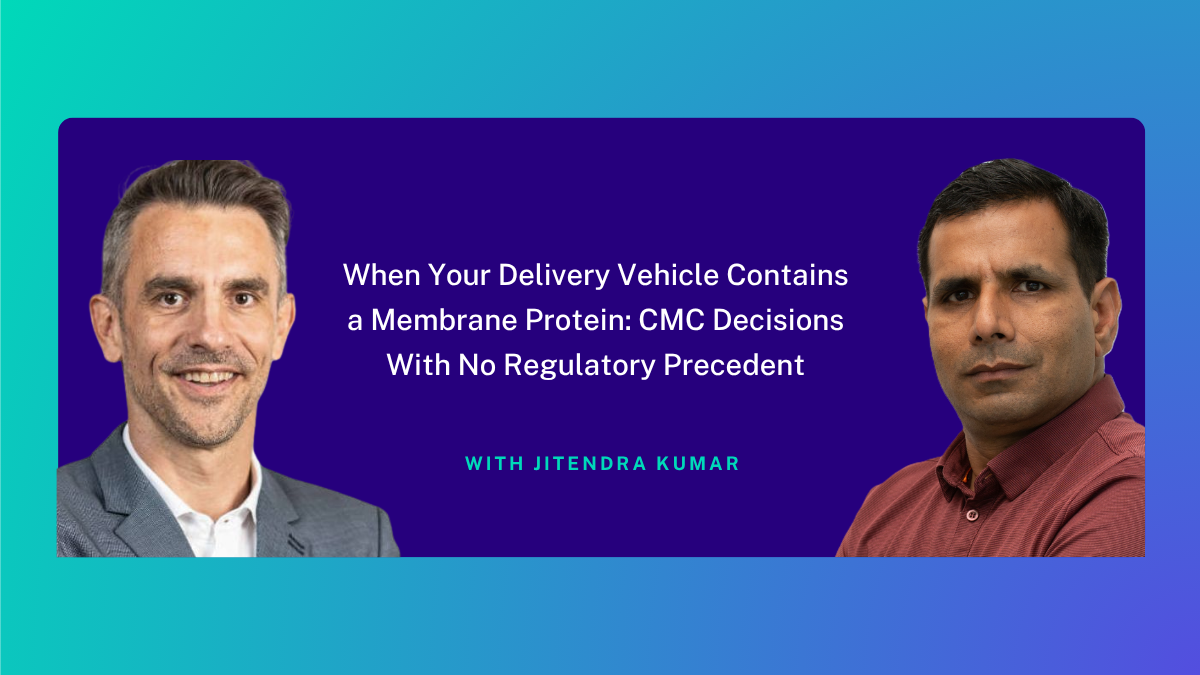
In this episode of the Smart Biotech Scientist Podcast, Jitendra Kumar, Lead Scientist for Chemistry and Process Development at Entos Pharmaceuticals, joined host David Brühlmann to discuss how a novel class of delivery vehicles—the proteolipid vehicle based on FAST proteins—might unlock new therapeutic frontiers.
Episode Highlights
- Jitendra’s career background in structural biology and journey to Entos Pharmaceuticals [03:18]
- The scientific motivation and challenges of working with prion proteins and breaking down complex diseases [04:55]
- Genetic medicine approaches: gain-of-function vs. loss-of-function, and the role of siRNA, ASOs, and gene delivery [06:27]
- The FAST protein platform: origins, function, and advantages for drug delivery [07:56]
- Manufacturing differences compared to LNPs, including the introduction of recombinant membrane protein production and related CMC complexity [09:55]
- Scale-up and production challenges for membrane proteins, and strategies for clinical supply [11:21]
- Clinical development progress: Phase 1/2 studies with the platform, especially for COVID vaccine delivery [12:23]
- Focus areas for the technology, including selective lung delivery and leptin therapy for lipodystrophy [13:12]
- Lessons for small biotech companies in phase 1/2 manufacturing strategy, technology transfer, and the value of an experienced network [14:31]
- Balancing process robustness with speed in new biotech ventures [16:02]
- The importance of identifying “pause steps” and must-have vs. nice-to-have features in early manufacturing processes [17:15]
In Their Words
Every system has some advantage and disadvantage because it’s a naturally occurring transmembrane protein. Our system’s advantage is that the heavy role of delivery to the cell is done by the transmembrane protein. Our particles get close to the cell membrane, it interacts with the cell membrane, allows our particles to fuse. A particle itself becomes a part of the cell membrane and the cargo directly goes to the cytosol, which is different from the LNPs where it mostly ends up in endosomes. And then you have an endosomal escape, which is not the case in our product, PLV.
Podcast Transcript
David Brühlmann [00:00:29]:
Gene therapy only works if the cargo reaches the right cells intact. AAV and lipid nanoparticles have carried the field this far, but a different class of delivery vehicle is shaping what’s possible. Today, Jitendra Kumar, who is the Lead Scientist for Chemistry and Process Development at Entos Pharmaceuticals, joins us to unpack proteolipid vehicles and the Fusogenix platform, and why this distinction matters for manufacturability. Let’s get into it.
Welcome, Jitendra. It’s great to have you on today.
Jitendra Kumar [00:02:23]:
Thank you, David, for the invitation.
David Brühlmann [00:02:24]:
You’re very welcome. To get us started, let’s start with this perhaps a bit controversial question. Share something that you believe about bioprocess development that most people disagree with.
Jitendra Kumar [00:02:37]:
In my opinion, bioprocess development, especially coming with the new technologies like LNPs and AAVs, is very complex and it involves a lot of structural biology information as well, which is a background about the development of these technologies, even though in terms of the methodology development, you see a straightforward pathway, there is a lot of background to it.
David Brühlmann [00:02:58]:
Yes. And I’m excited to dive further into this world during our conversation. Tell us a bit more about yourself. You have quite an impressive career, a long career. What sparked your interest in science and what were some interesting pit stops along the way that led you to your current role?
Jitendra Kumar [00:03:18]:
First thing is I grew up in a family of scientists. My father was an agronomist at an agricultural university in Kanpur, India. And obviously sitting around people who were in science, it was a natural development into science.
And during my journey, I met a lot of people who encouraged that development further. My natural inclination was towards physics, and that is where I got more into the physical chemistry side of things—physical chemistry, analytical chemistry—and that is where I enjoy myself most.
In terms of the current role, I did my PhD at Goethe University, one of the biggest NMR centers in the world, with Professor Harald Schwalbe. It was amazing to work with him and get the experience where, in an academic setup, you also get an industrial experience. The way the whole lab works is pretty much like an industry. We had very defined objectives there.
My current role came when I transitioned from structural biology into an industrial role where they needed more people in the field. I got into this role, I would say, by being lucky because I had a good network of people who supported me in finding this role.
And the one thing which I will say to anybody is: always enhance your network because you never know how the opportunity will come to your door. The answer to your question is that science was a natural inclination because of my family environment.
David Brühlmann [00:04:35]:
I agree that your network is important, and that’s something I stress also when I talk to younger scientists. Perhaps, I’m curious, you had this perspective too as a younger scientist in your career. You think science is the most important thing. Yes, science is important. However, building relationships is equally important.
Jitendra Kumar [00:04:55]:
Yeah, it is very important. And I spent almost 15 years working on the prion protein, which is one of the most difficult proteins to work with. I worked on its structural biology in Harald’s lab in Frankfurt, and then I got more curious about its biology.
So I moved to Edmonton, Alberta, where I joined a prion research center with a neurologist as a postdoc. I was still working on biophysical techniques, but on the other hand I got exposure to the more biological perspective of the disease.
Working with a person who actually deals with patients, seeing the patients who are affected by the disease, brings you a different level of knowledge. And not only the knowledge, but also the impact the disease is having.
I still remember the days when I’m in the lab and my supervisor, Valerie Sim, comes back from the hospital, and you can see on her face that she met somebody who had actually been diagnosed with the disease. And being a doctor, you know that there is a certain timeline you are giving to that person.
That gives a lot of motivation for the research because what you are doing is actually trying to impact the lives of those people in the future. It’s a lot of encouragement, but also the sad reality of life. There are a lot of rare diseases, a lot of things we still face, and a lot of big challenges.
David Brühlmann [00:06:04]:
Yes, absolutely. And I love that your science and your work are driven by a big purpose. Let’s talk a bit about that because you and your company want to deliver on the promise of genetic medicines. So tell us what that means and also how you go about that. What is the technology or the solution you’re providing?
Jitendra Kumar [00:06:27]:
Coming back to the company, Entos Pharmaceuticals, from the University of Alberta, it’s a startup from the Department of Oncology here. We started in the oncology sector. We’re trying to silence a few genes or the expression of a few genes. The thing is, genetic medicine is pretty much the future for many of our diseases. And if you look at it from a product perspective, you can classify a lot of diseases either as loss-of-function or gain-of-function diseases.
In either case, having a small molecule that can do the job is good. But if it’s a gain-of-function disease, where you are having protein overexpression, applying an siRNA or ASO (antisense oligonucleotide) to suppress the expression more effectively is a good technique.
Similarly, where it’s a loss-of-function disease, you can introduce a foreign gene or the natural gene using different drug delivery methods to express it. That is going to give you the desired natural expression of that protein, which in many cases we can do.
Say, for example, antibody therapies are there where you are introducing an antibody, which is a foreign protein you are giving as a dose. But genetic engineering is promising in a way that you can regulate it. It’s a multi-step process. So regulation can be done with promoters and enhancer designs. There are many factors where, with genetic engineering, you can have a controlled treatment.
It’s still a little futuristic, I will say, but we are getting there. Coming back to the company’s role here, we are close to LNP technology if you compare it to non-viral therapy. But on the other hand, I will say it’s an amalgam of two fields where we have viral and non-viral together.
We have identified a small transmembrane protein, which is called a fusion-associated small transmembrane (FAST) protein. It’s a family of about 10 proteins identified by Roy Duncan at Dalhousie University. In his lab, they created chimeric proteins, and the protein that we work with is one of those chimeras, for which we have the intellectual property.
It is one of the smallest transmembrane proteins known, and it allows our particles to fuse directly with the cell membrane, which addresses a major bottleneck for many of the technologies in the field of drug delivery.
David Brühlmann [00:08:26]:
So that means that, as I’m paraphrasing this, you developed a novel delivery mechanism to deliver whatever gene or whatever substance you want to deliver to the site of interest.
Perhaps to draw a picture, when we look at gene therapy, usually you use a delivery vehicle like AAV, for instance, or others for transport. So how is this mechanism different, and why is it better, or what are the certain advantages versus more traditional systems?
Jitendra Kumar [00:08:56]:
I will say that every system has some advantages and disadvantages, and I will talk about the advantage of our system. Because it’s a naturally occurring transmembrane protein that has the functional role of fusing with the cell membrane, our system’s advantage is that the heavy role of delivery to the cell is done by the transmembrane protein. And that is the bigger task in a lot of delivery vehicles.
So what is happening is our particles get close to the cell membrane, interact with the cell membrane, and allow our particles to fuse. The particle itself becomes a part of the cell membrane, and the cargo directly goes to the cytosol, which is different from LNPs, where it mostly ends up in endosomes, which is like being engulfed inside. Then you have to rely on endosomal escape, which is not the case with our delivery platform.
The advantage we have compared to the LNP space is that we are not dependent on the lipids themselves for the delivery. We have a much broader space of lipid flexibility. We can change the lipids much more easily, and that allows us to address tropism.
David Brühlmann [00:09:55]:
And what are the difficulties you are encountering with your platform?
Jitendra Kumar [00:10:00]:
I will not say difficulties, but if I compare it with LNPs at the moment, let’s put it this way. We have a protein component. So if you talk about the CMC, we introduce another factor, which is biological.
Rather than having a straightforward chemistry-based CMC, we have a biological process where we are producing and purifying the protein, and that protein becomes a part of our delivery vehicle. Rather than being a difficulty, it’s slightly more complex than a traditional LNP in that sense.
David Brühlmann [00:10:25]:
So what’s difficult or challenging with your platform? Because you’re using a biologics production system to generate your delivery vehicle.
Jitendra Kumar [00:10:33]:
It’s different from LNPs. Right now, our process is pretty much optimized. We have no challenges as such, but it’s very much like producing a monoclonal antibody or any recombinant protein. You have to follow the same path for the production of this FAST protein.
One of the challenges I faced initially is that there is practically no information available in the regulatory databases for membrane proteins. Everybody talks about soluble globular proteins or monoclonal antibodies, but the membrane protein space is still pretty new from a regulatory perspective.
David Brühlmann [00:11:00]:
But you’re producing this recombinantly as you would an antibody or other protein molecules?
Jitendra Kumar [00:11:06]:
Yes. We are using a baculovirus expression system for the expression of the protein, and that allows the post-translational modifications that are required for the protein.
David Brühlmann [00:11:14]:
And this system would also enable straightforward scale-up if you need much larger quantities of this molecule?
Jitendra Kumar [00:11:21]:
We have done a few scale-up studies, and I just want to add here that we have a facility in Carlsbad, California, where we can do our Phase I and Phase II manufacturing. We are in a very good position for that kind of production at the moment. We have also done a couple of scale-up studies with the support of Cytiva, which worked very well.
Having said that, it’s a membrane protein, and anybody who has worked with membrane proteins knows that there are inherent challenges associated with them. One issue I can mention is that there is a limitation in expression. It’s not a highly overexpressed protein, so the scale-up is much more linear than exponential.
We are working on that. There are a few things we are trying that look promising. That’s where it has been great working with Cytiva, who provided the 50-liter bioreactor, and we had a very successful production run with them.
David Brühlmann [00:12:08]:
Excellent. And tell us where you are in this development. Are you already in clinical studies with this? Is this still at the proof-of-concept stage? How easy is it for other people to use this technology?
Jitendra Kumar [00:12:22]:
It’s very straightforward to use, and as a company we are offering it to people who are interested. Coming back to my own journey, I joined the company at the time we received approval to conduct the Phase I clinical trial for our COVID-19 vaccine. That was also the time when the company needed more people, so it was a good transition point for me.
We are a clinical-stage company. We have completed Phase I and Phase II clinical trials for the COVID-19 vaccine in Canada. So, in terms of the technology, we have demonstrated that it is clinically safe and can be utilized. The question is that when it comes to different therapeutic targets, we still have to evaluate each one. If we change the lipid composition, there may also be some additional considerations.
But in terms of the core technology, we have demonstrated that it is clinically safe.
David Brühlmann [00:13:07]:
And what kind of applications are you focusing on with this technology?
Jitendra Kumar [00:13:12]:
There are multiple applications at the moment. Right now, we are very focused on lung diseases. That is where the current excitement within the company is.
When I say excitement, I mean that we are able to deliver selectively to the lungs, which is a challenge for many LNPs, especially bypassing the liver and delivering efficiently to the lungs. We perform very well there.
One of the key factors with our technology is that, since our delivery is based on the FAST protein, there is no lipid-related toxicity associated with the delivery vehicle, unlike many LNPs, which primarily accumulate in the liver. Those are generally considered liver-tropic systems.
That is advantageous for certain applications, but not for everything. That’s why I say there is room for almost every technology because each brings its own advantages.
So our current focus is on lung diseases. We are also working on a disease called lipodystrophy, where we are developing a leptin gene therapy.
Currently there is a peptide-based therapy that patients have to take daily. Our animal studies are showing that a single dose can restore leptin expression for up to six months. That is something we are hoping to bring into the clinic soon.
David Brühlmann [00:14:16]:
I’d be curious about the strategy when you’re designing these Phase I or Phase II clinical studies. I mean, you need to think about the manufacturing as well. What are some key decisions you lock in early, and perhaps what are some things that can wait until later?
Jitendra Kumar [00:14:30]:
To answer your question, when I got involved in the company, we were already starting Phase I. The thing that I learned, especially during that difficult time for any company—and particularly for startups during the COVID period—was that there were limited supplies.
As a company, we got lucky because there was a small-scale production facility within the University of Alberta. That is the facility we used for the Phase I production.
Because of the limitations in reaching out to other people, it became a very good learning experience for us. Almost all of the company staff at that point became GMP-trained as well. We changed hats, and based on that experience and our interactions with people at that point, I feel one of the biggest challenges for a small company is technology transfer.
So for Phase I, if you are a startup, my advice would be to find somebody who understands your technology and can get on the same page quickly, rather than going to a large CDMO, where technology transfer can take a long time.
During that experience, what we saw was that because we were the people who got trained to do the production ourselves, it sped up the whole process. Timelines that we thought would take more than a year were completed in under three months. And that’s significant.
That particular experience actually led us to establish our Phase I/Phase II production facility in Carlsbad, California, because we realized that if we want to get into the clinic quickly, that’s the way to go. And we are open to supporting other companies from that perspective as well.
David Brühlmann [00:15:53]:
Speaking of small companies, you often have to make a trade-off between process robustness and speed. What is your take on that?
Jitendra Kumar [00:16:01]:
I mean, there is no trade-off when it comes to process robustness. Our process has to be robust. It comes down to how many checkpoints you have. One key thing that I tell my team is to identify the pause points where you can safely halt the process.
Right from the beginning, I came from academia, and there is a transition when you move into manufacturing. Especially in the production space, it’s about finding the right people.
To be honest, in that regard, as a company we were lucky to find people who directed us in the right direction and did so quickly. Also, finding the right partners—as I said, Applied Cell Technologies (ACT) here at the University of Alberta—they were very supportive. So I will say we were lucky, but that’s also where your network comes into play: finding the right partners. There were a few larger organizations that we approached, but they did not fit our timelines. It’s a balance. You cannot compromise process robustness. Your process has to be robust. You have to be confident in your process. But on the other hand, if you have a technology and you want to make an impact, you also want to reach the clinic as soon as possible. So speed is also a key factor.
David Brühlmann [00:17:01]:
I agree. The process must be robust. No doubt about that. The question I sometimes see is: what are the nice-to-haves, and what can wait until later? That’s often a question small companies ask.
Jitendra Kumar [00:17:15]:
Yes. That is where our Head of CMC and our Head of Manufacturing have been invaluable. He has over 30 years of experience, and we were lucky to have him on the team. That experience counts for a lot because he was able to guide us on what is absolutely necessary and what can be addressed later. Identifying those things as early as possible is very important. The other thing, in terms of the production cycle itself, as I said earlier, is identifying the pause points. Whatever we think, we cannot have a completely continuous process. There will always be situations—whether it’s a mechanical failure or another issue—where we have to pause the process for some reason. If you have not identified where you can stop, store the material, and then restart the process, there will be a problem.
David Brühlmann [00:17:57]:
Yeah, absolutely. Delivery is where genetic medicines succeed or fail. Jitendra Kumar has already given us a lot to think about, from what sets proteolipid vehicles apart to the manufacturing strategies behind them. There’s much more ground to cover in Part 2, including production, characterization, and the CMC decisions that shape a novel delivery platform.
Thank you for tuning in today. If you’re enjoying the show, please leave a review on Apple Podcasts or your preferred podcast platform. See you next time.
Disclaimer: This transcript was generated with the assistance of artificial intelligence. While efforts have been made to ensure accuracy, it may contain errors, omissions, or misinterpretations. The text has been lightly edited and optimized for readability and flow. Please do not rely on it as a verbatim record.
Next Step
If you found value in today’s episode, take a moment to like, follow, and leave a review on Apple Podcasts or your favorite platform—it helps us reach and support more scientists like you.
Thanks for tuning in to the Smart Biotech Scientist podcast and being part of this journey toward bioprocess mastery. For more insights and practical tips, visit
About Jitendra Kumar
Jitendra Kumar is Lead Scientist for Chemistry and Process Development at Entos Pharmaceuticals, where he leads lipid and FAST protein production for advanced genetic medicine delivery platforms. With more than 25 years of experience in structural biology, biophysical chemistry, and drug development, he has dedicated his career to advancing therapies for cancer and neurodegenerative diseases. His expertise spans structure-guided drug design, protein engineering, NMR, and particle characterization. Dr. Kumar earned his PhD in Chemistry from Goethe University in collaboration with the International Max Planck Research School.
Connect with Jitendra Kumar on LinkedIn.
Further Listening
If you enjoyed this episode you might also like listening to:
Episodes 125 - 126: How to Enhance Cell Engineering Using Mechanical Intracellular Delivery with Armon Sharei
Episodes 231 - 232: From IND to BLA: The Biologics CMC Decisions That Determine Regulatory Success with Henri Kornmann
Episodes 89 - 90: Scale-Up Secrets: Cracking the Code of AAV Production with Ahmed Youssef
Episodes 71 - 72: Effective Outsourcing: How Small Biotech Companies Can Thrive with Mark Melville
Want to Join?
Are you a CMC or biomanufacturing leader with hard-won lessons on process development, scale-up, or CDMO management? We’re always looking for practitioners with real execution stories to share on Smart Biotech Scientist.
Apply to be a guest or recommend someone:
David Brühlmann is a strategic advisor who helps C-level biotech leaders reduce development and manufacturing costs to make life-saving therapies accessible to more patients worldwide.
Hear It From The Horse’s Mouth
Want to listen to the full interview? Go to Smart Biotech Scientist Podcast.
Want to hear more? Do visit the podcast page and check out other episodes.
Do you wish to simplify your biologics drug development project? Contact Us