
Bioprocessing in the biotech industry is often conservative, with many professionals hesitant to move away from established batch processes—even when process intensification and perfusion promise dramatic efficiency gains.
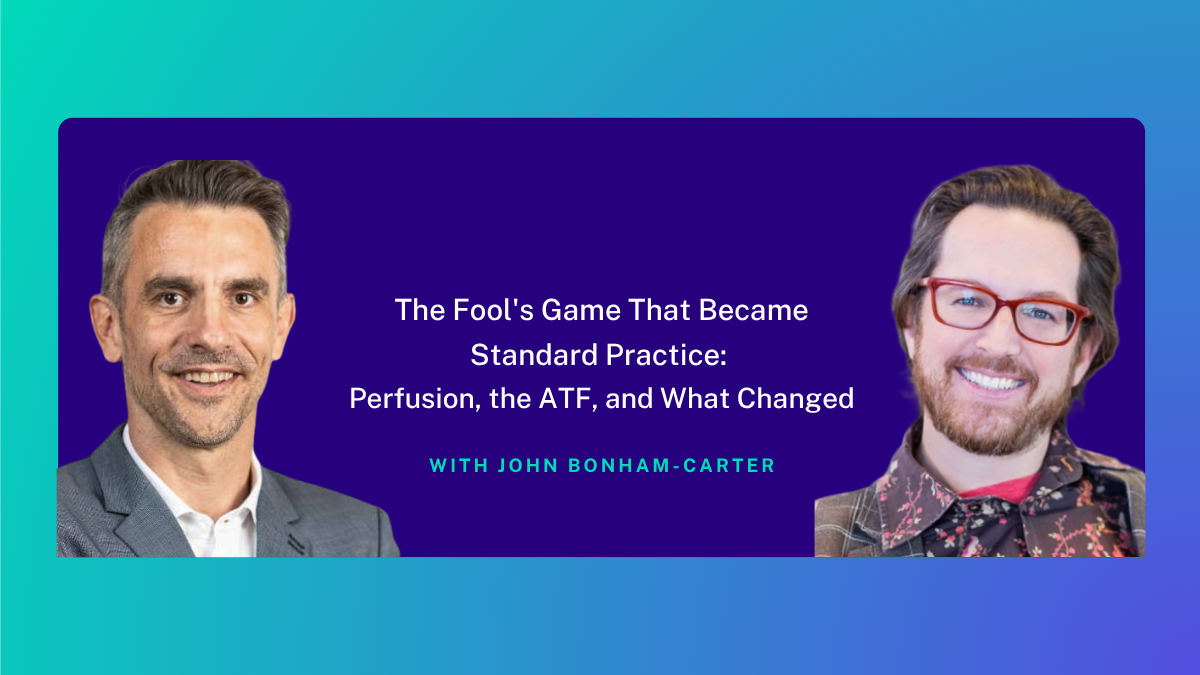
John Bonham-Carter, a serial biotech entrepreneur whose fingerprints are on some of the industry’s most transformative tools. From championing the once-ignored ATF system and putting perfusion on the global stage, to pushing for intense cell therapy bioprocessing with Erbi, John Bonham-Carter has consistently sparked new ways of thinking. His journey isn’t about chasing the next big exit—it’s about recognizing unmet needs, connecting the dots between invention and the bench, and building and selling biotools companies more than once.
Episode Highlights
- The story behind the ATF system, and how John Bonham-Carter and his collaborators convinced a conservative industry to adopt perfusion [04:43]
- Early career influences, including family ties to bioprocess equipment manufacturing [05:03]
- Reflections on the biotech industry’s culture of collaboration and the dual motivation to deliver medicines and achieve commercial success [07:18]
- Realities of scaling a startup, trading income for equity, and the role of persistence in sales [09:34]
- Lessons learned from global travel and building professional networks in biotech [10:16]
- The importance of recognizing what drives different biotech companies to adopt new technology [12:25]
- The transition from ATF to co-founding Erbi, a bioprocessing startup focused on small-volume cell therapy [19:05]
- Strategic acquisitions: experiences of being acquired by Repligen and Merck Millipore [22:50]
- Advice for founders on whether to build a company for exit or long-term operation [23:07]
- The limits of leading with technology, and why customer understanding is critical to success [26:10]
In Their Words
I was busy telling the world that they should do perfusion and process intensification, and nearly everyone was ignoring me apart from Amgen, who saw a vision of what I was trying to say. They saw it maybe clearer than me, but, and so I was telling everyone, you should be having higher cell density, you should be running perfusion, or at least in a concentrated way. And everyone went, „I don’t think we need to be doing that, John. That’s a fool’s game. There’s no future in that.”
And so now, well, I think almost everyone run some kind of perfusion device, whether it’s N-1 perfusion, continuous, concentrated-fed batch like WuXi and various other people. And Sartorius, their whole marketing campaign upstream is based on our original idea about what people should be doing in the bioreactor, is making sure it’s a more intense process.
Podcast Transcript
David Brühlmann [00:00:43]:
Some people spend a career chasing one big idea. John Bonham-Carter has built several. He commercialized the ATF System, bringing perfusion and process intensification within reach of the whole industry, then sold that company to Repligen.
He did it again with Erbi, a 2 mL cell therapy bioreactor acquired by Merck Millipore. Today, John joins Smart Biotech Scientist to unpack what it actually takes to build, launch, and sell a biotools company more than once.
Let’s get started. Welcome, John. It’s good to have you on today.
John Bonham-Carter [00:02:38]:
Thanks, David. It’s great to be here.
David Brühlmann [00:02:42]:
Absolutely. We have been talking about it for a while, and now this is the day, so I’m really excited about it.
John Bonham-Carter [00:02:48]:
You’re so right. When did we first talk? Oh, it was maybe 2 and a half years ago?
David Brühlmann [00:02:52]:
Probably.
John Bonham-Carter [00:02:53]:
I think it was after we sold Erbi, and then you went, oh, that’s a fun story, we should do that. And I went, absolutely, but I just need a little bit of time for myself for a moment. And it’s only, what, 2 and a half years later?
David Brühlmann [00:03:04]:
That’s fine. It’s like a Bordeaux, you know, it takes time.
John Bonham-Carter [00:03:07]:
There we go.
David Brühlmann [00:03:08]:
Good things take time. To start us out, John, share something that you believe about bioprocess development that most people disagree with?
John Bonham-Carter [00:03:19]:
You know what? That’s a really good question, actually. I think that 10, 15 years ago, that was an easy question for me to answer. And right now, I don’t think I’ve got a great answer. So I’ll start with what I would’ve said 15 years ago, which was absolutely true. At the time, I was working for Refine Technology, in which I was a minority shareholder, and I was trying to commercialize the ATF System. And I was busy telling the world that they should do perfusion and process intensification. And nearly everyone was ignoring me apart from Amgen, who saw a vision of what I was trying to say. They saw it maybe clearer than me. But, and so I was telling everyone, you should be having higher cell density, you should be running perfusion, or at least in a concentrated way.
And everyone went, I don’t think we need to be doing that, John. That’s a fool’s game. There’s no future in that. And so now, well, I think almost everyone run some kind of perfusion device, whether it’s N-1 perfusion, continuous, concentrated-fed batch, like WuXi and various other people. And Sartorius, their whole marketing campaign upstream is based on our original idea about what people should be doing in the bioreactor, is making sure it’s a more intense process. So I think, can I now disagree with what I said? I don’t think I can. I have to— but is there something new I can disagree? Not really, no. Maybe I’ve just come old. Who knows? I agree with everyone else now.
David Brühlmann [00:04:39]:
You fit in now, right?
John Bonham-Carter [00:04:43]:
Well, I don’t know about fit in, but I don’t have a radical view maybe anymore.
David Brühlmann [00:04:46]:
Before we dive further or deeper into the ATF and other exciting projects and companies you worked on, I’d love to hear your story. Tell us, what was the initial spark for biotech, for science, and what were some pivotal moments along your long career?
John Bonham-Carter [00:05:02]:
Actually, a really pivotal moment was before I was born, strangely, right? So I mean, I had nothing to do with it obviously, but it was my grandmother who was called Leslie Bonham-Carter. She took over a small engineering company in Stoke Poges, just west of London, and a company called G.D. Searle, who became Glaxo, had a place near there. And instead of making bullets in the war and stainless steel products afterwards, precision engineering, they started to make fermenters. So it was L.H. Engineering, which became L.H. Fermentation, which was the biggest British bioreactor manufacturer ’70s and ’80s. And she, a woman at the time, quite a dragon. You could also think of her as Maggie Thatcher on some level. She built this company up. My dad, who had been sort of bankrupt in a previous world, helped her build it and then sold it. But he and her were the first people, we believe, in the world to put a personal computer onto a bioreactor, right? A Commodore PET with 1K of memory, 1976. And I was playing Space Invaders on a green screen at the facility on Saturday and Sunday.
I probably should have worked out that being an entrepreneur at that time meant you worked most weekends, but I was playing Space Invaders when I was like 4 years old. So I was right then in the manufacturing of upstream equipment with my family. Fast forward to the late ’90s and having a business in the south of France running a newspaper, like a free ads newspaper, buying and selling things with my best friend at the time, I bumped into my future wife in Montpellier. And, but then I got into biotech with my dad. So we started a company called Adaptive Biosystems, which made intelligent software. We had neural nets working in 1999, well before anyone called it AI. We had genetic algorithms, genetic programming, trying to work out metabolic networks way before sophisticated people today, like DataHow and so on, do that today every day. But we were doing it back then as a really small startup. And I stayed in it after then. I just found it really fun. There’s such lovely people in our industry that I have a small timeout in the last few years, but I’ve stayed in it because it’s so lovely to work in this industry.
David Brühlmann [00:07:10]:
Absolutely. I’ve met so many lovely people in the industry. I mean, bioprocessing is an amazing industry, no doubt about that.
John Bonham-Carter [00:07:18]:
Everyone is focused on really delivering medicines in a safe and efficient way. And behind it, there’s money, You’ve got to make money in our capital world, but everyone has really got that duality of trying to help the world, making money while doing it. It’s not a zero-sum game. No one thinks of it like that in our industry, and we all collaborate and cooperate. Even competitors often collaborate on projects and on projects. It’s a wonderful place to spend your life working.
David Brühlmann [00:07:44]:
How did you end up working for ATF’s perfusion? How did this vision come about, and why was this an important vision or an important cause to fight for?
John Bonham-Carter [00:07:55]:
That’s very polite. It’s very polite of you to think that it was my vision. Almost nothing I do is my vision. It’s normally someone else’s vision that they’re failing at, and then I join and try and make it happen. So the ATF was invented by a guy called Jerry Shevitz. His real name, the family came over after the war from Poland, and his actual second name is so long, I never actually learned it, even though I lived with him almost for like a decade or more working together. But when they arrived on Ellis Island, they went, the guy went, oh, my name’s Jerry Duh-duh. Well, of course he was a kid at the time, but you know, Jerry Duh-duh-duh-duh-duh-duh-duh. And the guy went, Shevitz. First syllable, last syllable. That’s what your name is. And that’s how it was. So he is like a kind of crazy inventor. Anyone who’s met him will know, oh yeah, full-on crazy inventor. But that’s the kind of personality you need to go against the grain, to make a product which no one else has seen. And I somehow met him at some conference somewhere, very unclear actually, probably in America. And I thought he was a little crazy, but I thought his product was really kind of cool.
So I started distributing it in Britain and then Europe from around the year 2000. And then from about 2004, I really started doing it more seriously. It became my only product that I was working with. And finally, in between a stint at Finesse, which was bought by Thermo, I think I joined in 2007, 2008 full-time in Refine. Because while I was doing it part-time, I got bigger sales in Europe on one day a week than they had had working full-time 5 days a week. So they went, hang on, John, like you should really do this a little bit more. And I went, sure, this is fun, this is easy. And so they gave me a small share of the company and paid me very little. And I took that risk, which you can when you’re young, right? You trade income for equity and it worked out brilliantly for me. But not everyone can afford to make that trade and they need normal jobs. But at this time it worked out perfectly for me and my family and I had a great time building that company up.
Although I was living in Sweden at the time, I moved this time from England to Sweden with my wife, who’s Swedish, and lived in Stockholm for many years. And so I was running the global sales and marketing for Refine from Stockholm, but traveling all over. And I spent most years, I spent about 150 to 200 days outside Sweden. That’s how much I was working.
David Brühlmann [00:10:13]:
Oh wow, that’s a lot.
John Bonham-Carter [00:10:16]:
That was like 4 or 5 years. So that’s one reason I have a large network of people. At one point, I think at the end of Refine, when we sold Refine to Repligen, I think I’d met something in the region of 8,000 to 9,000 people personally over that sort of 10 to 15 years in all countries from Korea, China, Vietnam, Malaysia, Taiwan, through to Egypt and Turkey and everywhere. Cuba, been to Cuba several times, fun place to be. And Mexico, America, Canada, you know, everywhere. Argentina, great people in Buenos Aires, some lovely people at NPH I remember well, Marcus. So yeah, really traveled throughout. And I think there’s a lot of luck in the success story, to be honest. When you think of that, when you said vision, yeah, I mean, there was a vision, but I think it took 3 years to really understand what that product could do. So although maybe Jerry knew, I was much slower. I don’t think I truly understood the opportunity and the capability. And along with Amgen and various others at Sanofi, I think they saw it quicker than I did. And eventually I realized, Oh, this is something for everyone. Everyone can benefit from this product. It was fascinating for me, slow I was in really understanding the vision. I was marketing essentially, but I got there.
David Brühlmann [00:11:26]:
There’s no doubt about that. You’re a good salesman. I’d love to tap into your expertise and experience because the biotech industry is conservative.
John Bonham-Carter [00:11:36]:
Yeah, really.
David Brühlmann [00:11:36]:
It takes a while to convince people. And I know it firsthand. I’ve done a lot of perfusion and N-1 perfusion. It takes some time to convince people, and there’s some pretty shall I say, stubborn people in the industry and say, well, we have done fed-batch all the time, we’ll never change. So it takes some time. It takes also some, I’d say, persuasion skill to convince people that they should move. So what was your strategy to help people understand that they should actually adopt perfusion?
John Bonham-Carter [00:12:04]:
So I think that’s really interesting. So I did brute force. I knocked on a lot of doors is one thing. Any salesperson who gives up after the 3rd phone call is not a salesperson. So that’s one, but there are a number of factors which were out of my control that really lent themselves to success exactly when we were trying to get people to do perfusion and process intensification. And I think it’s really important to understand each company is a little different. So there’s a really great guy who was at Bob Kiss. I’m sure lots of people and lots of your listeners will know him, who was VP at Genentech. We got on great. We would hang out at Cell Culture Engineering and at ESACT conferences. And, you know, he said, We’re never going to do perfusion in Genentech because we’ve got these huge reactors, costs are really low. It’s just not a driving force. And I think I really didn’t understand that. And at the same time, Amgen was already investing in factories of the future. And Kimball Hall was a visionary here saying, can we build, instead of spending $1 billion or $2 billion on a facility, can we spend sort of $300, $400 million for the same output? The same grams going out per day? Not the same yield, but the same total output.
And the answer, well, yes, if you build it from scratch with intensified processing in mind. But Genentech didn’t need to build a facility. So they basically had different drivers for why these 2, you know, in my view, similar-ish companies were developing processes. Genentech to fit in facilities that were already made and were essentially written off. And Amgen, well, they had a vastly more complex portfolio of molecules and they had to get a platform process and they did not want to build a huge facility where maybe the capacity wasn’t going to be utilized. So they built a smaller facility, which was highly intensified and could adapt to different molecules. So in some respects, it was lucky for us to be there at the right time, and lucky that we were big enough that Amgen could take us on board, not take too much of a risk, and grow with us.
And so understanding that shift between these 2 companies and the reasons why they made their decisions went, okay, well, you know, Lonza is in the camp of Genentech. They really didn’t need to do that at the time, although they have But many other companies like Sanofi and others, they had their own reasons. Sanofi already had perfusion processes which were commercial. They needed to update them. They were getting a hundredfold, more or less ballpark, increase in productivity. Who’s going to say no to that? And other people who had factor VIII and factor VII and factor IX, they also committed heavily to perfusion. And that’s where we saw it going.
But in practice, that’s not really what built the company or made the company. It was the fed-batch people who realized, hang on, N-1. Biogen had a great paper. I’m sorry, I can’t remember your name who wrote it, but a great paper along with someone, people like Gargi Seth, who said, hang on, it’s the intensification of the seed train which transforms a fed-batch process, right? And it’s not obvious that that’s true when you first start out. It may seem obvious to everyone today that you’re going to get 30% extra throughput for no real change in a qualified process. But it was all true and the work was done. A lot of people actually in Switzerland did that work. Thomas, I’ve forgotten the guy’s name now, but it will come back to me in the interview. I’m sorry, Thomas out of Basel, you know exactly who you are, but I’m getting old and I’ve forgotten your name. So these processes people started to realize were really valuable to midsize and large companies, whereas back in 2005 to 2010, there wasn’t quite the driver needed in intensification. And it just changed more and people went, hang on, this is cheap. I can do it. Let’s go.
David Brühlmann [00:15:34]:
Yeah, that’s very well put. What I hear is on one hand, you need sales skills, you need to knock on doors and try talking to people. But on the other hand, there was also, especially those years, the industry was shifting and all of a sudden people recognized the value of N-1 perfusion and they were still able to do fed-batch in at the production stage.
John Bonham-Carter [00:15:55]:
Right. A lot of it to be in the products that I like to work with. The product might be mediumly average. If you looked at an ATF, you went, hang on, really? Like, that’s not a wildly inventive product. And the products I worked with subsequently at Erbi and today in cell culture analysis and so on, they’re not wildly radical. And that unsurprising given the nature of our business. As you said, people are conservative.
But it’s understanding who has a specific need today, which might be a little different to everyone else and is going to lead the way in changing the way people do either process development, analytics, or manufacturing. And in the ATF, it was like realizing in the times when you had $2 billion for a facility and you could just build it without too much, you had enough of a pipeline to make that risk worthwhile. That’s great. But some medium-sized companies went, I, we don’t have that money. I need to build a facility for $100 million, but I need it to do not just phase 1. Why can’t it do my commercial manufacturing? And of course that became possible with our technology at the time.
So understanding those drivers, presenting it correctly and not shoving it down people’s throat and sell, sell, sell. We’re not selling. terrible products, but it’s making sure you really work with the customer and don’t waste time trying to get something that really has no value to them. But even a company like Novartis, I remember in there to start with, they said, Marcel Emmerling and a couple of other people were there, went, John, we love you. We love this product. We think it’s amazing. We will never, ever run perfusion at Novartis.
David Brühlmann [00:17:18]:
Never ever say never, right?
John Bonham-Carter [00:17:20]:
And of course, things changed and, you know, Joe Shultz came along and various other people, David Garcia and quite a few others who went, hang on, well, maybe actually this technology that everyone else is doing, where does it fit in Novartis? What—is there a place we’ve missed to benefit? And of course, they ended up building the largest single-use continuous facility in the world, right? And they’ve used it in various other places as well, intensification. But it was the right time with their portfolio at that point. But if they hadn’t invested a little earlier and hadn’t thought maybe we should test it out, they wouldn’t have been ready to apply the technology when the driver came along.
So my persistence sort of helped. And I don’t know whoever it was in—I do know the name of the person in Novartis who was a very firm no against me, but when they moved on and things changed, opportunities opened up, and we’ve had a good laugh about that since. And I’m going to say I’ve remembered the guy’s name, Thomas Villiger, of course, who was in Lausanne and now is in Basel.
David Brühlmann [00:18:12]:
Yeah, he’s in Basel at the Fachhochschule in Muttenz. Yes, correct.
John Bonham-Carter [00:18:16]:
That is exactly what I would have said, so I don’t need to repeat that after you. Sorry, Thomas, for forgetting your name. I only saw you a month ago. Terrible. But yes, you do need some inspirational people like Thomas, like others, Joseph Shultz and various others who take that risk and move it in. And then you need, of course, those inspirational leaders at Amgen. It’s not, you know, Kimball Hall didn’t do it by herself. She needed a huge team of which Joe Shultz was one of them to make this happen. And Thomas Seewoester and all the people that were coming up through. So the leadership in those companies of bringing new technology, that is way harder than my job of just presenting the technology saying, does anyone want to use this? Could be useful. They’ve got a way harder job than I do.
David Brühlmann [00:18:15]:
Now, Refine and ATF, that was just the first chapter of a lot of other chapters. How did you then move over to Erbi? How did this come about?
John Bonham-Carter [00:19:04]:
So Refine was purchased by Repligen in 2014, and I was still living in Sweden, and that really didn’t work out very well, me living in Sweden, trying to make an integration with a Boston company who at the time was tiny. Repligen, it’s difficult to remember, but they were tiny. They, I think they had like 60, 70 people. I can’t remember exactly. And they were making Protein A for GE and others. And so Tony Hunt, who’s, I think a lot of people now know his name, he said, you’re right, this isn’t working, John. And I went, you know, just get rid of me, it’s fine. And I said, you know, either going to get rid of me and I’m going to go and do something like back into politics in Britain or something. I was thinking at the time, I even looked at standing for election and probably lucky I didn’t. I said, or just move me over to the States, move my family over and let’s give it a go. And he went, okay. So I moved over to the States, which was a big deal, I think, for Repligen, to take on that risk. But obviously it worked out very well for them.
And then in Boston, it’s a whole different ecosystem. So many more people. There’s a real hub of activity. And Boston is one of those places, it’s perfect for— and I live there still today. It’s a place where you’ve got a great mix of European kind of attitudes, appreciation of culture and history and the world. It’s looking east, it’s looking to the old world instead of San Francisco, Vancouver looking to the new world, to the west towards Asia. But in Boston, but you’ve also got that American can-do attitude. People would say, sure, I’m not going to invest in your business, but you should absolutely do it. And I’m going to talk to a lot of people. Or, yes, of course I’m going to invest in your business. And that was very difficult to do that in Europe.
Still today, it’s much, much easier in America. I was put into this mix and one of my jobs at Repligen was to find companies for Repligen to buy. And having been through the process receiving end, I was a nice person to talk to because they said, well, how does it work out? And I can go through and I’m a more trustworthy person since I’ve gone through the process. And one company called Pharyx I thought was going to be amazing. It was this 2-milliliter bioreactor. And I went, we gotta buy them. And I negotiated the price to a dollar. And that was too expensive because we were still gonna need to spend $5 million on the company to get it going. And I thought that was the wrong decision. And so I negotiated that I could invest personally into it. So I did that. I got a friend down the road from Somerville. Somerville’s an amazing place if you haven’t been there. And so that guy, Mike Chiu, became the CEO.
And then I had to quit Repligen and joined what became Erbi. It was Enabling Rapid Bioprocess Innovation, Erbi. And that was the inventor’s wife actually thought of that name. Very, very good name. Not my idea again. And I joined them in order to develop the product, move them from continuous culture, which was really the product. It was going to be competing really with Ambr 15, the continuous culture, but trying to move them away from that into cell therapy where the 2 mL would be a dose. And of course, even today, most people are using things like G-Rexes or standard bioreactors or Waves and so on. But everyone’s at very small cell concentrations, amazingly ineffective and inefficient processes. And we went, well, let’s do what we just did with ATF.
Why don’t we just perfuse it out? Then we’ve got to play around with the media. And so we got up to 100 million T cells per milliliter. I still think that’s the world record. So within this small bioreactor, we could get 200 million cells, which is good enough for an individual dose for certain indications, certainly pediatric and so on. So we went, okay, maybe we need to make a 5 and a 10 and a 100 mil version. But then we got bought by German Merck, Merck Millipore in the States, and they had different ideas. So they didn’t want to go into cell therapy. It was a mistake in my view, but it was the vision not of me to get into cell therapy, but of the inventor, Harry. He thought that’s where it should go. And Mike Chiu and I are the people who went, we completely agree, and we moved the company rapidly in that direction. Again, it was more ensuring that someone else’s vision occurred was my input rather than actually inspirational leadership. That’s not necessarily what my job in any particular company.
David Brühlmann [00:22:50]:
Now, in both cases, both ATF and Erbi were acquired by, let’s call it strategic companies, Repligen and Merck Millipore or Merck KGaA. What is your advice for founders today? Should they build with an exit in mind right from the beginning or not?
John Bonham-Carter [00:23:06]:
I think my answer is going to be focused on the biotech area. I’ve, you know, I’ve started a comedy club in Harvard Square or relaunched a comedy club in Harvard Square. And my first business was a newspaper in the south of France, radically different businesses to biotech. So in our area, I think, and I do a lot of advice now, probably every week I’m advising at least one, if not 2 or 3 companies to either CEO or the inventor or the C-suite team about how to grow a company, all small companies. I have a very constant message. There isn’t really a right answer to that question. It is, what is the life you want to lead? Do you want to be going from your 5 to 10 people you are today, raising a couple of million and then growing it and getting to be a 200-person company and running that company? ‘Cause if you wanna do that, absolutely.
You know, if you’ve got the skills and you wanna put in that energy and maybe you’ll grow with the company, or maybe the venture capitalist will replace you ’cause you’re just not the right person to be a CEO. People are different, companies are different. Or do you wanna just grow this company to a small revenue, $5, $10 million, prove you were right and sell to some other commercial organization who is gonna be way better than you potentially at ensuring that this technology touches everybody? And in my view, these are 2 different types of people, 2 different types of CEOs or entrepreneurs. And I’m definitely the latter one.
I have no desire to be running a 200-person company. That’s my nightmare. I’m, I know I’m rubbish at it and it’s not my desire, but other people, that’s exactly where they want to go. And so thinking about your exit is actually incorrect. It’s thinking, do you understand who you are and what do you want to be doing in 5 years and making sure you’re happy? Because otherwise you are going to be running very fast to stand still and unhappy. And if you’re unhappy running a company, that company’s gonna fail.
So the first step is understanding yourself. But if you think you want an exit, it’ll happen if you get big enough and it’s a good enough product. But you must run the company according to what the company needs every day. You must look after your customers. You must ship high-quality products. You look after your employees. I like to give shares to my employees and really involve them in the company. Make sure it’s a team that everyone’s growing together. They’re on the same side. Be very aware of shifts in the industry.
Maybe your strategy was wrong. You have to change strategy. That should be a constant conversation in the leadership of the company in case you’re wrong. Or as of now, cell therapy became big and then it became, you know, much significantly less attractive. Maybe you need to swap to a different sector. So all of those things you have to keep in mind, but you should never really have an exit that you’re focused on. You should just have an idea about out of all the options, that’s one of them. And I’ve thought it through a little bit, but you’re not driving to that exit, then you’re going to make some mistakes in my view.
David Brühlmann [00:25:40]:
And that’s very good advice. I just would like to ask a follow-up question because when you think about the kind of company you’re building and you made a point, you should be serving your clients well, and obviously also your employees. As a scientist, and I’ve had a lot of conversations with scientists, you tend to lead with the technology because you think the technology is amazing. What is the best approach there? Should you be leading with the technology, or is there a better way to do it?
John Bonham-Carter [00:26:09]:
I think in our industry, the technology is critical, and it could be the most critical, but it’s not sufficient. So it’s understanding if you don’t have a technology, you don’t have a product, you don’t have a company. But assuming your technology is at least medium, that is still good. I often in my entrepreneurship lectures, when I give them, I give the example of Betamax and VHS. And so you and I, David, are not the youngest people on the planet now anymore. So you’ll remember VHS. That’s a videotape to young people. But it’s like, it’s Instagram and Facebook or something. I mean, it’s like, which one wins? Is it better or is it worse? And Betamax was a significantly better technology in terms of its specifications, but it lost to VHS because of marketing capacity and deals on distribution. So the best product doesn’t always win.
And Novo might be thinking that they should have learned that lesson themselves recently in their fights with Lilly in the market. They were first, but they lost. Lilly outmaneuvered them. And so this happens in everything. So if you are the person who thinks, hey, I’ve got this great technology, it’s so good, I’m gonna win, I don’t really have to work very hard, that is absolutely false. You might win, you’re gonna work your ass off, and you really have to understand how the technology impacts the person using it. It’s an insight that I probably should have read from a book, but had to work it out myself. Probably should have done more studying when I was young, but I was busy playing pool. But I learned that and I realized I have to understand that when this technology arrives on the bench in PD, or if it’s in the facility in manufacturing, how is that going to change the person who’s using it’s life? And maybe even if the technology’s great, it actually makes their life a little more annoying.
Even if the facility wins or the process development team goes more efficient, If that person is slightly more annoyed, they’re highly unlikely to use that product. So the fact that it’s good is, in my view, not really very important. Does the team understand how this product will be used by their customers and are they listening to their customers? Without that, companies like Pharyx, which was Erbi, which went 12 years doing nothing, companies like Refine, which went 6, 7 years doing nothing, product was fine. Both of these companies, when I joined them, did not understand how to interact with the customer and make a partnership and learn to grow. That’s the input I gave. Small shift in direction, but it’s more about that understanding of interaction.
David Brühlmann [00:28:26]:
That’s where we’ll pause for now. John Bonham-Carter has a lot more to share, including what pulled him back into building a company after years of coaching others. More on that in part 2.
If today’s conversation gave you something to think about, we’d love if you left a review on Apple Podcasts or wherever you’re listening from. It helps other biotech scientists like you find the show. Thank you so much for tuning in, and we’ll see you in part 2.
Disclaimer: This transcript was generated with the assistance of artificial intelligence. While efforts have been made to ensure accuracy, it may contain errors, omissions, or misinterpretations. The text has been lightly edited and optimized for readability and flow. Please do not rely on it as a verbatim record.
Next Step
If you found value in today’s episode, take a moment to like, follow, and leave a review on Apple Podcasts or your favorite platform—it helps us reach and support more scientists like you.
Thanks for tuning in to the Smart Biotech Scientist podcast and being part of this journey toward bioprocess mastery. For more insights and practical tips, visit
About John Bonham-Carter
John Bonham-Carter is a biotech entrepreneur with nearly 30 years of experience and several successful start-ups. He commercialized the ATF System, helping make perfusion and process intensification more accessible across the bioprocess industry. His company was acquired by Repligen, while his later venture Erbi developed a 2 mL-scale cell therapy bioreactor before being acquired by Merck Millipore in 2023.
Connect with John Bonham-Carter on LinkedIn.
Further Listening
Some ideas are ahead of their time; a few people make a career of being early. This is part bioprocess history, part founder’s playbook: why the best technology doesn’t automatically win, how to move a conservative industry, and when to sell rather than scale. To go further on both the technology and the business behind it:
Episodes 191 - 192: Process Intensification Secrets: A Process Engineer's Decision Framework with Andreas Castan
Episodes 183 - 184: From Lab to Market: Secrets to Commercializing Cutting-Edge Biotech Innovations with Chervee Ho
Episodes 259 - 260: Why Strong Science Isn't Enough to Get Funded: What Investors Actually Look For with Michael Rome
Episodes 165 - 166: Why Your Funding Pitches Fail Despite Brilliant Science (And How to Fix It)
Want to Join?
Are you a CMC or biomanufacturing leader with hard-won lessons on process development, scale-up, or CDMO management? We’re always looking for practitioners with real execution stories to share on Smart Biotech Scientist.
Apply to be a guest or recommend someone:
David Brühlmann is a strategic advisor who helps C-level biotech leaders reduce development and manufacturing costs to make life-saving therapies accessible to more patients worldwide.
Hear It From The Horse’s Mouth
Want to listen to the full interview? Go to Smart Biotech Scientist Podcast.
Want to hear more? Do visit the podcast page and check out other episodes.
Do you wish to simplify your biologics drug development project? Contact Us