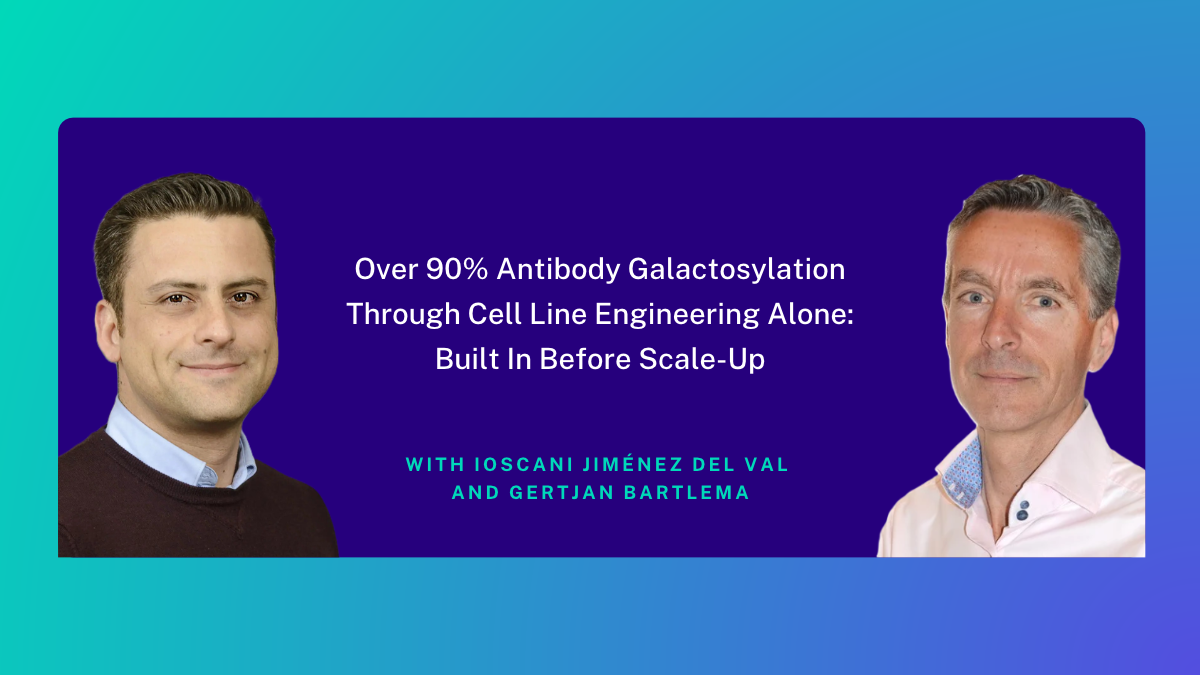
Turning a promising piece of academic research into a commercially viable biotech venture is a challenging path, layered with both obstacles and opportunities.
That journey was at the heart of the conversation with Dr. Ioscani Jiménez del Val (CSO) and Gertjan Bartlema (CEO) of Glyvantis Bio on the Smart Biotech Scientist Podcast. Together, they explore how academic discoveries can translate into industrial applications—and why getting the commercial and cultural transition right is essential.
Episode Highlights
- Navigating the mindset shift from academia to commercial biotech—including leveraging tech transfer offices and institutional support [02:32]
- Lessons from pairing operational/commercial leadership with scientific founders, and the benefits of cross-disciplinary collaboration [04:21]
- Key challenges in turning top-tier academic technology into a fundable and credible company [06:24]
- The importance and mechanics of building industrial-scale data packages to validate new biotech platforms [07:52]
- Balancing the dual identity of a tools company and a therapeutics developer, and how parallel strategies can work [09:35]
- Practical advice for academics considering entrepreneurship, including the value of humility and moving quickly [11:32]
- Reflections on what could be done differently in the commercialization process [13:44]
- Broader concerns about early-stage science funding in Europe versus the US, and the need to support emerging research [14:33]
- Final takeaways on why people and teams are ultimately the driving force behind technological progress [15:47]
In Their Words
It’s the team, the people, the common passion is key. And then because I feel like I have to from the kind of nerdier side, and again, preaching to the converted, glycosylation is a critical quality attribute starting off. So to circle back, there is therapeutic effect that is being left on the table, I believe. – Ioscani Jiménez del Val
Podcast Transcript
David Brühlmann [00:00:21]:
Every promising technology eventually faces a decision. Either stay in the lab or step out into the world. Welcome back to my conversation with Ioscani Jiménez del Val, who’s the CSO of Glyvantis Bio, and Gertjan Bartlema, its CEO. We continue with the story behind GalixaTM, how an academic idea becomes a venture, how 2 different backgrounds come together, and what other scientists like you can learn from that path.
I’d like to shift gear a bit and move towards the commercial part and the adventure you have embarked on. What were some of the key challenges and opportunities you have seen so far, experienced in spinning out this academic research into a startup company?
Ioscani Jiménez del Val [00:02:30]:
I guess challenges is, I want to say the academic mindset is slightly different, right?
David Brühlmann [00:02:38]:
Slightly.
Ioscani Jiménez del Val [00:02:39]:
We do have different perspectives purely from the academic side. We have a very distinct set of perspectives that are kind of ingrained into us during our postgraduate studies and so on. So I think trying to adapt and bring on board a broader kind of mindset that makes further considerations was one of the key initial challenges. Now I do have to say and give props. So I think University College Dublin, where I’m based, has an exceptional kind of a tech transfer office, NovaUCD. So they provide a lot of training, which at least I vouch for my own experience.
They provided a lot of training to open up that mindset, to connect us with people that have vast experience in industry and in commercialization. And I also have to give a shout out to Enterprise Ireland. So it’s one of the, let’s say, massive supports that we received early on. It’s a government body within Ireland, and they also provide a lot of training and a lot of support and funding as well for these type of aspects.
And again, they catalyze that kind of shift in perspective from academia to both hats, if you may. I guess I’m going from challenges to infrastructure that’s available or opportunities that are available to, I want to say the most, I’ve felt very, very fortunate in meeting the people that I have and started working with that I’ve had learning from them. That’s one of the best things that has come about from this whole process.
David Brühlmann [00:04:07]:
How was it for you, Gertjan? You come from an operational commercial biotech leadership background. Now, quote unquote, going back to academia, or at least halfway, how has this experience been?
Gertjan Bartlema [00:04:20]:
Been on a journey. When I left Celgene with some ex-Celgene colleagues, we formed Populus Bio. So we surround ourselves, we look for really interesting science, then team up with the scientific founders to basically advance the science. And when we got connected to Ioscani, one, we did our diligence on the technology. We were like, this is too good to be true. It’s so simple, and we know it solves a real issue. And in the conversation with Ioscani, there was just a, a click and a positive chemistry. I know enough about the science. I know what I don’t know, but what I look at is when you’re building companies is that the team chemistry working. So you actually achieve more because the team works. And if you really boil it down, in our industry, the good science needs the right people, and then you get the capital.
We have a tremendous amount of traction, so we are very confident that we can close a financing round despite the environment currently being extremely challenging for early-stage science. But that’s not something that we can change. I think it will change over time. But the really exciting thing for us and for me is actually working with scientific founders like Ioscani, where you can have an exchange and we come out better and are both 100% aligned around how do we get the science to the next level with an eventual objective to get it into patients. And that’s just motivating.
One of the reasons I left the companies that I left and it started when I left Amgen, I left because for me it had become too big. After 12 years with Celgene, that was exactly the same reason. The culture changed, it became too big, and it became more internally focused. And actually, our purpose to be working at these companies, actually, how do you move science into the clinic? And if you lose sight of that, then some people are okay with that. My life is too short. Then I move on, find the next piece of science, work with people that I like to work with, and then focus on, let’s just get this thing done and move it to the next level. And that’s just exciting. Every time Ioscani and I talk, I come home with it like, okay, I learned something today.
David Brühlmann [00:06:11]:
What was for you the hardest thing in this process of turning top-notch academic research or technology into a fundable, commercially credible company?
Ioscani Jiménez del Val [00:06:23]:
For me, the most challenging, the shift in perspective, I guess, from the academic side to the more commercial-oriented. The same way that Gertjan mentioned a moment ago, every conversation I have with co-founders and on the business side also, every single conversation, I also feel like I’ve learned something. So the most challenging aspect I think has been kind of that shift in mindsets while maintaining, of course, the nerdy interest and perspective. The shift in kind of having both hats on has been one of the more challenging aspects, I’d say.
David Brühlmann [00:06:56]:
And for you, Gertjan?
Gertjan Bartlema [00:06:57]:
So when I moved the first time into the startup world, realized actually you’re very spoiled when you’re working at larger successful biotech companies. And it goes as simple as travel. It’s done, it’s arranged for you. Now it’s like travel, hmm, let me book my own ticket. It’s an adjustment which would take about 5 minutes, and then it’s refreshing because it’s liberating. And you can work with these scientific founders, just really focus on one thing, and that’s the science. There’s no politics, partly because there’s not enough people around, but partly because you focus on the science. And that is extremely refreshing. It’s not so much a transition, but that realization that a lot of people out there, their sole purpose in life is actually moving science forward in the most efficient way. And that’s sometimes in larger organizations we tend to forget about. That’s the sole purpose why people come into an office.
David Brühlmann [00:07:44]:
What is your vision of this technology? Where do you see your company going to in, let’s say, 3 years from now?
Gertjan Bartlema [00:07:51]:
I can start on, Ioscani. We have the opportunity to— the first step for us is building that data package in an industrial setting. And while we do that, we need to make sure that on the USP of the technology, we built that data package on the effector functions, on the the manufacturing parameters, critical attributes, as well as on the scalability and the replicability. So multiple sites, multiple companies. So that’s the first priority. That’s probably going to take us 12 to 24 months. And then part of that exercise will also be, one, the technology will be used in the industry, and two, we will develop our own biobetter to getting ready in that 3 to 4-year window for a larger financing to accelerate the technology.
And I think one role— maybe role model is too exaggerated, but there is a playbook out there. And you probably know it well, David, at Zurich, the ETH spin-off GlycArt.
It’s still a tremendous technology that addressed one effector function. We believe we can have multiple things that we can address and make these antibodies better. But we need to have the dataset, the experience in the industry while we parallel develop our own pipeline, and then we’ll see what comes out of it. If the funding environment had changed, we get significant amount of funding, we could completely develop our own proprietary pipeline. In the current market, it’s most likely an M&A trajectory. But at the end of the day, we want to make sure that at least one antibody with the technology gets into the clinic so it can help patients.
David Brühlmann [00:09:18]:
How do you manage this stretch between being a tools company, so you develop the technology, and then also becoming a therapeutics company? Isn’t that too wide of a stretch, or would you need to hire different kinds of people to manage that?
Gertjan Bartlema [00:09:35]:
Yes and no. I think the stretch— it’s when we started with Ioscani, we had that discussion. Do you go one way or do you go the other way? But if you really think about what the technology does, and we created a development plan to generate that industrialized dataset, any asset antibody that out of the development plan could become a biobetter. So the gap between the one scenario and the other scenario is actually not that wide, because if you have the end in mind, it’s pretty much happening already as soon as you start generating the dataset in an industrial setting.
So we came to the conclusion, you do it parallel, knowing that actually the earliest, fastest, most economic way of validating technology is in an industrial setting to a feasibility license. But part of that also then is actually keep in mind that it’s not a stretch to develop your own proprietary biobetter pipeline.
Ioscani Jiménez del Val [00:10:23]:
Just to add there. So in parallel, both, yes, but also a little bit of a staged approach as well. As Gertjan voiced it, the easier or more straightforward initial way of validating the datasets and so on, or generating the datasets, validating them, would be through the tools kind of side. But then that doesn’t mean that you close the door for the biotech side of things. And another perhaps aspect that arises from the tools perspective is partnerships that we can consolidate to join biotechs to deliver some of these engineered next-generation molecules. So it’s more of a trajectory rather than an either-or, but then addressing the question that you were asking. So depending on the growth that we would have, of course, we would expand, let’s say our workforce, we’d definitely consider making those hires to expand depending on the rate and the needs of the company as it continues growing.
David Brühlmann [00:11:19]:
What piece of advice would you give, let’s say, a postdoc or perhaps even a professor who has a great technology but is not sure if they should take the leap?
Gertjan Bartlema [00:11:29]:
You go first, Ioscani.
Ioscani Jiménez del Val [00:11:30]:
I’d say from the purely kind of encouragement standpoint, a little bit on the softer side, go for it, take a shot. Worst case scenario, you learn so much, right? And if there’s no commercial argument for the technology, at least you learn that, you gain that information for subsequent work you may do. So take a shot. I think there’s a win-win. You have to put in the work, but there’s no, I can’t see too many caveats of just taking the leap, if you may, beyond a fair bit of work.
And just to add a little bit, one of the key things that I would also give, this is more on the mentoring side, say for postdoc and so on, be humble with what you don’t know. Make sure that you bake that in. Just be humble and honest with what you don’t know. And in my experience, it’s just opened doors to meet people that could teach me what I don’t know or that I can lean on to cover aspects that I don’t know.
Gertjan Bartlema [00:12:22]:
From my perspective, I think it’s specifically for European-based postdocs, academics. Don’t wait too long. When you have an idea, talk to your transfer office, make sure you have IP locked, and go out there. Because I think that’s an area— don’t want to get into politics, but I think there’s a few things we can learn from Americans. They’re just way more entrepreneurial. They don’t sit on science. These tech transfers are just commercial entities. They drive science, and if it fails, then they move on to the next one.
We in Europe tend to be more conservative, and whether that’s cultural or, oh, we need to have another piece of data, once you have the IP, get out there. And if it works, then it works. If it doesn’t, at least you know it early, and then it can just become a scientific project, which is fine. But we wait too long, and there’s so much science sitting there where— and it’s not where it actually could be because of cultural— maybe it’s cultural discipline. And that’s something I think we can learn.
David Brühlmann [00:13:15]:
That’s excellent advice. Don’t wait. Take your risk. Fail early, fail fast. What other question do you suggest I ask?
Ioscani Jiménez del Val [00:13:25]:
Oh no. Well, I try to come up with awkward questions as an academic, just purely with the academic lecturer kind of hat on. But see, if I ask the question, I’m already trying to think of answers and I’m— Perhaps what would you do differently?
David Brühlmann [00:13:38]:
I’m curious. What would it be?
Gertjan Bartlema [00:13:40]:
Right back at you. Exactly.
Ioscani Jiménez del Val [00:13:44]:
That’s why I was hesitating slightly. And this is going into the weeds without providing a ridiculous amount of details, but some of the planning, for example. So we received a commercialization fund from Enterprise Ireland. So knowing what I know now, there’s dimensions to the research that was proposed there that we undertook with 2 industrial partners that I would maybe not change, but I would tweak geared towards, let’s say, getting closer in the academic setting to the datasets that we’re planning on building now that the company is incorporated. Some tweaks there, but then again, I really want to emphasize this. I think I’ve been very, very fortunate with the people that I’ve met, co-founders. There’s nothing about that that I would change. I think those minor tweaks are the only thing that I think of right now.
Gertjan Bartlema [00:14:32]:
Today, other questions to ask. I think one of the questions we live daily is how do we make sure that early-stage science gets funded? Because everyone, as in everyone from corporate venture firms, BD teams in biotech, pharma, even VCs, everyone has become so risk-averse that the early-stage science is going to suffer. And by the time we realize that, you cannot catch up. And historically, I think our industry is highly dependent on big grants coming out of the US. That’s changing.
We have a lot of VCs in Europe, and there is money around, but it goes to later stage because of that risk profile. And I would almost say, like, if there’s one question I would be interested to know the answer to, and how do we make sure as a society that early-stage science continues to get funded? Because the future of the problems we have today is only going to be solved if you keep funding the science. It’s not rocket science, but we seem to forget that as an ecosystem.
David Brühlmann [00:15:28]:
Excellent point. Definitely, we need the funds, otherwise we are not going anywhere.
Gertjan Bartlema [00:15:32]:
Yeah, and I think the grants, I mean, there’s a lot of, especially the Irish government, a stunning amount of the number of programs they have, but grants only get you so far.
David Brühlmann [00:15:40]:
This has been great. What is the most important takeaway from our conversation?
Gertjan Bartlema [00:15:47]:
I can start, Ioscani. There’s probably a common theme that you’ve heard from both Ioscani and myself, like, it’s the people make a difference. If you have the right group of people, and that’s different for everyone, but part of the skill set, the chemistry, you can do a lot even with limited resources because they all aligned about the common objective. That is, get the technology into patients. Then everything else becomes very simple, and you can align and get a lot of work done. I’m a big believer that you can have great science. If you put average people around it, it might not make it. If you have average science, you put great people around it, it will make it.
Ioscani Jiménez del Val [00:16:22]:
Just to echo what Gertjan mentioned there, it’s the team, the people, the common passion is key. And then because I feel like I have to from the kind of nerdier side, and again, preaching to the converted, glycosylation is a critical quality attribute starting off. So to circle back, there is therapeutic effect that is being left on the table, I believe. And there’s tools available, including our own, that could do it. And then also for postdocs, for early-career academics, or for even more seasoned academics, take the plunge because it only helps you learn more. So those are the 3. I asked for one, but I gave you 3. So, oh well.
David Brühlmann [00:17:03]:
That’s amazing. Where can people get ahold of you and learn more about your technology?
Gertjan Bartlema [00:17:08]:
I mean, they can send us the email, but we also have a website. So there’s a contact form on there, glyvantisbio.com. Or our LinkedIn profiles.
Ioscani Jiménez del Val [00:17:16]:
And from the academic side, I still have my Animal Cell Technology Group at UCD. So either Glyvantis or University College Dublin, feel free to reach out.
David Brühlmann [00:17:26]:
We’ll leave the links in the show notes. So smart biotech scientists, feel free to reach out to Ioscani and Gertjan. And Ioscani and Gertjan, it was a huge pleasure talking about glycosylation, about spinning out your company. I wish you all the best, and it has been a huge pleasure having you on the show today.
Gertjan Bartlema [00:17:45]:
Great. Thank you, David.
Ioscani Jiménez del Val [00:17:46]:
Thanks so much, David. It was a pleasure to chat with you.
David Brühlmann [00:17:48]:
A strong technology is only the beginning. Turning it into something that eventually benefits patients also takes people, timing, and a willingness to learn outside of your own discipline. If this episode resonated with you, please leave a review on Apple Podcasts or your favorite platform. Your support helps more biotech scientists discover the show. Thank you for tuning in today. Until next one, keep building smart.
Disclaimer: This transcript was generated with the assistance of artificial intelligence. While efforts have been made to ensure accuracy, it may contain errors, omissions, or misinterpretations. The text has been lightly edited and optimized for readability and flow. Please do not rely on it as a verbatim record.
Next Step
If you found value in today’s episode, take a moment to like, follow, and leave a review on Apple Podcasts or your favorite platform—it helps us reach and support more scientists like you.
Thanks for tuning in to the Smart Biotech Scientist podcast and being part of this journey toward bioprocess mastery. For more insights and practical tips, visit
About Ioscani Jiménez del Val and Gertjan Bartlema
Ioscani Jiménez del Val is a scientist, academic, and biotech entrepreneur. As Associate Professor at University College Dublin and Scientific Co-Founder of Glyvantis Bio, he focuses on advancing pharmaceutical bioprocessing through computational modelling and synthetic biology. He also leads the Animal Cell Technology Group at UCD, working on innovative approaches to improve upstream bioprocesses.
Gertjan Bartlema is a biotech leader with more than two decades of international experience across the biotechnology and healthcare sectors. He previously served as CEO of VICO Therapeutics, where he worked in the development of RNA-modulating therapies for rare CNS diseases. His experience spans business leadership, building new organisational capabilities, healthcare data and real-world evidence, and commercial strategy.
Connect with Ioscani Jiménez del Val and Gertjan Bartlema.
Further Listening
If this conversation got you thinking about your own glycosylation strategy, here are a few episodes to listen to next:
Episodes 227 - 228: Media-Based Glycan Engineering for Biosimilars
Episodes 69 - 70: Glycoanalytics Explained: Analysing and Designing Better Biopharmaceutical Drugs with Róisín O’Flaherty
Episodes 43 - 44: Mastering the Art and Science of Glycan Engineering in Drug Development with Henning von Horsten
Episodes 17 - 18: How Extracting Gold From Your Data Accelerates Process Development with Ioscani Jiménez del Val
Want to Join?
Are you a CMC or biomanufacturing leader with hard-won lessons on process development, scale-up, or CDMO management? We’re always looking for practitioners with real execution stories to share on Smart Biotech Scientist.
Apply to be a guest or recommend someone:
David Brühlmann is a strategic advisor who helps C-level biotech leaders reduce development and manufacturing costs to make life-saving therapies accessible to more patients worldwide.
Hear It From The Horse’s Mouth
Want to listen to the full interview? Go to Smart Biotech Scientist Podcast.
Want to hear more? Do visit the podcast page and check out other episodes.
Do you wish to simplify your biologics drug development project? Contact Us