
For decades, manufacturing cell therapies has been a tangled web of complexity, cost, and constraint. Early-stage T-flask cultures balloon into bioreactors, simple transfers turn into sterile headaches, and the dream of affordable, global cellular medicines feels perpetually just out of reach. But what if modular automation and a paper pull tab—yes, that old biotech workhorse—could finally tip the balance?
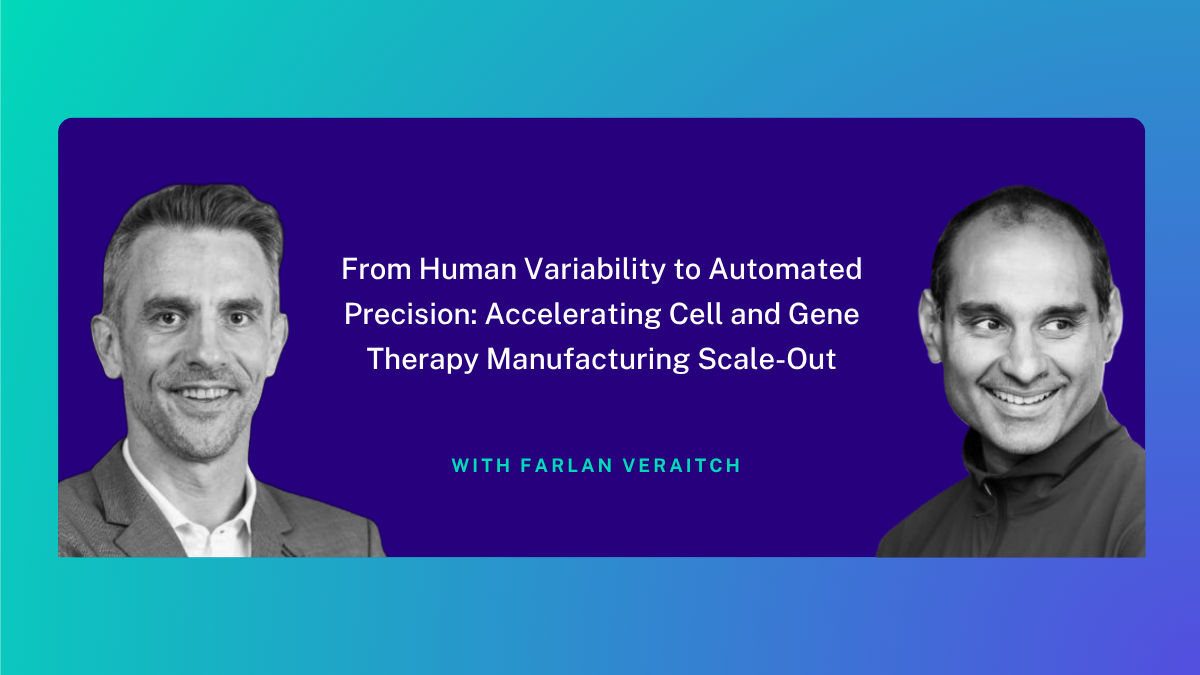
David Brühlmann welcomes Farlan Veraitch, founder and Chief Scientific Officer at Ori Biotech. Farlan Veraitch has spent years challenging industry dogma: from pioneering flexible bioreactor designs that cater to both early research and clinical-scale runs, to reimagining sterile connections and digitizing the entire cell therapy workflow.
Episode Highlights
- The use and adaptation of the paper pull tab sterile connection system—miniaturized and multiplexed—to ensure reliable material transfer in the manufacturing process [06:36]
- How modular and stackable system design supports scale-up and scale-out, increasing manufacturing capacity and flexibility [09:17]
- Full digitization of the Ori platform, including setting up digital twins, integrating sample prep automation, and capturing data for QA/QC in real time [10:11]
- Deskilling bioprocess operations, reducing the need for highly trained cell culture staff, and enabling broader use in both centralized facilities and hospitals [14:02]
- The logistical benefits of separating material prep (like buffer and virus formulation) from the manufacturing site to streamline point-of-care applications [15:39]
- Farlan’s vision for an accessible, profitable, globally distributed manufacturing platform to support new treatment pipelines [17:14]
- Driving down cost and improving scalability as key challenges to unlocking the potential of cell and gene therapies [18:49]
In Their Words
Instead of designing and implementing a new sterile connection system, what I did was go back to biotech and ask, what is the number one most reliable way of making sterile connections in biotech? And if you haven’t seen it, it’s the paper pull‑tab system, where you have two folds of paper, one on either side of what you’re trying to connect. You bring the two pieces of paper together, the dirty surfaces connect there, and then you pull the dirty surfaces away. You can start passing fluid here in a sterile manner, and that’s been used by biotech for decades now.
Podcast Transcript
David Brühlmann [00:00:37]:
Welcome back to our conversation with Farlan Veraitch, founder and Chief Scientific Officer of Ori Biotech. In part one, he revealed why cells are so unforgiving during manufacturing and how simply opening an incubator creates a perfect storm of destructive forces. But recognizing the problem is just the beginning. Today, we will explore his solution: IRO®, a modular automation platform that maintains the hermetically sealed control the cells need while remaining flexible enough to support multiple clinical programs.
From R&D through commercial manufacturing, from centralized facilities to hospital environments, we are discussing how technology can finally democratize access to life‑saving cell therapies.
Let’s look at the IRO® model first, and if you can give us a sneak peek into how that works. You’ve done quite some work on CAR‑T. When you start developing early on, you have smaller volumes, and then as you move into process development, the volumes may increase—also depending, obviously, on the manufacturing setting and demand.
How does that practically work? How can you use that model across different volume scales? And how do you practically, for instance, transfer liquids in a sterile manner? How does automation come on top of that?
Farlan Veraitch [00:03:18]:
We had to get very creative with IRO®. If you think about the challenges you’ve just set out there, you can understand why people build rooms and the kind of automation we’re seeing come to the fore at the moment. Getting that functionality into a module is not simple.
Let’s think about it: you’ve got to do something that works as a T-flask, but also works as a wave bioreactor or a stirred-tank bioreactor. The cells we’re dealing with—it’s not just a case of static versus suspension. You might want to focus the cells to enhance cell-to-cell contact, or have them somewhere in between, fully suspended.
The kind of flexibility you need with mixing at all different volumes, from a 30 mL culture all the way to a liter, was a big challenge. I am very, very lucky—when I was at the University of Birmingham, I made good friends with a true pioneer of stirred-tank bioreactor mixing in wave bags, a guy called Professor Alvin Nino. I took him some early designs—maybe a bioreactor that might work—and discussed them with him. He helped me design a bellows-based bioreactor that could do it all.
We could, on one hand, do a classic T-flask culture, running conditions that focus cells and tightly control cell-to-cell contact. But we also designed it to run like a stirred-tank bioreactor in a tightly controlled environment—all in a single container.
So we really had to innovate. Now, we have a system that is bellows-based, so it can go static, it can go rocked—it’s not just a wave bioreactor. It’s fully suspended, but it also has a circular base, which allows you to rock it in a way that focuses cells in the center. You can play some very subtle “games,” particularly when recovering very delicate cells. Many scientists know that cell-to-cell contact is priceless when trying to recover cells.
As you compress the bellows and move toward a stirred-tank type situation, it doesn’t have an impeller spinning—it has a plunger-type mechanism, which is very low shear, so very gentle on primary cells. We have a single container where you can optimize activation, optimize transduction, and optimize expansion of cells separately. It’s an incredibly powerful system.
The biological results we see: I haven’t yet seen a process where we haven’t been able to radically improve, for example, transduction efficiency, speed to dose, or cell yield. It’s a real game changer in our ability to build manufacturing processes that are cheaper and faster, which is exactly what we’re after.
David Brühlmann [00:06:20]:
And how will you now connect this module to the new module you’re developing for upstream and downstream processes? Also, we need to think about how to do sampling and the whole QC workflow on top of that—how does that work?
Farlan Veraitch [00:06:36]:
So the bioreactor is just part of the system. The fundamentals of Ori Biotech from a manufacturing infrastructure perspective really have to do with how you get material in and out of your manufacturing process—and how you do that without requiring highly skilled operators. Nothing off the shelf could do this, so I had to build a solution.
I relied on one principle from all my biotech experience: never develop a completely new sterile connect system. People might think, “Why not?”—after all, sterile connects have a long history, are FDA-approved in many processes, and are well understood.
Instead, I went back to the basics: what’s the most reliable way to do sterile connections in biotech? That’s the paper pull-tab system. If you haven’t seen it, it works like this: you have two folds of paper—one on each side of the connection. The “dirty” surfaces touch each other, then you pull them away. After that, you can pass fluid in a sterile manner. This system has been used in biotech for decades.
I miniaturized the paper pull-tab and multiplexed it. In the IRO® bioreactor, you now have a ring of miniaturized pull-tabs. The instrument brings the tabs together, connects, pulls them out, and allows sterile fluid transfer in or out of the manufacturing process.
We also had to innovate further. We developed a septum-based system to detach empty consumables or samples from the system. That’s critically important. If you look at systems like Progeny, there are lots of tubes and bags everywhere.
Controlling the temperature of all feeds is a big challenge, makes the system large, and prevents stacking. Our sterile connect system allows you to add material, remove containers, and keep the system neat. You avoid accumulation of plasticware and don’t need pre-attached sample bags. This enables a front-facing, stackable module.
David Brühlmann [00:09:06]:
And that’s how you do so-called scale-up, or perhaps better said, scale-out—multiplying either volume or running different processes in parallel.
Farlan Veraitch [00:09:17]:
Exactly. It’s tremendously important. It radically increases the number of CGT processes you can run in a given square foot of manufacturing facility. Think back to biologics: before titer increases, they didn’t need to build new facilities. That accelerated how quickly they could get medicines to patients. Building new facilities takes a long time and costs a lot of money.
David Brühlmann [00:09:44]:
Yes, that’s extremely time-consuming and expensive. I’m curious now, Farlan, as you develop this system further: I’d love to hear your vision for full digitization of the platform. Is there potential for real-time control, quality by design, processes linked with machine learning, AI, or hybrid modeling? What’s your vision there?
Farlan Veraitch [00:10:11]:
The vision is very big on digital, and you touched on some things around process control. Let’s start there. One of the most important things we’ve done with this new bioreactor is really start to fully understand the environment inside it. This allows us to make strong correlations between the engineering environment—shear, fluid mixing, gas transfer—and biological outcomes. That’s a fundamental principle of biochemical engineering: can you minimize the number of experiments needed and quickly reach an operating window that is robust?
It’s tremendously important that Ori builds the kind of digital twins that people will want for their manufacturing processes. That lies at the heart of modern process development.
Then there’s the infrastructure challenge of manufacturing these therapies. Today, the fact that these processes haven’t been digitized creates a huge problem for QA/QC and batch records. Multiple lever-arch files of paperwork impact scalability and cost of goods.
So just designing a new bioreactor and a fancy sterile connector isn’t enough. Ori ensures everything is done within the system, whether local, networked, or cloud-enabled. Every addition, removal, and sensor reading in the bioreactor is digitally captured, and every assay from the manufacturing run—through QA/QC—is logged.
We’re working with best-in-class providers of cell counters, sterility equipment, PCR, and flow cytometry. There’s been a quiet revolution in sample prep, with brilliant new cassettes that prepare cells for PCR, cell counters, or flow cytometers. Ori is embedding these cassettes into our sampling consumables, so material flows directly from the manufacturing process through the sterile connect into the sample prep cassette.
This enables either a robot or an operator to remove the consumable from manufacturing and load it straight into analytics equipment. All results are uploaded to the local network or cloud, giving a digital record of the entire process. Every step has been deskilled and made automatable—even with simple robotic grippers if high throughput is required.
David Brühlmann [00:13:28]:
Yeah, let’s look at the descaling. In this final part of our conversation I would like to zoom out again Your vision at Ori is to make cell and gene therapies more accessible, more affordable, because that’s finally the ultimate challenge we are solving with this technology. And one particular challenge, as you mentioned, is the cost of goods, but it’s also the way we manufacture and find ways to do that closer to the patients. So tell us about how descaling and this modular approach can solve exactly that.
Farlan Veraitch [00:14:02]:
Our system is designed so that modules can be multiplexed for large-scale centralized manufacturing. You go from a single IRO® to maybe a row of 100 IRO® and maybe three or four modules and three or four IRO® , all can which can be operated by humans—but you don’t need highly skilled cell culture experts. Literally, move the consumable from the fridge into the manufacturing module.
It’s also designed for robotic operation in large facilities. The modular design and the inclusion of that Star connect technology also means that you can start and the deskilling of how you get material in and out. Actually means that you could start using this technology in a hospital type environment and not in a high grade cleanroom environment as well. The fact that everything’s digitized means that, say you’ve got three or four of these modules sitting in a hospital, you can start sending a text message to a nurse which says, „load virus into module two now”. Okay, she can go take the virus from the freezer, move it into module three, completely deskilled, everything digitally captured, and you start to have an infrastructure that can be used much closer to the patient in the manufacturing process.
David Brühlmann [00:15:25]:
What remaining gaps do you see for point-of-care manufacturing, or innovations in the industry over the next few years?
Farlan Veraitch [00:15:39]:
From our point of view, one of the coolest things that you can do with the technology is start eliminating your preparation of material from the manufacturer, start separating where you prepare material like your buffers and your virus from where you do the manufacturing process.
The greatest example is one of our partners at the moment, they have their virus manufacturing in house and what they’re doing is at the end of the virus manufacturing process, they’re filling our consumable with the sterile connect attached. They can then freeze that at minus 80, ship it at minus 80, and then at the hospital the virus is ready to be added directly to the manufacturing process.
If you think about it having all of that ability to thaw the virus, to formulate it in the right bag tube, welded onto a system at the hospital. That’s just something a healthcare professional is not going to be able to do that work. And the facilities needed to do that work are extensive and the training needed to do that work is also extensive. So it’s all about streamlining the flows of material into and out of these manufacturing processes and de-skilling at every corner and having everything totally digitized. I think that lies at the heart of it. That is the manufacturing infrastructure that we need in order to seamlessly move from process development to either multiplexed, centralized or distributed manufacturing or possibly in the future, point of care.
David Brühlmann [00:17:07]:
Before we wrap up, what burning question haven’t I asked that you’re eager to share with the biotech community?
Farlan Veraitch [00:17:14]:
I don’t think it’s a question—it’s something that drives the whole company here at Ori Biotech. It’s related to what happened with monoclonals. The dream for Ori is to build a manufacturing platform that joins the missing dots in the broken business model of cell and gene therapy.
Even today, after all of the clinical success and FDA-approved medicines, we still do not have the huge cell and gene therapy pipelines that the promise of this field deserves. Until manufacturers can distribute their medicines globally and make a profit, they won’t be able to reinvest in new therapies.
I truly believe that cell and gene therapy has proven it is a new modality that will radically change how we treat most diseases. It will impact lifespan and the treatment of many conditions. But until there’s a fit-for-purpose manufacturing platform, the field will be constrained in its growth. I cannot wait for the moment our platform drives the first Amgen or Genentech equivalent in cell and gene therapy. That really is the dream, and we’re tantalizingly close.
David Brühlmann [00:18:36]:
This is exciting—a real vision of the future. Let’s hope it materializes and beyond that. Farlan, what is the most important takeaway from our conversation?
Farlan Veraitch [00:18:49]:
This field needs to drive down cost of goods and scale up manufacturing. Those are the two things we need to do, and we need to be laser-focused on them.
David Brühlmann [00:19:00]:
Thanks so much, Farlan, for sharing your vision, experience, story, and for leading the way in cell and gene therapy. Where can people get a hold of you?
Farlan Veraitch [00:19:13]:
I’m always on LinkedIn, so you can send me a message there. My email is farlan.veraitch@oribiotech.com. I love Teams and this video conferencing world—it’s allowed me to build relationships globally very quickly. Our technology is now being used in China for CAR-T manufacturing. Digital networking platforms let me build amazing relationships with scientists worldwide, so I’m always keen to jump on Teams or another platform to chat and explore collaboration opportunities.
David Brühlmann [00:19:58]:
Smart Biotech Scientists, please use this invitation—reach out to Farlan, links are in the show notes. Once again, Farlan, thank you for sharing your passion and being on the show today.
Farlan Veraitch [00:20:12]:
Thank you very much, David. It’s been a pleasure.
David Brühlmann [00:20:15]:
From understanding primary cell sensitivities to building automation systems that protect them throughout manufacturing, Farlan Veraitch and his team at Ori Biotech are pioneering a path toward accessible cell therapies. The vision of point of care manufacturing isn’t just about convenience. Instead, it’s about ensuring these transformative treatments reach every patient who needs them.
Disclaimer: This transcript was generated with the assistance of artificial intelligence. While efforts have been made to ensure accuracy, it may contain errors, omissions, or misinterpretations. The text has been lightly edited and optimized for readability and flow. Please do not rely on it as a verbatim record.
Next Step
If you found value in today’s episode, take a moment to like, follow, and leave a review on Apple Podcasts or your favorite platform—it helps us reach and support more scientists like you.
Thanks for tuning in to the Smart Biotech Scientist podcast and being part of this journey toward bioprocess mastery. For more insights and practical tips, visit
About Farlan Veraitch
As Founder and Chief Scientific Officer of Ori Biotech, Farlan Veraitch combines deep scientific expertise with extensive experience in cell and gene therapy manufacturing. An internationally recognized authority in the field, he previously spent over ten years at University College London, where he led pioneering academic research in CGT manufacturing.
Connect with Farlan Veraitch on LinkedIn.
Further Listening
If you enjoyed this episode you might also like listening to:
Episodes 249 - 250: How T Cell Activation Redefines TIL and CAR-T Manufacturing (Boosting Success Rates to 95%) with Chantale Bernatchez
Episodes 233 - 234: Why Most Bioprocess Automation Projects Fail Before the Robot Is Even Ordered with Anthony Catacchio
Episodes 211 - 212: When the Innovator Becomes the Patient: Manufacturing Reality vs. Patient Urgency with Jesús Zurdo
Episodes 193 - 194: Viral Vector CDMO Mastery: Singapore's Answer to Cell and Gene Therapy Supply Shortages with Lucas Chan
Want to Join?
Are you a CMC or biomanufacturing leader with hard-won lessons on process development, scale-up, or CDMO management? We’re always looking for practitioners with real execution stories to share on Smart Biotech Scientist.
Apply to be a guest or recommend someone:
David Brühlmann is a strategic advisor who helps C-level biotech leaders reduce development and manufacturing costs to make life-saving therapies accessible to more patients worldwide.
Hear It From The Horse’s Mouth
Want to listen to the full interview? Go to Smart Biotech Scientist Podcast.
Want to hear more? Do visit the podcast page and check out other episodes.
Do you wish to simplify your biologics drug development project? Contact Us