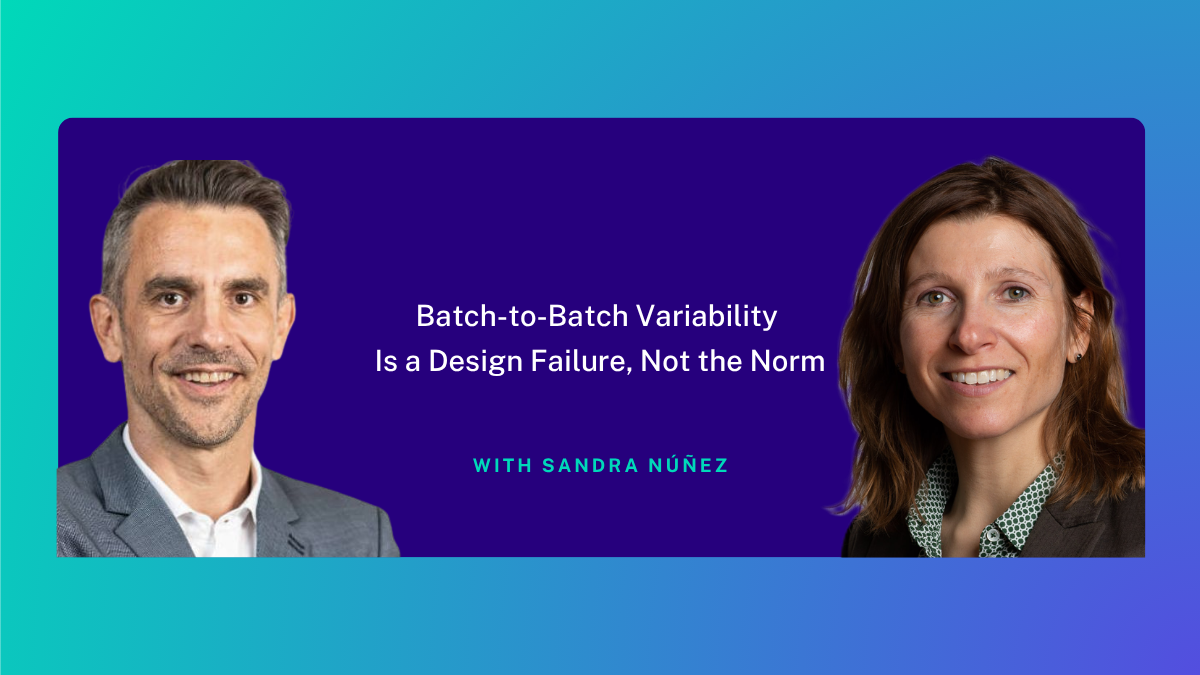
For decades, scientists have tolerated the headaches of animal-derived matrices—unpredictable performance, endless lot pre-testing, and workarounds that cost time and money. The result: reproducibility woes that slow down progress and undermine confidence in critical research. But an engineered, animal-free matrix might change all that.
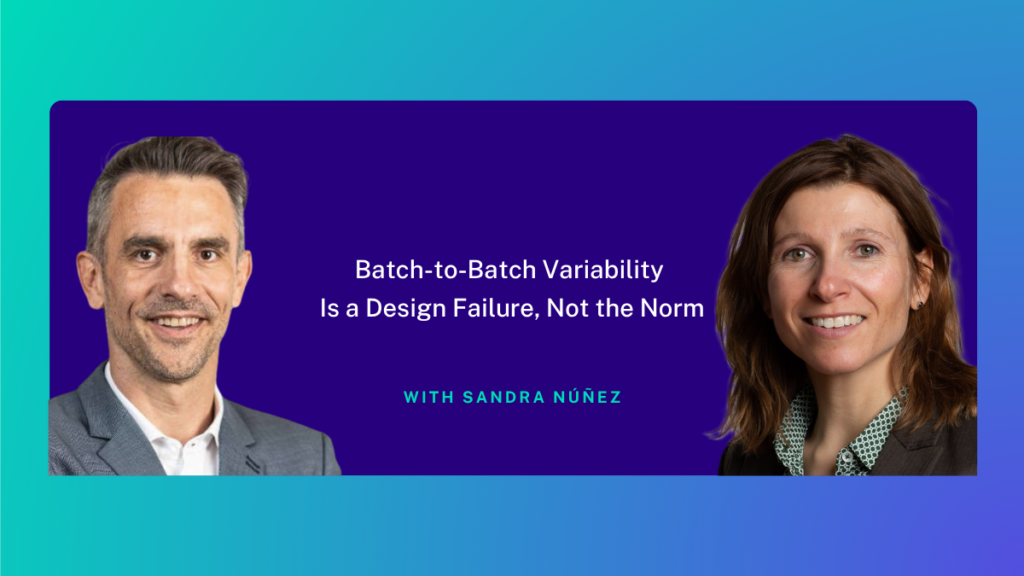
This episode, David Brühlmann sits down with Sandra Núñez, CEO of Amela Biosciences. With 15 years of experience across every corner of the biotech sector—from drug substance and product development to program management at giants like Lonza and Biogen—Sandra Núñez brings unique insight to solving reproducibility challenges. Her company’s bioink platform, spun out of protein design research at ETH, is already helping researchers achieve consistent results and unlock complex tissue models.
Episode Highlights
- The widespread issue of batch-to-batch variability and why Sandra argues it’s a design failure, not the norm [02:49]
- The mechanics and biological tunability of Amela’s engineered protein matrices, and how this technology works [06:34]
- How Amela’s recombinant protein bioinks differ from traditional animal-sourced extracts, enabling reproducibility [08:53]
- Manufacturing insights: why the proteins are relatively straightforward to produce for research use [12:05]
- Engaging with users to optimize and customize protein matrices for diverse tissue and assay applications [13:33]
- The creation and use of protein libraries for specific user requirements and the flexibility this provides [16:20]
- Definitions and roles of ‘bioinks’ in tissue modeling and 3D cell culture [16:52]
In Their Words
If you use animal-derived raw materials, then you make your process or your work kind of dependent on animal-derived supply chains. Certain workarounds you need to establish, like pre-testing of lots. I, for instance, experienced a company that was running a full pilot process next to the GMP production just to really pre-test animal-derived components that were introduced into the GMP process. And the same issues happen as well for people who want to create tissues, who want to create organ models.
Podcast Transcript
David Brühlmann [00:00:37]:
You may know this frustration. A new lot of Matrigel arrives and suddenly your assay behaves differently. Sandra Núñez, CEO of Amela Biosciences, set out to fix exactly that. Her company engineers reproducible, animal-free protein matrices, so-called bioinks, that let researchers tune mechanics and biology independently, batch after batch. Sandra brings 15 years of drug substance and drug product experience from Lonza, Medinova, Baxalta, and Biogen to this challenge. Let’s get into it.
Welcome, Sandra. It’s good to have you on today.
Sandra Núñez [00:02:34]:
Hi, David. Thank you for having me on your podcast.
David Brühlmann [00:02:40]:
It’s a huge pleasure. To start this out, share something that you believe about bioprocess development that most people disagree with.
Sandra Núñez [00:02:49]:
I think batch-to-batch variability is accepted by many people as normal. I think the bioprocessing community would say that it is rather a design failure than something you would accept.
David Brühlmann [00:03:05]:
I’m excited to further dive into this batch-to-batch variability. Before we do that, draw us into your story because you have an interesting story, and tell us: What was the initial spark to science and biotech, and what were some interesting pit stops along the way leading to your current role?
Sandra Núñez [00:03:27]:
I started off as a medical assistant, an apprenticeship here in Switzerland, and my path moved through biomedical analyst into biotechnology, later on into program management for biotech. And now I am CEO of Amela, and I think the common point is really the science behind, on one hand, but then also being able to solve riddles for a certain purpose. So either it’s for human, animal, or environmental welfare. And I think that’s what drew me into biotech because the field is so vast. You have so many areas you can look into and whereby a technology can be useful for these purposes. So that’s what led me also to Amela Biosciences.
David Brühlmann [00:04:17]:
Yeah, that’s exciting. I’d be curious, what were some key learnings you were able to learn or realize along these very diverse roles?
Sandra Núñez [00:04:25]:
I think I’ve always been taking parts of the different roles that I had. Like, if you think back at medical assistant, so now I’m in a position to kind of understand medical background, like for our current customers, if they want to build a tissue model, I know how it looks like. I had histology training, so I can really imagine what shapes the cells need to have, what kind of scaffold they need to grow on. And all these little experiences along the road, they give me some— a huge backpack I can leverage and also use to interact with the different players in my environment.
David Brühlmann [00:05:08]:
What convinced you that reproducibility in vitro biology was a problem worth solving and, more importantly, building a company around?
Sandra Núñez [00:05:18]:
So there are two aspects to that. First of all, and that’s also valid for bioprocessing, so if you use animal-derived raw materials, then you make your process or your work kind of dependent on animal-derived supply chains. Certain workarounds you need to establish, like pre-testing of lots. I, for instance, experienced a company that was running a full pilot process next to the GMP production just to really pre-test animal-derived components that were introduced into the GMP process.
And the same issues happen as well for people who want to create tissues, who want to create organ models. They experience batch-to-batch variability. They are not able to reproduce results because of that. They are not able to continue their work. And while the transition happened in bioprocessing, it didn’t happen for these kind of materials. And with the technology that has been developed at ETH, we are now in a position to also enable that transition as part of the tissue engineering field, which is nice, exciting.
David Brühlmann [00:06:31]:
Yeah, tell us more about this technology.
Sandra Núñez [00:06:34]:
So we are combining biotechnology processing with a protein design platform that has been developed at ETH. It’s a protein that controls two features. One building block that basically defines how rigid, how stiff the architecture is going to be where the cells are growing on. And the other element basically displays with climbing holdings where the cells can attach themselves and also grow into the tissues, into the form they are typically supposed to do that also in our bodies. And the nice thing about this platform is that we can individually tune those aspects. And we translate that into a protein that self-assembles and builds a 3D structure for the cells to grow in it.
David Brühlmann [00:07:30]:
And these are cells that usually grow in an adherent fashion, correct? Or what are the applications?
Sandra Núñez [00:07:36]:
Any kind of tissue, really. So you could think of brain tissue, of skin, muscle tissue. Those proteins would basically display the necessary features, but then also the necessary stiffness that guides and also controls the cell behavior in a tissue. So it really mimics what happens in our body.
David Brühlmann [00:08:00]:
And how does this control work? How can you tune the mechanics and, I’d say, the biology of your matrix?
Sandra Núñez [00:08:07]:
It happens the same in our extracellular matrix. So there are protein components and independent of the amount of those components, you get a stiffer environment, whereas the other part is basically also amino acid sequences that are very specific for certain cell types that they like to attach to. So it’s really a structural protein. And we just, or ETH in that case, developed some sort of—it’s like a serving tablet, basically, displaying the necessary amino acid sequences for the cells to attach to it.
David Brühlmann [00:08:46]:
Coming back to the initial question about the variability, so how does your system solve that?
Sandra Núñez [00:08:52]:
The proteins are manufactured biotechnologically, so the sequence of that protein is DNA-coded. And if you compare with available materials like that currently on the market, these are extracts. So they are extracts from mice or from slaughter waste. So what you get right now is really a solution that has so many components in it, whereas our product is just one single molecule that builds into this 3D matrix. It’s very defined. You have no other components that disturb perhaps the cell attachment. And it’s also very specific because we can tune that to the needs of specific cell types. And that’s how the reproducibility comes, because the user will always get a solution that has the same composition, the same protein amount, the same formulation at all times and everywhere.
David Brühlmann [00:09:51]:
So it’s basically comparable to a recombinant drug, where you have the same molecule, it’s produced recombinantly, and by that you reduce significantly your batch-to-batch variability. So in your case, is it also produced recombinantly?
Sandra Núñez [00:10:08]:
No, it’s a good comparison. It’s really like a drug product, but in that case for in vitro and research use.
David Brühlmann [00:10:16]:
You get this protein, which is produced recombinantly instead of sourcing these materials from animals, where you have a huge batch-to-batch variability. Perhaps they come from even changes with the diet from the animal or whatever. So pretty much day and night, I guess.
Sandra Núñez [00:10:33]:
Exactly. Right now, if we talk to users, some of them have those workarounds implemented. So they either order a number of different lots just to ensure they have at least a few batches that work out and to not jeopardize their experimental chain throughout a full project. Others really do that pre-testing. So they get samples from the suppliers that they check out with their cells, which is a huge effort because you basically do a feasibility test with your cells. There are people involved, and you need to test different batches. And then others just try multiple times around just to find the conditions because the components are just really varying inside.
There are also good things. They are rich in growth factors, for instance. There may be other supportive components there, but this is nothing you couldn’t cover through defined media, which you need anyway. So we keep it simple as to what is really needed in terms of the structure, and that’s the big difference.
David Brühlmann [00:11:37]:
I’m curious about the manufacturing of the protein since we talk a lot about CMC and all the process development issues here in the podcast. How complicated is it to produce this protein? Is this fairly straightforward? Is it very different to other processes out there, or could you actually just work with a template, I’d say, a standard process, and then it was pretty straightforward?
Sandra Núñez [00:12:05]:
Yeah, we are in a lucky position. So the protein itself is not really complicated. There is no refolding required. Glycosylation is not a topic at this point. And because of that, the process is pretty short as well. For research use, there is no complex purification train required. And that’s the beauty of that.
Right now, we are in a research-use-only area. But at some point, we may need to go into GLP or GMP areas. GMP, especially if the scaffold is, for instance, used to create a skin model as an implant, like for decubitus, diabetes, or even burns. In that case, we will need to adapt our quality standards and, for that, of course, also the purity of the product.
But for research use only at this point, we are basically working in ISO environments, and we can keep our process, which is, I would say, rather platform-based, simple, and lean, which is nice.
David Brühlmann [00:13:09]:
Yeah, that makes a lot of things a lot easier.
Sandra Núñez [00:13:11]:
Yes.
David Brühlmann [00:13:14]:
I’d love to talk about the different use cases. Do you have certain use cases in mind, or is that then up to your customers to use your technology to whatever they think is possible? Or what are the limitations of this technology, I’d say?
Sandra Núñez [00:13:32]:
To a big part, it’s really up to the user to choose. I would say right now in academia, for instance, where they use these kind of materials for cell-based assays, also to establish a sort of tissue model to understand biological functions, it’s really up to the user to choose.
And for that, we have, I would say, a rather generic portfolio of bioinks that we have already developed, that they can basically buy off the shelf and then just introduce that into their workflows.
And then there is, like, a next step. There might be use cases like, if I go back to skin, where you may want to introduce vascularization, where you may want to introduce innervation. So, some sort of higher complexity, which is currently very difficult to achieve with the materials that are commercially available because they are also rather too generic.
So you can imagine that a neuronal cell has different requirements than just a skin keratinocyte or a fibroblast that is, I would say, rather simple in its demands. So we can basically achieve or enable our researchers to go into or beyond their limits in terms of complexity.
And then I think right now we have some sort of Swiss Army knife in our hands. So I would say the sky is perhaps the limit at this point. That’s something we also now, as a startup, need to evolve, right?
We are currently approaching beta users who are introducing our products into their systems. We have proof of concept, but now it’s also about gaining experience with the users as part of their workflow. So we are very close in contact with our users to see what works well, what may need to be changed.
And the nice thing is, because it’s biotech, we can very fast adapt. We can do high-throughput screening. We can establish a new library of proteins and basically put that into production and generate very small amounts of protein for the user to test, kind of a minimum viable product.
And that’s another thing that our competitors right now can’t provide. So for the user, it means they start with the right material from the start and have also different options that they can check out in one go. So they have a higher chance to get faster to a result with us and with our products.
David Brühlmann [00:16:07]:
So did I understand this correctly, Sandra, that it’s not only one single protein, you have a library of different proteins and you could easily adapt them to whatever needs your customers have?
Sandra Núñez [00:16:19]:
This is correct. So we work with libraries and smaller, you’d say, amounts that they can test. And here as well, we talk to our customers, we get their user requirements, and our peptide team translates that back into a protein in different combinations that we then establish as a library and can then bring back to our customer as protein variants that they can test in their systems.
David Brühlmann [00:16:47]:
And how is that linked to the bioink? I might have missed that point.
Sandra Núñez [00:16:51]:
Well, bioink is more the generic term for what our protein does. You could say it’s a synonym for the extracellular matrix that is being mimicked with that component. There are also synthetic bioinks or animal-based bioinks. It’s really a general term for the components that are being used for 3D cell culture.
David Brühlmann [00:17:16]:
That’s where we’ll pause the first part of our conversation. Sandra Núñez has already given us a lot to sit with. From why reproducibility became her company’s founding problem to what actually goes into an engineered protein matrix. There’s more ground to cover, so stick around for Part 2.
If this episode has been useful, please leave a review on Apple Podcasts or your favorite platform. Thank you so much for tuning in, and I’ll see you in Part 2.
Disclaimer: This transcript was generated with the assistance of artificial intelligence. While efforts have been made to ensure accuracy, it may contain errors, omissions, or misinterpretations. The text has been lightly edited and optimized for readability and flow. Please do not rely on it as a verbatim record.
Next Step
If you found value in today’s episode, take a moment to like, follow, and leave a review on Apple Podcasts or your favorite platform—it helps us reach and support more scientists like you.
Thanks for tuning in to the Smart Biotech Scientist podcast and being part of this journey toward bioprocess mastery. For more insights and practical tips, visit
About Sandra Núñez
Sandra Núñez is a biotechnology professional and CEO of Amela Biosciences. She has over 15 years of experience in drug substance and drug product manufacturing, having worked across fermentation, formulations, injectables, and final fill at Lonza, Medinova, Baxalta, and Biogen. Since 2025, she has led Amela Biosciences from proof of concept toward pilot production and market entry.
Connect with Sandra Núñez on LinkedIn.
Further Listening
Here are four episodes that pick up the same threads: animal-free matrices, reproducibility by design, and building a biotech without a factory:
Episodes 271 - 272: From Static Scaffolds to Dynamic Matrices: Hydrogels for Animal-Free 3D Cell Culture with Jan Hunik and Matt Baker
Episodes 221 - 222: From 2D Cultures to Advanced 3D Cell Models for Preclinical Research with Catarina Brito
Episodes 275 - 276: From Lab-Scale Molding to GMP: Manufacturing a Collagen Implant for the Clinic with Eva-Maria Balet
Episodes 279 - 280: Why Nanovesicles Outperform Exosomes: Scalable Drug Delivery Beyond Injectable Vaccines with Christopher Locher
Want to Join?
Are you a CMC or biomanufacturing leader with hard-won lessons on process development, scale-up, or CDMO management? We’re always looking for practitioners with real execution stories to share on Smart Biotech Scientist.
Apply to be a guest or recommend someone:
David Brühlmann is a strategic advisor who helps C-level biotech leaders reduce development and manufacturing costs to make life-saving therapies accessible to more patients worldwide.
Hear It From The Horse’s Mouth
Want to listen to the full interview? Go to Smart Biotech Scientist Podcast.
Want to hear more? Do visit the podcast page and check out other episodes.
Do you wish to simplify your biologics drug development project? Contact Us