
Glycosylation, the subtle process of adding sugar chains to proteins, shapes almost every aspect of monoclonal antibody behavior. For most companies, controlling it feels like wrestling a cloud: batch-to-batch shifts, process-induced changes, and a laundry list of variables threaten product quality and consistency. But a revolution may be in the offing, sparked by fresh thinking at the intersection of engineering and biology.
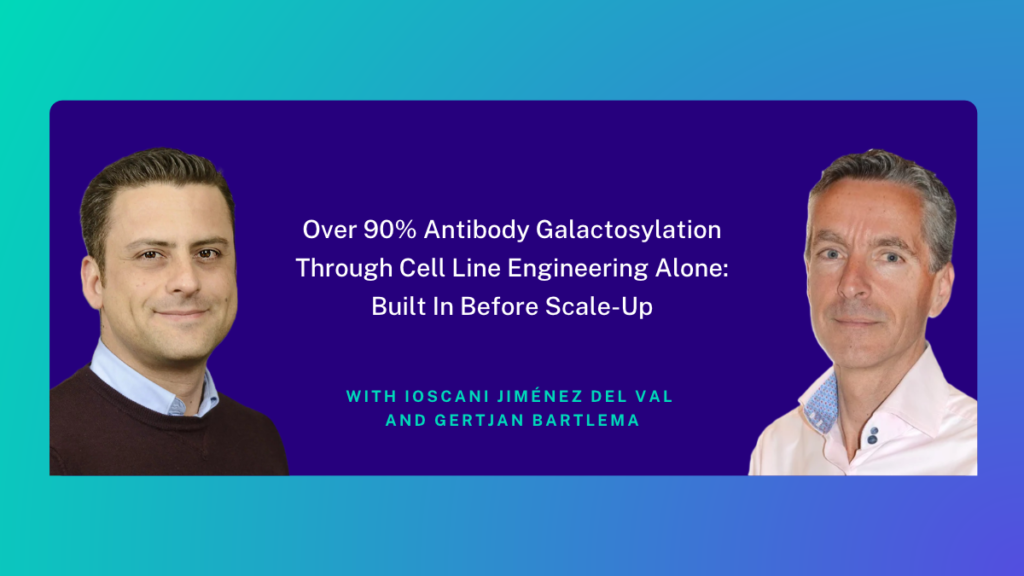
Meet Ioscani Jiménez del Val, Associate Professor at University College Dublin, and his co-founder Gertjan Bartlema. Together, they’ve launched Glyvantis Bio, introducing GalixaTM—a glycoengineering platform promising to finally put developers in control of antibody galactosylation.
Episode Highlights
- Personal journeys into biotech and what sparked long-term passion for the field [04:04]
- The team dynamic and motivation to bring promising scientific advancements out of academia and into real-world application [05:32]
- Why glycosylation is a critical quality attribute and so difficult to control in therapeutic proteins [07:41]
- The commercial perspective on current industry solutions versus a proactive, root-cause approach to glycosylation control [09:49]
- How the GalixaTM technology works, including details on cell line engineering and addressing metabolic and cellular bottlenecks [13:14]
- The role of computational modeling (ChompAct) in identifying and validating engineering targets [15:45]
- The importance of reliable and robust data as a catalyst for industry adoption and next steps in scaling up new bioprocessing technologies [17:39]
- Application of the technology to more complex biologics such as bispecifics and those with highly branched glycans, as well as potential limitations [18:36]
In Their Words
What do they do? How do they work? It clicked immediately. And I think from an industry perspective and an experience perspective, I think you see a lot of antibodies that go to the development and then a problem pops up and it gets solved at that point in time rather than either it should have been solved so it never happens, or you actually solve it at the root. And that’s, I think, where the elegancy of Ioscani’s invention comes in. And we’ve seen from our own experience when we were working in BD that we looked at certain assets, antibodies, and they didn’t make it because the therapeutic window was too narrow, directly related to a glycosylation profile issue. – Gertjan Bartlema
Podcast Transcript
David Brühlmann [00:00:34]:
Imagine an antibody process where galactosylation shifts from one batch to the next. It seems minor, yet it raises hard questions about quality and consistency. Today, I’m joined by Ioscani Jiménez del Val, who’s an associate professor at University College Dublin, and Gertjan Bartlema, a biotech leader with more than 20 years of experience. Together, they co-founded Glyvantis Bio, a spin-out built around GalixaTM a glycoengineering technology designed to deliver more consistent glycan profiles. Welcome, Ioscani and Gertjan. It’s good to have you on today.
Ioscani Jiménez del Val [00:02:33]:
Thanks, David. Thanks for having us.
Gertjan Bartlema [00:02:35]:
Good afternoon, David.
David Brühlmann [00:02:36]:
It’s a pleasure. To start us out, let’s start with this controversial question. Share something that you believe about biologics development that most people disagree with.
Gertjan Bartlema [00:02:48]:
Ioscani, why don’t you go first?
Ioscani Jiménez del Val [00:02:50]:
I think it might be semi-controversial. I think it could be argued that effector function, say for oncology therapies, it may be the case that due to glycosylation, some of that effector function, therefore oncolytic activity, is being left on the table during development.
Gertjan Bartlema [00:03:06]:
I would say that even though there’s a tremendous amount of biologics that really work well and come out well out of the manufacturing kind of channel, that a lot of the problems that surround the development of that antibodies are not solved at actually where the problem starts. So they’re midstream or late, and it’s for different reasons, and we’re very successful as an industry, but it’s not ideally optimized to get the drugs faster to the market and with a better profile.
David Brühlmann [00:03:32]:
Yes, that’s an excellent point. I absolutely agree with that. Let’s start our conversation with your story. And Ioscani and I, we had the pleasure to have a conversation about a couple of years ago. Not everyone listening today has had the chance. So why don’t you start, Ioscani, with your story, and then, Gertjan, you add your story. Tell us how you got started in biotech. What was that spark that initiated your passion, and what were some interesting pit stops along your way?
Ioscani Jiménez del Val [00:04:03]:
I think it started— this is going to go a little bit old or back in the day. So I was blessed with having fantastic biology teachers in high school specifically, but I love the engineering and technical challenges, so that’s why I studied chemical engineering. National Autonomous University of Mexico, and there weren’t too many biotech options in my program. So I went to study abroad for my junior year in university, which I spent at the University of California, Santa Barbara, and I focused entirely on all the biotech modules that I could take. So I’d say that was the first kind of key pit stop.
And then I became even more in love with the field to the extent that I ultimately ended up pursuing a PhD and a subsequent postdoc at Imperial College to explore biotechnology, especially applied to biopharmaceutical manufacturing. And then I set up my group at UCD in 2014, precisely to continue that kind of work and importantly leveraging some of the engineering aspects. So our more kind of classical chemical engineering aspects where we use computational modeling, very chemical and process-derived computational modeling to describe pharmaceutical bioprocesses and use those models to optimize processes as such. So that’s kind of the first moment where I became in love with it was, let’s say, between university and postgrad, for sure.
David Brühlmann [00:05:15]:
Fantastic.
Gertjan Bartlema [00:05:16]:
And for me, it was pure coincidence. So I joined an Erasmus program. I finished my master’s degree in economics at Bern University in Switzerland, and then mainly for personal reasons, stayed in Switzerland and became one of the first interns at the Amgen Europe headquarters based in Lucerne back then. And that’s where I really, like, first aha moment that I realized, like, probably 10 years afterwards, that happened at the coffee bar at that office because we were talking about a patient letter, handwritten letter that was on the whiteboard thanking back then it was Epogen or Neupogen, don’t recall. But she basically thanked that we’re still alive and had a great quality of life.
And then around the coffee bar, you had the lawyers, the IP, the drug developers, the marketing, the finance people, and all like that’s— we contributed to that. So that’s when I realized on the aha moment, it’s you can have great science, but it’s a team sport to actually make science into a product that actually is addressing patient needs. And through my career, I have been very fortunate to work with biotech companies that were extremely innovative, both on the science side, but also on the career development side.
And that started with Amgen. I was from Switzerland, moved to the US, came back, and then was at Celgene. Same thing. And when I left Celgene, I really wanted to go smaller again because that’s, I think, where you can make the biggest impact on that science and surround yourself with the right people, functional experts surrounding the science and the scientific founders like Ioscani, to move the science forward. Because I think there’s a tremendous amount of opportunities, particularly in Europe, on how we can be better, faster, smarter around the technology, bringing it to patients. Science, you need it, but if science stays too long in the scientific environment, it never gets to the clinic.
And at the end of the day, that’s why we do it. You want to impact lives. And that, to me, has always been the motivation, and especially the kind of the patient stories that you hear or you read. That’s what basically gets you out of bed every day, at least for me, working in this industry. And it’s a lot more fun if you work with people that you know well, that know their stuff, to get that science to the next level.
David Brühlmann [00:07:14]:
And speaking of taking your science to the next level, tell us what is the problem you are now attacking? Because, well, first of all, I love the topic because glycosylation is one of my topics dear to my heart. And some of the listeners, they know that I did my PhD in glycosylation. So I’m really excited about that. But tell us, why in particular are you targeting glycosylation? Why does that matter? Tell us more.
Ioscani Jiménez del Val [00:07:41]:
So we’re targeting glycosylation because, to use industry or semi-industry terms, it’s a critical quality attribute of our common therapeutic proteins, right? It’s even more clear when it comes to monoclonal antibodies. Virtually all commercial, or all antibodies in the clinic contain that consensus N-glycosylation site. And it’s widely known that even small variations or subtle variations in the composition of those glycans that are bound to the antibody can lead to important effects on the therapeutic mechanisms and the extent of the therapeutic mechanisms on the molecule, right? So that’s on one front.
And then the other front is it’s also widely reported that glycosylation varies substantially, even with minor changes in process conditions. So both of those in conjunction kind of lead us to, we want to be really careful with glycosylation. I’m preaching to the converted here, David. It’s just an important quality attribute. It’s highly variable. And as an engineer, what we love to do is try and control those critical aspects of a molecule. So that’s in a nutshell, I guess, or trying to tackle issues associated with glycosylation.
Gertjan Bartlema [00:08:49]:
And I think from a more commercial angle, when we first met Ioscani, we always look at the science as one thing, but actually the scientific inventor, who are they? What do they do? How do they work? It clicked immediately. And I think from an industry perspective and an experience perspective, I think you see a lot of antibodies that go to the development and then a problem pops up and it gets solved at that point in time rather than either it should have been solved so it never happens, or you actually solve it at the root. And that’s, I think, where the elegancy of Ioscani’s invention comes in.
And we’ve seen from our own experience when we’re working in BD that we look at certain assets, antibodies, and they didn’t make it because the therapeutic window was too narrow, directly related to a glycosylation profile issue, which means a potential drug never can actually be proven to be valuable for patients because of an issue that’s solvable. As an industry, we’ve done tremendous good, but there’s also an untapped opportunity. And we now know that some of these opportunities we can solve for with a very elegant 2-step process.
David Brühlmann [00:09:49]:
And you mentioned that glycosylation is extremely difficult to control. Why is that?
Ioscani Jiménez del Val [00:09:56]:
As I was mentioning a moment ago, glycosylation is very sensitive to even small changes in how the process is run. So even small excursions in trace metals can lead to large variations in glycosylation. From the development standpoint, variation in glycosylation can be observed when you’re starting to scale up to develop these products. Nutrient limitations, temperature, all of the process conditions have been reported to have some degree of influence on glycosylation. So because it’s so multifactorial, and because the other key aspect about glycosylation is it’s non-template driven, in stark contrast to, say, protein synthesis, it’s just prone to variability.
And then it follows that in such complex processes that are used to manufacture these products, there’s a risk of having that variability, which ultimately can translate into, as Gertjan was mentioning, reductions in, or well, maybe even a drug not reaching patients. But at the same time, if it does reach patients, there might be fluctuations, oscillations. There may be negative impacts on the extent of therapeutic effect that it can reach into patients, right?
David Brühlmann [00:11:01]:
Just dive deeper also a bit in the commercial part, because from a technical part, absolutely, it’s a huge challenge. It’s a very difficult process. Lots of things going on. On the other hand, on the commercial side, I’m wondering, many companies have been doing this for decades now, optimizing post-translational modifications. There’s different ways you can do that. Why do you think is now the time to provide your solution or what is perhaps still the missing link a lot of companies struggle with?
Gertjan Bartlema [00:11:33]:
Basically, from the commercial perspective, it’s almost like there’s 2 angles I look at it. One is the solution is simple. And it’s at the beginning, at the source. So where you go wrong, that’s where you solve it for. The current processes oftentimes solve it at the back end through media. You get the assets in the ranges so you can actually bring it to the next stage. We solve it from the beginning. It’s scalable, it’s transferable. Why now? I think the market is large at the moment. We know that there’s a fair amount of antibodies coming off patent. So all these companies are going to look at the next generation. Even biosimilars. And biosimilar, I think, was a terminology that was pretty much single-handedly invented by Amgen for a very practical reason. It protected their business.
But the biosimilar, I think, in the nature of what the word says, it’s not the same. So it’s not a generic of a biologic. It’s similar. And that’s, I think, where we have a tremendous opportunity. We’re making better antibodies. We narrow the specifications because we solve the problem at the beginning. And not midstream. So the best what people currently can do is come up with a biosimilar that gets you as— it’s a proxy for the originator. We actually make a better antibody, and hopefully we can actually even rescue certain antibodies that we know that had galactosylation problems and failed in clinical development because they didn’t have a therapeutic window.
It’s almost a white space, and that’s what gets us so excited when we look at this technology. And oftentimes the simplicity of it gets overlooked. This is something applicable to anyone who’s developing antibodies, could actually implement it.
David Brühlmann [00:13:05]:
So take us please under the hood. How do you help companies develop better antibodies? How does your technology work?
Ioscani Jiménez del Val [00:13:13]:
Again, alluding to what Gertjan just mentioned, our technology is deployed during cell line development. And we all know here, right? So one thing is you get the cells or companies have the cell line development process, and then arguably a few years down the line is when scale-up starts occurring, and that’s when many of the issues, especially around galactosylation, are encountered in terms of variability and so on and so forth.
As Gertjan was mentioning, we’re targeting that first step, building robustness and resilience into the cell lines against that variability, especially, or purely associated to galactosylation or entirely associated to galactosylation. And under the hood, might go into the weeds here a little bit, but galactosylation requires 2 key components. It requires metabolic precursors, so co-substrates to add galactose onto the glycan chains, which are products of metabolism.
And then on the other front, the cells need the machinery to attach those galactoses onto the mAb-bound glycan. So under the hood, very simply, what we’ve done is we eliminate a form of unnecessary galactosylation. So O, cellular O-linked galactosylation. And with that, we direct the unconsumed UDP-galactose that would’ve been consumed for something that’s not necessary for the product down to product N-linked galactosylation. So the first step is that knocking out, and then the second step is scaling up the cellular machinery that the cells use to galactosylate the mAb. So it’s very, very simple. In doing both of those, we’re alleviating both the metabolic bottlenecks and the cellular machinery bottlenecks that drive galactosylation.
David Brühlmann [00:14:48]:
And how does that work if I have already a cell line? I think it’s a good cell line, and what additional editing steps will you do with an existing cell line?
Ioscani Jiménez del Val [00:14:59]:
So it’s exactly the same ones. So the technology is designed to be deployed as a platform cell line where our customers can pop in their antibody sequence or their glycoprotein sequence. That’s on one front, but then it’s very plug and play. So even if a cell line already exists, we can perform the cell engineering on a cell line that already produces a glycoprotein with the same— It’s a single knockout and a knock-in, and that’s it. And in our hands with the proof of concept studies, we know that that pathway works as intended.
David Brühlmann [00:15:33]:
And if I understand correctly, your technology’s a 2-step approach. So it’s, there’s a cell line engineering step. There’s also some modeling piece to it. Is that correct?
Ioscani Jiménez del Val [00:15:45]:
Back end. So the model is what inspired us to, or well, what helped us identify the targets that we’re engineering. In 2023, we published CHOmpact, which is a reduced metabolic model that describes the metabolism of CHO cells. And among, I guess, some innovation in that model, the, the most relevant one to what we’re talking about here is we were the first ones to include the metabolic burden of cellular glycosylation on CHO cells.
So based on the results that we were getting with that model, so we could compute using that model how much of the UDP-galactose the cells are consuming towards, again, unnecessary cellular O-galactosylation. And it was a hefty amount. I’m an engineer. I like simple solutions. So it just begged the question, we can just knock out that type of galactosylation and see if we can divert the unconsumed UDP-galactose down to product galactosylation. So then the next step was precisely to test it. And we did, and it did exactly what we were intending it to do or what the model sort of suggested it would do.
David Brühlmann [00:16:53]:
And what do you do? Because from my experience, when you engineer a cell line, you get what you get. You have a certain quality profile and you probably will need to do some optimization to fine-tune. Could you do that by media, for instance, design, or how do you typically proceed?
Ioscani Jiménez del Val [00:17:12]:
So with our technology, with GalixaTM.
David Brühlmann [00:17:15]:
Yes. Or do you hit it right away, right on spot?
Ioscani Jiménez del Val [00:17:19]:
So in the proof of concept studies and across the cell lines we’ve deployed the technology, we achieve greater than 90% galactosylation on the antibody Fc. So it’s never gone below that. So answering your question, we hit it just through cell engineering.
David Brühlmann [00:17:34]:
Okay. Oh, that’s excellent. So no, no further optimization needed.
Gertjan Bartlema [00:17:39]:
And that’s the beauty of the technology because you solve the problem at the beginning rather than midstream through media. And the other thing, what attracted us from a commercial perspective, is that the robustness of the dataset that Ioscani had created in the lab. And it’s like, okay, this is now ready to move it out into a commercial setting, in an industrial setting, to generate that next level of data package and validate it across multiple sites, multiple antibodies, and make the next step.
You can only do so much in the university, and he’s done tremendous— I mean, it’s a really nice dataset, multiple CHO cell lines, different scales, different experiments. A lot of manuscript publications came out of it already. We just published, what is it, last week one. Now it’s ready to actually move it to the next step and create it in an industrial setting. That’s one. People believe it, but now they want to say, I want to see it now in my setting. And that’s where the company is, to get it out there, start generating that next dataset. And hopefully the objective is getting the technology into antibodies that actually make it into patients.
David Brühlmann [00:18:36]:
To what extent can you use your technology for more complex modalities, bispecifics, fancy constructs? Where are the limits?
Ioscani Jiménez del Val [00:18:45]:
So for bispecifics, I guess it’s a 2-tiered answer to your question, I’d say. If the molecule contains only N-linked glycans, then I think it’s a direct deployment and the same benefits would be encountered. Again, going slightly into the weeds, one of the antibodies that we engineered contains Fab glycans, and we found that the hypergalactosylation that we achieve translates onto the surface or more exposed glycans, and that also has positive effects on sialylation, which is another important glycosylation-associated quality attribute. So that’s the first tier. So I think if there’s N-glycans only on the molecule, then there should be no limits as far as I can envision.
The limitation may arise if or when the molecule does contain O-glycans, because we are modulating O-glycans. So that might perhaps curb some applications there. But then just to answer your question more directly, bispecifics, if it’s a standard IgG-based scaffold on the Fc with the conserved N-glycosylation site, our technology should be able to help in the development of those products as well.
David Brühlmann [00:19:52]:
How about highly branched N-glycans?
Ioscani Jiménez del Val [00:19:55]:
Coincidentally, that’s another manuscript that we’re working on at the moment. We were fortunate to do recently is to generate datasets on cellular glycosylation in CHO in collaboration with Stuart Haslam at Imperial College. So on the products, we haven’t dealt with products that have beyond 3 branches, 3 antennae, and we see that hypergalactosylation on those.
The key example being the Fab-glycosylated antibody that I was mentioning. So we do see near full galactosylation on the Fab glycans that are triantennary. But then the publication with Imperial— it’s a full glycome of CHO. So that’s a breadth of complex glycans as you can get. And we see distinct kind of shift towards higher galactosylation with our GalixaTM technology as well. So I know I’m drawing an analogy here, but if it works for the cellular glycans that are more highly branched, there’s no reason why it shouldn’t work on recombinant proteins that bear higher branched glycans.
David Brühlmann [00:20:52]:
Fair enough. Yeah, definitely. At least the risk is low that it will not work. Consistency in biologics is rarely about one dramatic decision. More often, it comes from understanding and controlling the details that others accept as variability. If this conversation gave you ideas for your own glycosylation strategy, please leave a review on Apple Podcasts or your favorite platform. It helps other scientists like you find the show. Thank you very much for tuning in today, and I’ll see you in part 2.
Disclaimer: This transcript was generated with the assistance of artificial intelligence. While efforts have been made to ensure accuracy, it may contain errors, omissions, or misinterpretations. The text has been lightly edited and optimized for readability and flow. Please do not rely on it as a verbatim record.
Next Step
If you found value in today’s episode, take a moment to like, follow, and leave a review on Apple Podcasts or your favorite platform—it helps us reach and support more scientists like you.
Thanks for tuning in to the Smart Biotech Scientist podcast and being part of this journey toward bioprocess mastery. For more insights and practical tips, visit
About Ioscani Jiménez del Val and Gertjan Bartlema
Ioscani Jiménez del Val is an Associate Professor at the School of Chemical & Bioprocess Engineering at University College Dublin and Scientific Co-Founder of Glyvantis Bio. He leads the Animal Cell Technology Group, which combines computational modelling and synthetic biology to optimise upstream pharmaceutical bioprocesses.
Gertjan Bartlema is an experienced biotech executive with over 20 years of global industry experience. He previously served as CEO of VICO Therapeutics, a Netherlands-based company developing antisense oligonucleotide-based therapies for rare CNS diseases. Throughout his career, he has contributed to the growth of emerging organisations and the development of new capabilities, including healthcare big data, real-world data, and marketing and sales excellence.
Connect with Ioscani Jiménez del Val and Gertjan Bartlema.
Further Listening
If this conversation got you thinking about your own glycosylation strategy, here are a few episodes to listen to next:
Episodes 227 - 228: Media-Based Glycan Engineering for Biosimilars
Episodes 43 - 44: Mastering the Art and Science of Glycan Engineering in Drug Development with Henning von Horsten
Episodes 69 - 70: Glycoanalytics Explained: Analysing and Designing Better Biopharmaceutical Drugs with Róisín O’Flaherty
Episodes 17 - 18: How Extracting Gold From Your Data Accelerates Process Development with Ioscani Jiménez del Val
Want to Join?
Are you a CMC or biomanufacturing leader with hard-won lessons on process development, scale-up, or CDMO management? We’re always looking for practitioners with real execution stories to share on Smart Biotech Scientist.
Apply to be a guest or recommend someone:
David Brühlmann is a strategic advisor who helps C-level biotech leaders reduce development and manufacturing costs to make life-saving therapies accessible to more patients worldwide.
Hear It From The Horse’s Mouth
Want to listen to the full interview? Go to Smart Biotech Scientist Podcast.
Want to hear more? Do visit the podcast page and check out other episodes.
Do you wish to simplify your biologics drug development project? Contact Us