So much hinges on those initial choices—the protein sequence, cell line, and manufacturability studies—that can ripple downstream into years of hidden friction, costly rework, and even clinical failure. Scale, speed, and reliability all come into question if you haven’t kicked the tires hard enough at the start.
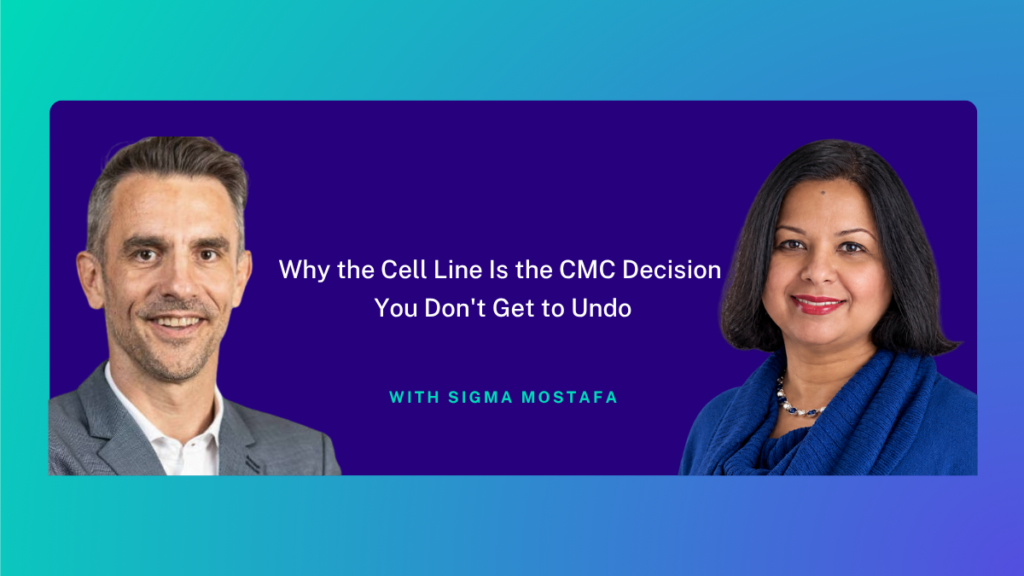
On this episode, David Brühlmann sits down with Sigma Mostafa, Chief Scientific and Technology Officer at KBI Biopharma. Sigma brings deep expertise in early-stage CMC decision-making and has guided countless programs—from upstart startups to established pipelines—through the traps and trade-offs of process development. Her ground-floor perspective spans in silico modeling, innovative cell line engineering, and the gritty realities of tech transfer.
Episode Highlights
- Practical advice for startups on selecting robust cell lines and avoiding long-term lock-in to problematic platforms [03:07]
- Managing risks in process development, such as high oxygen demand and filter loading, before tech transfer to manufacturing [04:47]
- The value of pressure testing bioprocesses at scale and identifying potential failure modes, including filter clogging and narrow feeding windows [07:41]
- Balancing speed, robustness, and regulatory expectations when advancing new molecules [09:23]
- How fast-tracking from transfection to IND is changing timelines, and the associated risks of accelerated development [09:54]
- Trends and caution in applying AI and in silico tools to protein and process modeling, and the limits of digital solutions [12:01]
- What first-time founders need to get right, including early analysis of molecular issues and careful cell line selection [15:48]
- Shifting modality trends—growing numbers of ADCs/XDCs, more complexity, and the move toward smaller scale and more potent molecules [16:55]
- The overarching lesson: invest early in the areas you cannot change later—especially cell line and understanding of molecule challenges [18:23]
In Their Words
The key success factor starts with looking at the protein sequence. This will be sort of an interesting aspect that I hope the audience finds insightful. One of the things we have started doing is doing a lot more in silico modeling as well. Very early understanding, looking at the protein sequence, what kind of challenges we may run into. But we see where the market is going. We used to talk about 12 months from transfection to IND. Now there are advertisements of, in six months, going from transfection to being able to do an IND.
Podcast Transcript
David Brühlmann [00:00:38]:
Welcome back to my conversation with Sigma Mostafa, who is the Chief Scientific and Technology Officer at KBI Biopharma.
In part one, we have been unpacking how the earliest CMC decisions ripple forward into scale-up and industrialization. And there’s plenty more ground to cover on manufacturability—from the pitfalls that quietly become future lock-ins, to how strong teams pressure-test a program before moving it forward, to where speed and robustness pull in opposite directions.
Let’s get back into the interview with Sigma Mostafa.
How would you advise a startup company? Obviously, it’s always the question: what do you do in-house? What do you outsource? What is the expertise you have inside, and what expertise are you relying on?
And the important question I see is cell line development.
And do you go with a platform like the Selexis platform or some other platform? Do you advise this on a case-by-case study or what should smaller companies do to get started? And also what should they be aware of in order to not be locked into a platform for their entire life? Because it’s important that you make an informed decision.
Sigma Mostafa [00:03:06]:
So for cell lines, again, cell line is the one decision you are making early, and you are kind of stuck with it. So I do think for startup companies, where cost and timeline are big factors, the advice is that you really want to choose a very robust cell line where you have the opportunity to improve productivity. There is a track record of improving productivity, also a track record of a lot of commercial products, that the cell line has gone commercial across many different regulatory bodies.
For Selexis, we have 14 commercial products. So those are things that are very important, and the cell line would be robust. I keep saying that because you may get higher productivity, but we have seen certain cell lines that have extremely high oxygen demand.
The cell line, because of its doubling time and productivity, allows you to shorten your production time, perhaps, and that can be attractive, but the oxygen demand is so substantially more that you have to do some engineering solutions in your manufacturing facility.
And in this case, clients themselves were having failure modes where they couldn’t maintain the oxygen demand. So going to some extreme solutions, some newest solutions that haven’t been tested or scaled, can be highly risky as well.
Also, you want a cell line provider that is really good in codon optimization, identifying any kind of risk in your sequence, and giving you that information early—that maybe your molecule may be prone to deamidation or aggregation and things like that.
David Brühlmann [00:04:46]:
The oxygen consumption is a great example of decisions you make early on that could have a potentially disastrous impact once you scale up into the manufacturing plant.
What other important decisions should you make when you’re in process development in order to prepare your tech transfer and to make sure that once you have locked in your process, you can actually transfer it to the manufacturing facility?
Sigma Mostafa [00:05:11]:
It’s very important to understand a couple of things. One is, if you are going to be a high-concentration product, which more and more we are seeing for a lot of products, your formulation development work needs to be done well so that you are able to get to that concentration. You see a lot more issues when you are going to 200 mg/mL or 300 mg/mL concentration. There’s something called the Donnan effect that we see.
So these are different, very complex scientific issues, but they can create challenges for you in terms of the presentation of the drug that you need to be a competitor in the market.
The other things I’d say are, for example, viral filter choice or loading of UF/DF. Because these things require significant volume of product, oftentimes those studies don’t happen in the early stage. You can’t really test this without going to a pilot-scale run, let’s say.
But by the time you’re in pilot scale, you’re already a couple of months away from going into GMP. So if you are going to have issues with clogging of your viral filter or some issues with your UF/DF, you may learn that a bit late. So again, being able to do as many studies early on to understand these things is important.
Viral clearance is very costly work. So if you find out that you are not getting the log clearance, then you are kind of in a bind. I will mention a solution we are looking at, which is a very unique solution we are proud of. Selexis is coming up—it’s going to introduce a new cell line. We are calling it Clear CHO, which will have—basically, we have knocked out virus-like particles in the CHO host line.
So with qPCR, we are seeing 15-fold less viral particles to start off with. So having a cell line that will have a lower threshold of viral particles assures you that you’ll get to the right viral clearance. That’s an innovative solution where the problem is downstream, way down, but we are trying to find a more fundamental solution for it.
David Brühlmann [00:07:29]:
What are the things you see that the great teams, the strong teams pressure-test before moving a program forward? And when do they usually do that?
Sigma Mostafa [00:07:40]:
The pressure-testing is super important for upstream and, let’s say, for harvest. You are pressure-testing at scale. Are you going to have CO₂ buildup issues? Is your gas purging strategy adequate?
If you have a—for tech transfer processes especially, we see sometimes very unique feeding strategies, where you have a very tight window to do your feeds.
But ideally, in manufacturing, you may not be able to maintain that kind of tight window. So if you have to hit this very tight cell density to do your feed, that is not the ideal situation. You want to be able to say, within plus or minus 8 hours, you can do the feed and you’d be fine. So the more you can test out, like in manufacturing, what problems might happen, the better.
The loadings of filters is a big one. If you are going to run into issues, let’s say your depth filter, like your coarse versus fine filter ratio, is not appropriate and you keep on getting one of the filters clogged, and people are real-time changing filters, all of that brings a lot of risk to the manufacturing process. So understanding those things early is also very important.
David Brühlmann [00:08:59]:
There’s a lot of moving parts when you’re developing a new drug. You have to look into the manufacturability. Then there are all these CMC-related parts. You need to have a cell line. You need to think into scale-up and lots more. You need to have viral clearance. How do you balance the speed and robustness and also the readiness? What are the key success factors there?
Sigma Mostafa [00:09:22]:
The key success factor starts with looking at the protein sequence. This will be sort of an interesting aspect that I hope the audience finds insightful. One of the things we have started doing is doing a lot more in silico modeling as well: very early understanding, looking at the protein sequence, what kind of challenges we may run into.
But we see where the market is going. We used to talk about 12 months from transfection to IND. Now there are advertisements of, in six months, going from transfection to being able to do an IND.
When those shortened timelines are being discussed and they come across as very attractive, you are obviously doing that through more of a risk appetite. You are taking a pool to, let’s say, do your IND-enabling talks, and you are assuming that your clones would look exactly the same.
You are taking certain risks that may add up at the end, be a very big roadblock. What we do is we offer a menu. We say that we can be as fast as any other CDMO, but these are the set of risks you are taking.
The easy one is in the next phase you have to do considerably more development. But the more impactful immediately might be regulatory questions and some kind of a roadblock there.
We have our very bespoke solutions that we can come up with, and then we would provide something in the middle, saying that this is what, based on your molecule, but it really comes down to, do you have a vanilla mAb, very well-behaved, with a pI around 7, or do you have a very complex molecule?
That may have a lot of host cell protein issues, that may have other issues. And that is where we would say, “Do not go as fast. Do want to take the time because otherwise you’ll have such low yield or you will have host cell protein issues that you’ll get questions from the FDA”
David Brühlmann [00:11:31]:
I’d like to dive a bit into the technologies. You mentioned in silico modeling. There’s so much going on in that space. Every day, pretty much, there’s a new technology.
Well, we’ve been doing modeling for a long time—mechanistic modeling, hybrid modeling. Now we have the LLMs on top, machine learning.
How do you see bioprocess development in the next couple of years? Like, how will this change? What are the trends you’re most excited about?
Sigma Mostafa [00:12:00]:
So in terms of digital solutions and AI, I’ll answer kind of in a broad perspective, and then I’ll mention some specific things. We at KBI looked at: do we focus on the more exciting, sexy solutions, which is on the scientific side, or do we focus on low-hanging fruits, how to reduce deviations and things like that?
The answer is we want to do both, obviously, but we are focusing a lot on the simpler things for AI to do that are in terms of early review of deviation reports, anything that we can automate.
On the other side, we have heavily focused on this in silico model where basically we are using AlphaFold to look at the protein and then look at what vulnerabilities the protein has so that we can model that. Are we going to have aggregation challenges? At the same time, the melting temperature is an issue, so we can bring in what potential challenges we’ll face.
Now, there has been a lot of modeling work historically and continues to be in terms of modeling process development, especially for downstream chromatography and things like that. And the idea there has been to reduce the number of studies, perhaps being able to quickly identify the resin, the process conditions. We continue to look at that, but if you have well-behaved molecules, even for bispecifics, multispecifics, you don’t necessarily need that. I think with all the high-throughput technologies, those studies have been collapsed already quite a bit.
Can we completely move away from wet work? My thought would be no. We want to still do some wet work in the lab before we go into manufacturing. But I do think the modeling, more in terms of the protein understanding, is quite valuable to know the pitfalls.
David Brühlmann [00:13:58]:
What do you think are the pitfalls with these technologies? Because it can be quite overwhelming, and it’s sometimes difficult to differentiate between the hype and what is really working. What would be your advice there?
Sigma Mostafa [00:14:12]:
My advice would be not to try to be that trailblazer per se and try to take on every new technology. And I think some level of caution is needed. There is a lot of hype, and what we see in some cases is significant investments in this area, but not the level of results.
And ultimately, that’s why we are excited about being in this biologics field, because there are a lot of unknowns that no level of LLM modeling would tell us because we just don’t know the fundamentals with the correlations.
My advice would be, things that have shown results and taking small steps is better, and showing that this is adding value, constantly looking at that. Some of the things we talk about is rather having small case studies in the AI space and results. For example, we are looking at automating our reports, as opposed to very high-achieving goals. But all we are tracking is how many tokens you have used, how much energy you have used. That doesn’t tell anything in terms of the ultimate results.
David Brühlmann [00:15:26]:
Now let’s make this practical. If I were a first-time founder and I tell you, “Sigma, we have this exciting new molecule, we have some exciting preclinical results,” what are the few things I need to get right right now, and what are the things I can wait? Because I say, “Well, but maybe CMC can wait.”
Sigma Mostafa [00:15:45]:
You would need to understand if the molecule has any fundamental issues, even if that’s not a full-blown manufacturability study, but some evaluation, whether it’s in silico or some small amount of developability-type of work.
If there are some fundamental challenges with the molecule, either in terms of, let’s say, as soon as you start concentrating it, it’s precipitating, or issues in terms of it has a patch in the sequence where host cell proteins bind extremely tightly. These understandings early on are important.
And the second thing is you choose the right cell line. I think those are the most important things where the right investment should be made.
David Brühlmann [00:16:32]:
Fantastic. As we are wrapping up, Sigma, what additional questions should I have asked?
Sigma Mostafa [00:16:40]:
What’s new modality-wise, perhaps, and do they bring additional challenges? What type of preclinical molecules are we seeing, and is that shifting over time?
David Brühlmann [00:16:53]:
So what are your thoughts on that?
Sigma Mostafa [00:16:55]:
We actually did an analysis looking at, in 2026, all the preclinical assets. And we are assuming in 3 to 4 years these are in clinic. And what we see is that mAbs are still the most, but if we compare to 2022, the number of ADC or XDC is very high.
Then you think about the linker and the payload, and if you are not doing the conjugation under the same roof, are there double development work? Those are things to consider. Because we are seeing varied types of conjugation chemistries, and they are bringing in new types of challenges.
David Brühlmann [00:17:41]:
So that means we are seeing increasing complexity as we’re moving forward, more and more different molecule formats.
Sigma Mostafa [00:17:48]:
Exactly.
David Brühlmann [00:17:49]:
Does that also mean that increasingly we’ll move towards a smaller scale because it’s more personalized?
Sigma Mostafa [00:17:55]:
Likely, yes. We do have products that are ADCs that actually have very large volume needs. But in general, that’s going to be the trend. A lot of the ADCs, the volume need is low. Also, even for the standard biologics, we are seeing more potent molecules and less of a volume need.
David Brühlmann [00:18:16]:
In a nutshell, Sigma, what is the most important takeaway from our conversation?
Sigma Mostafa [00:18:22]:
That speed and good science can be done together, as long as you invest in the few things that you cannot change later. And those things are your cell line and your understanding of your molecule’s inherent challenges.
David Brühlmann [00:18:41]:
Fantastic, Sigma. Where can people get a hold of you, learn more about what you’re offering, and just perhaps also talk with you if there are ways to collaborate?
Sigma Mostafa [00:18:52]:
Absolutely. I’m available and interested in collaborating with wise folks. So certainly, our KBI website is a good place, as well as my LinkedIn. My email is smostafa@kbi-biopharma.com, and I welcome any and all discussions.
David Brühlmann [00:19:10]:
Fantastic. There you have it, smart biotech scientists. Use this opportunity to reach out to Sigma. And Sigma, once again, it was great to reconnect, and it was a huge pleasure having you on the podcast again.
Sigma Mostafa [00:19:22]:
This was a lot of fun, David. Thank you so much for the opportunity.
David Brühlmann [00:19:26]:
If there is one thread running through this conversation, it’s that manufacturability isn’t something you bolt on later. It’s built or broken in decisions made far upstream. Sigma Mostafa’s insights on pressure-testing, platform adoption, and what founders need to get right early are the kind of lessons that save teams years of rework down the line. If you found value in this episode, please leave a review on Apple Podcasts or wherever you’re listening. It helps scientists like you find the show. Thank you so much for tuning in today, and I’ll see you next time.
All right, smart scientists, that’s all for today on the Smart Biotech Scientist Podcast. Thank you for tuning in and joining us on your journey to bioprocess mastery.
Disclaimer: This transcript was generated with the assistance of artificial intelligence. While efforts have been made to ensure accuracy, it may contain errors, omissions, or misinterpretations. The text has been lightly edited and optimized for readability and flow. Please do not rely on it as a verbatim record.
Next Step
If you found value in today’s episode, take a moment to like, follow, and leave a review on Apple Podcasts or your favorite platform—it helps us reach and support more scientists like you.
Thanks for tuning in to the Smart Biotech Scientist podcast and being part of this journey toward bioprocess mastery. For more insights and practical tips, visit
About Sigma Mostafa
Sigma Mostafa is a biopharmaceutical executive and Chief Scientific and Technology Officer at KBI Biopharma. She has extensive technical and leadership experience spanning cell line and process development, manufacturing, technology transfer, and organizational growth. At KBI, she oversees Analytical Services, Process Development, and Cell Line Development, driving innovation and supporting the development of high-performance teams.
Connect with Sigma Mostafa on LinkedIn.
Further Listening
This episode unpacks what that means in practice and where speed and robustness pull against each other. If it resonated, these conversations expand the picture: how to spot manufacturable candidates early, how in silico tools predict stability and aggregation before the lab, and which early CMC decisions quietly become permanent.
Episodes 123 - 124: Manufacturability: Why Most Protein Candidates Fail (And How to Pick Winners Early) with Susan Sharfstein
Episodes 213 - 214: From Developability to Formulation: How In Silico Methods Predict Stability Issues Before the Lab with Giuseppe Licari
Episodes 231 - 232: From IND to BLA: The Biologics CMC Decisions That Determine Regulatory Success with Henri Kornmann
Episodes 103 - 104: One-Stop Shop vs. Specialist CDMO: A Scientist's Guide to CDMO Selection with Sigma Mostafa
Want to Join?
Are you a CMC or biomanufacturing leader with hard-won lessons on process development, scale-up, or CDMO management? We’re always looking for practitioners with real execution stories to share on Smart Biotech Scientist.
Apply to be a guest or recommend someone:
David Brühlmann is a strategic advisor who helps C-level biotech leaders reduce development and manufacturing costs to make life-saving therapies accessible to more patients worldwide.
Hear It From The Horse’s Mouth
Want to listen to the full interview? Go to Smart Biotech Scientist Podcast.
Want to hear more? Do visit the podcast page and check out other episodes.
Do you wish to simplify your biologics drug development project? Contact Us