Clonal cell lines are the lifeblood of CMC, but let’s be honest: “monoclonality” is more myth than fact. The moment a cell divides, intrinsic biological variability creeps in—putting your manufacturability assumptions at risk.
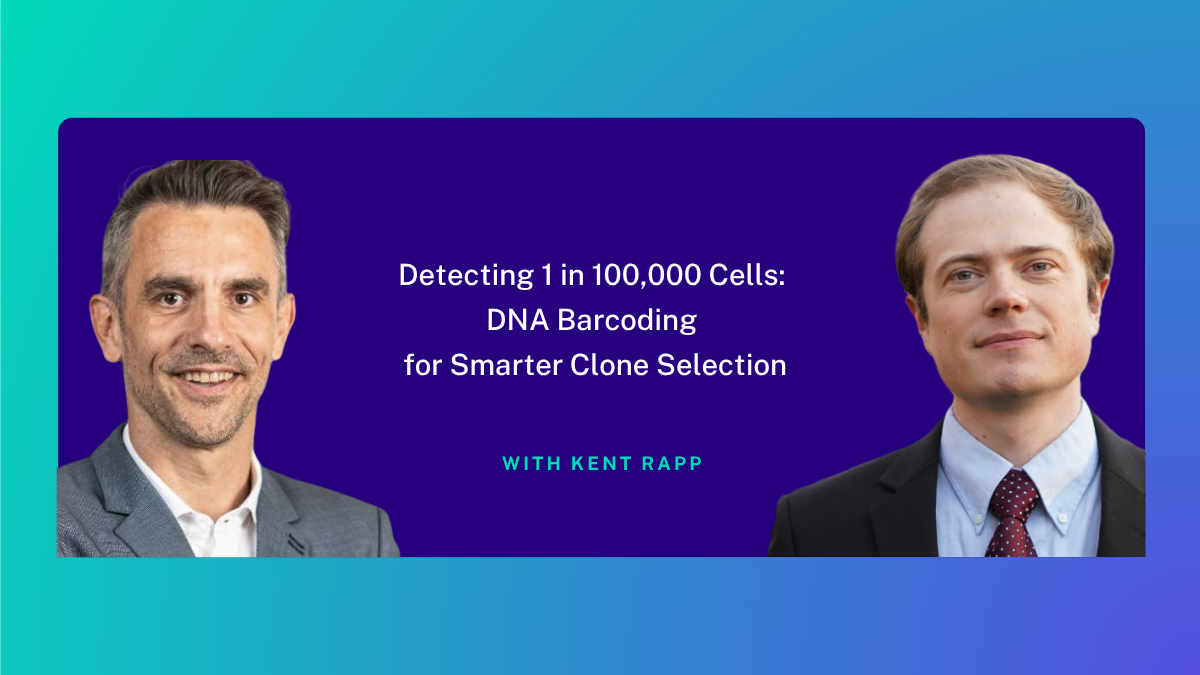
Kent Rapp, Co-founder and CEO of Biolinco (fresh off a postdoc at Johns Hopkins), joined the Smart Biotech Scientist Podcast to share how his team is reframing cell line development for a new era of robustness, speed, and actionable data.
Episode Highlights
- Common pushbacks and questions from industry regarding new cell line development technologies [03:18]
- Practical advice for resource-constrained startups developing cell lines, emphasizing efficiency and data quality over brute force automation [08:42]
- The role and value of DNA barcoding in screening and developing robust cell lines for therapeutics [08:56]
- Lessons learned from translating scientific innovation into a commercial product, including securing early support and customer trust [10:27]
- Insights on adapting messaging, leveraging feedback, and understanding market needs as part of the entrepreneurial process [13:52]
- Key differences between academic research and industry requirements for reliable, repeatable biotech tools [15:26]
- Kent’s most important takeaway for successful cell line development: focus on collecting the right data at the right scale for informed decisions [17:14]
In Their Words
Biology is inherently kind of random and variable and soft and mushy. The notion of a clonal cell line is a little bit fishy to begin with, which is why I think a lot of people in this space are interested in moving away from the notion of monoclonality, because once a cell divides once, you might already have incurred changes that mean the two cells are now different.
There is only so much you can do about that intrinsic variability that comes up as cells are dividing. And having a holistic picture of all of the paths that a cell has taken through its clonal journey, from transfection to 1,000 generations or so down the road, will give you a better picture of how robust that clone is for performance.
Podcast Transcript
David Brühlmann [00:00:50]:
Welcome back. Kent Rapp, co-founder and CEO of Biolinco, who recently completed his postdoc at Johns Hopkins, is still with us, and we are picking the conversation back up on cell line development and manufacturability.
We’ll keep digging into the science, how well early signals actually predict bioreactor performance, and where vector design fits into the picture before turning to Kent’s own path as a founder. And we’re going to look at what it really took to move a new technology from an idea into something the industry would trust.
Let’s get back into it.
What are the potential pushbacks for someone, you know, who is interested in this new technology, someone who wants to speed up cell line development? What are things perhaps you have heard and you can share? Is that more mindset-related? Is it technology-related? What are some things people should watch out for?
Kent Rapp [00:03:09]:
We have been talking to many different customers who are interested in this technology. The hesitations that often come up are, first, “Does this actually work?” It almost seems too good to be true, right? And how does this compare with other measurements that are more industry-standard and accepted?
That is something that we have been working on, building out our data portfolio to just prove that it matches up. And at the same time, we try to reassure potential customers that this is not necessarily the end-all, be-all assay that you’re using for everything. You’ll still have a monoclonal cell line at the end. You’re still going to be measuring your titer the good old fashion way tht everybody knows and loves. So, it’s a complementary tool that can speed up the process for the cell line development workflow.
Some of the other feedback that we’ve gotten is mostly that sometimes clonal performance can vary between subclones, which is true, although that variation is much smaller than the clone-to-clone heterogeneity that you normally see.
Yeah, I think that’s a good point. And some other feedback is people are more interested in product purity.
Product purity for bispecific antibodies has been a big challenge for the field in recent years. And while titer and productivity and growth are really great things to keep track of, and are the bread and butter of the cell line development space, what people are more interested in is all of these additional product quality attributes that have become increasingly important in the era of bispecific antibodies.
We have been working actively to build on our assay portfolio and expand the critical quality attributes that we are able to measure, specifically for bispecific antibodies.
We actually have an investment that we received recently from the state of Maryland, specifically focused on expanding our platform to bispecific antibodies and developing assays for these really important critical quality attributes that people care so much about.
David Brühlmann [00:05:26]:
Now, just to rephrase that again, what I’m hearing is that the subclones that come from your selection process are less different than a subclone, for instance, in the traditional workflow. Is that correct?
Kent Rapp [00:05:41]:
Biology is inherently kind of random and variable and soft and mushy. The notion of a clonal cell line is a little bit fishy to begin with, which is why I think a lot of people in this space are interested in moving away from the notion of monoclonality. Because once a cell divides once, you might already have incurred changes that mean the two cells are now different, right? So, there is only so much you can do about that intrinsic variability that comes up as cells are dividing.
And having a holistic picture of all of the paths that a cell has taken through its clonal journey, from transfection to 1,000 generations or so down the road, will give you a better picture of how robust that clone is for performance.
For example, if you see a really wide distribution of productivities, then you’ll know that there’s a lot of potential variability that could happen down the road for that clone. If you see a really narrow distribution of productivities or growths, then you’ll know that that clone is more robust for your process and less likely to deviate from how you expect it to behave.
David Brühlmann [00:06:58]:
I agree. Where are you at this journey now? What scale-up data do you have? Do you have also some data on the stability of your clones? Is that comparable? Have you observed some differences?
Kent Rapp [00:07:12]:
We’re recently spun out of an academic setting. We didn’t have access to bioreactors, unfortunately, because of academic limitations, but we were able to do 60 mL fed-batch cultures in shake flasks and test at that scale.
And generally speaking, our measurements line up exactly how you would expect for a monoclonal cell line versus the mixed culture.
In terms of stability, that is an experiment that every once in a while comes up with customers, but many companies have mitigated their stability challenges through innovations in the transposase space and in the targeted integration space. Random integration is still used by some companies, and that’s where you’ll often see some of these stability issues.
And the stability of our cell lines is more related to which integration method you use rather than anything special about the barcode itself. It allows you to measure stability in thousands of clones in parallel, but the actual stability rate will remain unchanged.
David Brühlmann [00:08:19]:
Let’s make this actionable. Regardless of the technology folks are using for cell line generation, what are some pieces of advice you could give, especially people in startups who perhaps have less understanding of or fewer possibilities? They have resource constraints. They don’t have bigger bioreactors. What are some important things they should look at right from the beginning?
Kent Rapp [00:08:42]:
I came from an academic background, so I am very familiar with the resource limitations and constraints that are likely facing a small company. And even now, I am spearheading a small company myself and facing those exact same resource limitations and constraints.
One of the big things that we had to figure out how to do is do more with less and get more valuable information with fewer resources and fewer dollars and time put into the process, which actually is what led us to this DNA barcoding approach in the first place, as we can dramatically increase the data volume and intensity from fewer experiments by just getting more sensitive readouts and more accurate readouts.
For a small team that is interested in having a robust cell line development campaign that meets their needs and is able to meet the needs for the clinic, they can use an improved technology that doesn’t necessarily automate the challenge and just really try to scale up and automate cell line development and single-cell clone screening in separate reactors, but think a little bit harder about the problem and try to figure out how they can screen everything in a multiplexed format and altogether in a mixed population to get the answer that they’re looking for.
David Brühlmann [00:10:05]:
Let’s shift gears a bit and let’s talk about the entrepreneurial journey and a bit about the challenges and your experience you have had so far.
What was the hardest part of getting this platform from an idea into now something that companies actually want? Not just a fancy technology, but something that has a use and people are interested in?
Kent Rapp [00:10:26]:
There have been quite a few challenges as we have gone down this road. People always talk about the gap between academia and industry, and I’ve really felt that firsthand.
As we move from the academic setting, or rather, even as we were starting in the academic setting, one of the first challenges that we had to face was getting support for the initial idea to build our proof-of-concept data package.
When you’re an entrepreneur, it’s always easy to see the things that could be, but everyone else around you wants to see the actual reality of how things work and whether you can prove it. We had these great ideas, bold ideas, but you need funding to make them a reality. And that was the first challenge that we had.
Fortunately, we were supported by various partners at Johns Hopkins, in Baltimore, like Blackbird Laboratories, and also the state of Maryland through their Maryland Innovation Initiative grants for commercializing innovative technologies in this space.
That was the first hurdle we had to overcome.
And then, once we got the science working, the next hurdle was bringing it to customers and understanding how to speak their language and describe the value proposition in a way that resonated with them and told them also how it was different from what they were doing, but it was an improvement over what they were doing and how it complemented all of that work.
So, that took quite a few iterations to get through and constant face time with customers, some good feedback, some much harder feedback from people as well, who basically told you to talk to your friends and get feedback. And they’ll always be a little nicer, and they’ll tell you, “Oh, these are the things that people aren’t telling you, too, that you need to hear.” Those were our real champions back in the day when we were learning about this space.
But after we were doing that, the next challenge became actually showing that there was a willingness to engage with this technology and a willingness to pay for it from a company perspective.
It’s hard to be the first person to adopt a technology from the buyer side, and finding someone who trusted us enough and was willing to make that leap was the next big challenge.
And that really relies on a lot of trust that you’ve built over years and years of working with someone. And fortunately, we had people in our network that trusted us and believed that what we were doing was really able to benefit cell line development and cell line developers as a whole, and were willing to partner with us for our first contract.
Of course, you can entice them with substantial discounts and everything to make sure that they’re being compensated for their share of the risk. But at the end of the day, from a business perspective, you do need to make sure that you understand the market and willingness to pay there.
Those were the three kind of major hurdles that we’ve had to face up to this point so far: the initial kind of technology development, then also understanding the value proposition and how to speak to the business leaders in this space that feel this pain so intensely and acutely and addressing that need, and then also finding someone who’s willing to take that first risk with you, that leap of faith.
David Brühlmann [00:13:44]:
What would you say is the secret to your success? Is there one thing, or is it a few things?
Kent Rapp [00:13:52]:
I’m not sure that there’s necessarily one secret or anything. I think it’s more about being responsive to all of the information that you are learning about and getting from the space.
Feedback is, even if it’s good feedback, bad feedback, whatever, it is a gift that you are getting from your customers and the people who are giving it to you. They are giving you data points that you’re able to reflect on and build on and use to potentially pivot if you need to.
The way we are advertising and selling our product now and the things that we’ve decided to focus our future work efforts on have meaningfully changed from where we were a year or two ago based on the feedback of what’s important to this industry.
Trying not to take things personally is an important thing. And just making sure you listen to what your customers have to say, to what people in the space have to say. There’s a lot you can learn from the experts in this space. No one person can know everything.
David Brühlmann [00:15:02]:
I agree. What additional questions should I ask you?
Kent Rapp [00:15:06]:
Great question. What additional questions should you ask me? I think I would love to talk about where I see things going and how to better translate technologies from research, innovation, and discovery to actually commercially useful tools.
We had to kind of work through the valley of death between academia and industry. And a lot of times, the incentives for academics are measurably different than the incentives for people in the commercial space.
For academics, they need to get a grant, they need to publish their research, and then move on to the next grant and rinse and repeat. This is very different from an industry person who needs to have a robust process that they develop, and then it works and it works very well, very reliably.
And usually, a research product that happens in the academic space is something that was one-and-done. It doesn’t necessarily need to be repeated over and over and over again.
In an academic space, also, it only necessarily needs to work in that grad student’s hands or that lab space. With an industrial technology, it needs to work regardless of what company it’s at. That tech transfer is important. It needs to work repeatedly, reliably, and give you meaningful information.
We have spent a lot of time just iterating on technology that we had already proven and probably could have published a research paper on ages ago. But really making sure that it is consistent, reliable, and repeatable, and giving accurate readouts regardless of whose hands it’s in, what lab space we’re working with, or what equipment we’re working with.
And that’s really the gap that exists between academia and industry, just that refinement that is required to bring a technology to market.
David Brühlmann [00:17:07]:
As we are wrapping up, Kent, what is the most important takeaway from our conversation?
Kent Rapp [00:17:14]:
I would say the most important takeaway is that you need the right data at the right scale to make the right decisions for your cell line development process.
And when you’re thinking about all these things together, it’s important to solve your problems rather than just automate them, unless the automation is the goal you’re going for. Just be aware of that going into your decision-making process, and know what to expect from that outcome.
David Brühlmann [00:17:42]:
Where can people get ahold of you, learn more about your technology, and hopefully even test it?
Kent Rapp [00:17:49]:
I think I’m pretty easy to find on LinkedIn, so that would probably be the first place to reach out to me. The next one would be at our company email address, so that’s info@biolinco.com.
And then the last place would be we have a website to learn a little bit more, and that’s just www.biolinco.com as well.
David Brühlmann [00:18:16]:
Excellent. Well, thank you so much, Kent, for being on the show today, for sharing more about cell line development and how we can speed that process up and make it better. It’s been a huge pleasure having you on the show today.
Kent Rapp [00:18:28]:
It’s been great to be here. Thank you so much for inviting me, David. Really appreciate it.
David Brühlmann [00:18:33]:
This wraps up our conversation with Kent Rapp. The through line from our discussion is that real manufacturability data gathered early saves biologics teams from expensive surprises down the road.
He also made a strong case that good science, and now, on his entrepreneurial journey, good entrepreneurship, reward patience.
If this episode was useful, please leave a review on whatever platform you’re listening on. Thank you so much for tuning in today, and I’ll see you next time.
Disclaimer: This transcript was generated with the assistance of artificial intelligence. While efforts have been made to ensure accuracy, it may contain errors, omissions, or misinterpretations. The text has been lightly edited and optimized for readability and flow. Please do not rely on it as a verbatim record.
Next Step
If you found value in today’s episode, take a moment to like, follow, and leave a review on Apple Podcasts or your favorite platform—it helps us reach and support more scientists like you.
Thanks for tuning in to the Smart Biotech Scientist podcast and being part of this journey toward bioprocess mastery. For more insights and practical tips, visit
About Kent Rapp
Kent Rapp is Co-Founder and CEO of Biolinco, where he is commercializing DNA barcoding technology to accelerate cell line development for biomanufacturing. He holds a Ph.D. in Chemical and Biomolecular Engineering from Johns Hopkins University and has a background in biomanufacturing research.
Connect with Kent Rapp on LinkedIn.
Further Listening
If this got you rethinking how you screen clones, you’ll want these next. We’ve tackled cell line development, high-throughput screening, and the art of spotting manufacturable candidates early from a few different directions — here are four worth queuing up.
Episodes 117 - 118 : Cell Line Development Secrets: Eliminating Critical Bottlenecks for Faster Timelines with Andrea Gough
Episodes 09 - 10: Revolutionizing Cell-Line Development: Unleashing the Power of Nanopens and Microenvironments with Tanner Nevill
Episodes 123 - 124: Manufacturability: Why Most Protein Candidates Fail (And How to Pick Winners Early) with Susan Sharfstein
Episodes 115 - 116: Revolutionizing Biologics Development with Hyper Throughput Screening and AI with Jeremy Agresti
Want to Join?
Are you a CMC or biomanufacturing leader with hard-won lessons on process development, scale-up, or CDMO management? We’re always looking for practitioners with real execution stories to share on Smart Biotech Scientist.
Apply to be a guest or recommend someone:
David Brühlmann is a strategic advisor who helps C-level biotech leaders reduce development and manufacturing costs to make life-saving therapies accessible to more patients worldwide.
Hear It From The Horse’s Mouth
Want to listen to the full interview? Go to Smart Biotech Scientist Podcast.
Want to hear more? Do visit the podcast page and check out other episodes.
Do you wish to simplify your biologics drug development project? Contact Us