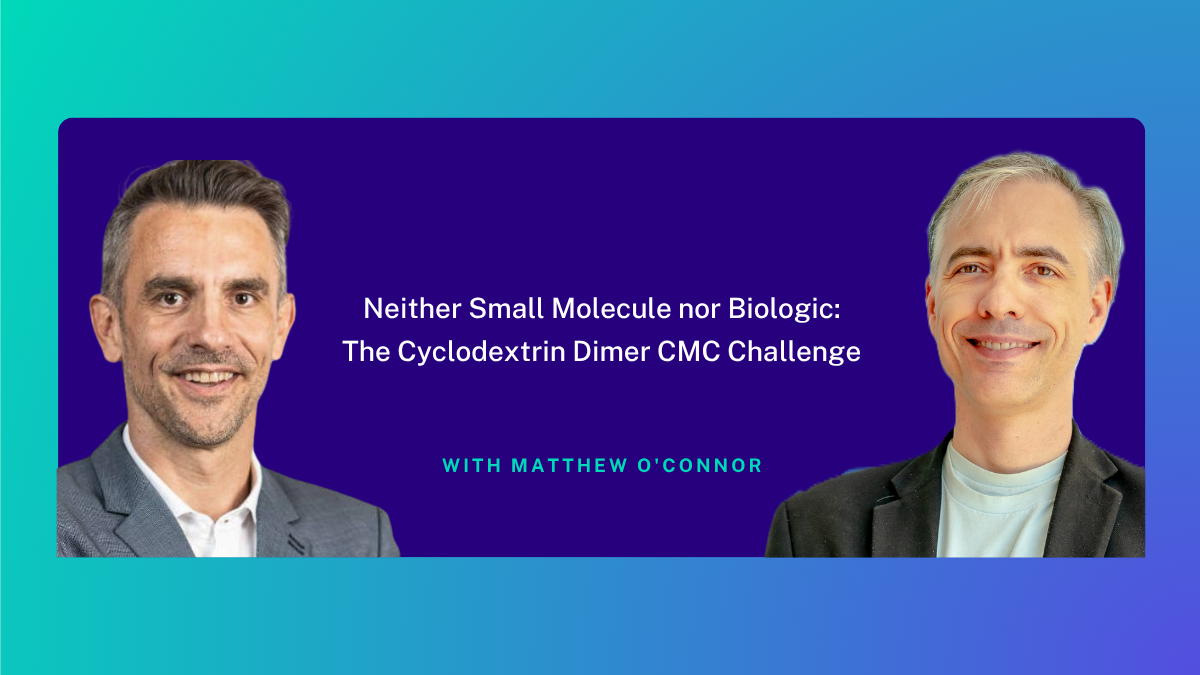
Cardiovascular therapies are on the verge of a revolution, with the boundaries between small molecules, biologics, and novel modalities becoming increasingly blurred as companies strive to not only halt but reverse chronic diseases.
Cardiovascular disease has long been managed by slowing its relentless progression. But Matthew O’Connor, CEO of Scientific Affairs at Cyclarity Therapeutics, is betting on a outright paradigm shift: treating atherosclerotic plaque with therapies designed to actively reverse disease, not simply manage symptoms or risk.
Episode Highlights
- Insights into the company’s clinical development progress, including completion of a first-in-human study and what comes next [02:47]
- How the FDA views drugs that don’t fit traditional categories and how this influences development pathways [04:35]
- The challenges and considerations in demonstrating efficacy for drugs designed to reduce heart attacks and strokes [05:22]
- Cost considerations in manufacturing the cyclodextrin dimer and how it compares to biologics and GLP-1 drugs [08:14]
- Vision for how cardiovascular disease may be diagnosed and treated a decade from now, including the role of imaging and prevention [10:24]
- Broader implications for treating age-related diseases by targeting toxic metabolites in the body [14:25]
- Why next-generation therapeutics may be built not by sticking to old modalities but by tackling root causes with custom solutions [16:10]
- Reflections on making new drugs both safe and fundamentally beneficial, minimizing side effects [17:10]
In Their Words
I think the thing that differentiates our approach from traditional approaches is that we’re trying to actually reverse the disease rather than just slow its progression down. So I think that we’re going to have a big advantage there because if you start doing the math and such and start making predictions about the incidence of heart attacks and strokes when you’re reversing plaque as opposed to slowing down the growth compared to your control group, the number of patients that you need to demonstrate— you think about the design of these studies, you’re saying, well, you’ve got to reduce the incidence of heart attacks and strokes. Well, people don’t have a single individual like you or me isn’t very likely, even if we’re pretty sick, we’re not very likely to have a heart attack tomorrow or next week or next month, right?
Podcast Transcript
David Brühlmann [00:00:39]:
Welcome back to part 2 of our conversation with Matthew O’Connor. In part 1, we covered the science behind Cyclarity’s cyclodextrin dimer. And today, Matthew O’Connor, who’s the CEO of Scientific Affairs at Cyclarity Therapeutics, takes us further into what it actually takes to manufacture, characterize, and defend a molecule that doesn’t behave like anything in the regulatory playbook. From isomeric mixtures with no single peak to point to, through tech transfer, specifications, and FDA conversations, Matthew shares what building an unconventional therapeutic really demands. Let’s get back into it.
Where are you in the clinical development? What have you done so far? What are you currently working on and what will be the next steps?
Matthew O’Connor [00:02:47]:
We’ve completed our first-in-human study and we actually just recently announced the completion of that. We’d finished dosing late last year and of course it took a while to compile all of the data. And now we have a 5,000-page report that details every detail of everything that happened to these 72 wonderful healthy volunteers who received our drug at different doses and different numbers of doses. That is done and we have initiated a Phase 1b-style study that is technically part of the same study, the same Phase 1 study, and that is in patients with coronary artery disease who have plaque. So we’re working with a very small number of patients who have plaque, and of course this is mostly looking at safety and pharmacology, but we’ll be able to look at some outcomes in those patients.
There’s other disease indications that— closely related disease indications of atherosclerotic plaque that we’re interested in looking at as well, and other aspects of disease that oxidized cholesterol builds up in that we’re also exploring looking at in patients at early stages as well. But this Phase 1b will hopefully give birth to a Phase 2 study in a similar group of patients in the coming months and years.
David Brühlmann [00:04:01]:
From the conversations you already had with the regulators, to what extent is the feedback different for such a drug that’s, shall I call, a bit in the in-between space? It’s neither a large molecule, it’s not a small one. It’s also, I’d say, yes, it solves the disease, but you also have some prevention of heart attacks, or let’s say it will be also used in the rejuvenation area. Did you notice any difference in the way the FDA treated that, or is it very similar to a standard biological or small molecule drug?
Matthew O’Connor [00:04:35]:
So far, they’re treating it very similarly in the ways that you say. In the early stages, like where we are, they’re primarily— FDA is primarily concerned with safety and manufacturing. And so those ways they’re treating it similarly to other drugs. The weird part being, like we’ve already sort of talked about, the non-isomeric mixture is pretty unusual for a small molecule. Isomeric mixture, non-single isomer is unusual. And so in that way, they’re treating it more like a biologic. But in terms of safety and later efficacy, it will be treated very similarly.
We hope that the landscape for efficacy in chronic disease is evolving and will evolve quickly in coming years, and that there will be some surrogate endpoint considerations. But for now, everybody— everybody assumes that at least eventually we will need to show a reduction in heart attacks and strokes, which is sort of the key expectation that if you’re claiming that you’re doing something to the vascular system that is going to improve the health of it, that it should reduce heart attacks and strokes. And that is no different expectation for us as for any other drug. I think the thing that differentiates our approach from traditional approaches is that we’re trying to actually reverse the disease rather than just slow its progression down.
So I think that we’re going to have a big advantage there because if you start doing the math and such and start making predictions about the incidence of heart attacks and strokes when you’re reversing plaque as opposed to slowing down the growth compared to your control group, the number of patients that you need to demonstrate— you think about the design of these studies, you’re saying, well, you’ve got to reduce the incidence of heart attacks and strokes. Well, people don’t have— a single individual like you or me isn’t very likely, even if we’re pretty sick, we’re not very likely to have a heart attack tomorrow or next week or next month, right? So this is something that you have a probability of having a heart attack this year or next year or within the next 5 years.
And so a lot of these studies are tracking thousands of patients, sometimes tens of thousands of patients for 3 years or 5 years. And we’re hoping that an approach like ours will compress that time and reduce the number of people that we need to follow for that time. That’s part of the excitement of our approach for us is that even if we’re held to that very high standard, I think that we should get conditionally approved if we can show that we reduce plaque, that we reduce plaque inflammation, that we improve the density of the plaque, which are all things that have been proven to affect the outcomes and affect the likelihood of having a heart attack or a stroke.
I think that the regulators should say, okay, let’s not wait so long. Basically, you’re doing these sort of bellicose studies where you’re just sort of tick clicker and saying, well, you know, another person in this control group died and another person in this group died. And oh, people in the control group are dying faster than the people in the active group. And so we’re going to wait for 3 years or 5 years or something and say, yeah, it’s a statistically significant number of deaths that are faster here than there, so your drug is approved. I’d like to say, let’s use some common sense. You improved the plaque. Let’s give you a conditional approval and then see— then count those bodies for a few more years and say, look, it really is working. Let’s make this permanent.
David Brühlmann [00:07:45]:
I would just like to zoom out a bit. Your company’s ambition is a simple, affordable preventive therapy at a global scale. What does this molecule actually cost to produce? You said that raw materials were very cheap. Is this also true for the whole manufacturing process? Is it cheap? And then what would be additional costs, for instance, due to the distribution model? Where would you think would the cost of this drug land compared to other drugs in the market?
Matthew O’Connor [00:08:14]:
It’s a good question, and it’s something I don’t have all the answers for yet, especially in terms of your latter question. The cost to produce is kind of like the molecule size. It’s kind of in the middle. It’s not dirt cheap to produce. There are multiple synthetic steps, and then there’s the purification and the fact that you’re making a liquid formulation. So these are all like not dirt cheap things to do.
And so this isn’t the type of thing where sitting from where I’m sitting now, it’s never going to be 10 cents a dose to produce our drug. And so that’s kind of a one fundamental limitation. That said, it is cheaper than producing a biologic. It’s cheaper than producing a therapeutic antibody. And so it’s not going to be horribly expensive and it is like you were saying, something that we envision, it is more scalable than making a biologic. There’s nothing fundamental that says we need to produce small batches, for example. We can produce very, very large batches. We’re nowhere close to even challenging the kind of equipment that our drug is being produced on. So there are economies of scale and such that we’ll be able to rely on.
And so I think that it’s going to be something that we can produce for everybody. And it’s the kind of thing that we’re thinking about in comparison to the GLP-1 drugs. The GLP-1 drugs are not horribly expensive to produce, but they are not as cheap as aspirin. And this is actually bending the curve of the cost of healthcare today in the world. And it’s something that we’re struggling with. Now, of course, the companies are making a decent amount of profit on what they’re producing. And so that’s going into some of that impact on the cost of health. And so our drug is similar that the cost of the drug is not enough to shape— the cost of producing the drug is not enough to impact the world economy. And so I think we’ll be able to produce cheaply enough and offer it for cheaply enough that everybody will be able to get access to it. And that is in fact our vision, that everybody will need our drug eventually, and we want to be able to make it available and affordable to everybody. And I think that we can.
David Brühlmann [00:10:16]:
Speaking of vision, Matthew, how do you think will we be treating cardiovascular disease in 10 years from now?
Matthew O’Connor [00:10:24]:
I think that there’s 2 ways. One is with diagnostics and the other is with treatment. And the latter, of course, I’m biased in favor of my very specific treatment, but there’s nothing fundamental to physics that says you must use a cyclodextrin to get rid of plaque that grows in your arteries, right? So I think that though that there will be a technology, whether it’s ours or a competing technology, that doesn’t just slow down the growth of plaque, which is basically where technology sits today, that we will have ways to impact it.
Before we can do that, we need really good ways to diagnose the growth of plaque. And fortunately, we’re in the midst of an imaging revolution right now, and it’s something that our company has just gotten lucky with that. We came about just as this revolution was starting to gain a head of steam. And so when we were launching our company 6 and a half years ago, we assumed that we would be doing traditional invasive angiograms, meaning running a catheter up from your thigh all the way up into your chest and taking pictures of your coronary artery, for example, and saying, this is how big the plaque is, this is its characteristics, stuff like that. And in just these past 6 years, nobody does that anymore. It’s completely changed.
Everything has gone to non-invasive imaging, and right now it’s coronary CT angiograms, which is an X-ray, but there’s other fantastic competing technologies that are being worked on as well. You can get really good images with MRI, for example, which uses no radiation. So that’s the state of the art now, and you have certain symptoms, or even at the consumer level in some places in the world, like in the United States now, now you have people going and getting voluntary CT angiograms and getting fantastic images of their coronary arteries for a few thousand dollars, and then doing AI analysis of that and seeing things that your human cardiologist or radiologist can’t see with the naked eye and making predictions about it.
The 2 aspects of imaging and interpretation of the imaging is really just evolving year over year in ways that medicine and the regulators can’t keep up with, which is really phenomenal. And I envision a day in 10 years from now when we’re not just picking and choosing like, oh, you have chest pain, let’s take a picture of that one really important artery that’s coming out of your heart. We should be getting full body. You’ve got 100,000 kilometers of blood vessels in your body. 100,000. How can you pick one of those and look at how that’s changing over the decades as you age? Like, you can’t do that on a case-by-case basis. We need to get full-body imaging. We need to do it in a way that’s not dangerous to people, so it’s not using a lot of radiation or injecting them with contrast agents that could make them sick, right? So we need to be able to do full-body imaging.
We need to do it in a way that doesn’t harm them, in a way that we can do in a reasonable amount of time and for a reasonable amount of cost. And so I see that as changing from the state of care right now, where you react to somebody who comes in with symptoms and you say, “Let’s send you for imaging,” and instead that it’s part of preventative medicine, that you’re getting preventative imaging and you’re starting to get treatment before you’re getting rushed to the emergency room, before you have chest pain, before you’re having a hard time climbing stairs. Those are sort of how we’re reacting to cardiovascular medicine now. I think we’re going to be heading it off earlier and then we’re going to have treatments, whether it’s our treatment or other competing treatments that are removing plaque. You can do that in mechanical ways with advanced surgical procedures.
Right now we have kind of old-fashioned surgical procedures that are done using bypass or stents. I think there’s going to be more sophisticated ways to do surgery, and we’re going to have drugs that go to the molecular level and the cellular level and say, how do we dig out this plaque at that level and not just prevent the onset of disease, but actually reverse it? That’s how I see things changing 10 years from now.
David Brühlmann [00:14:20]:
As we are wrapping up, Matthew, what additional questions should I have asked?
Matthew O’Connor [00:14:25]:
I think that you should be asking, well, if you’re looking at fundamental biological processes that change with age, why are we only talking about plaque? It doesn’t sound like anything about your drug. You didn’t say anything about targeting your drug to plaque, which we’re not. We didn’t say anything about the fact that you have cholesterol in every cell in your body. We have oxygen in every cell in your body.
And so these fundamental processes of getting rid of toxic metabolites as entropy is driven, which is almost another way of saying the aging process, and oxidized cholesterol is toxic in every cell and tissue type in your body. And so these basic processes that are driving the formation of plaque in your arteries are driving the aging of your brain, aging of your other organs, could be driving the aging of your skin, of your eyes. And so I think that the next generations of drugs that are targeting toxic metabolites as we age are all going to be— talk about in drug development of, can you do label expansion after your drug is approved?
And can you have a pipeline in a pill? And the answer for our drug is yes, we will be able to do that. And it will be more expansive than things like the GLP-1 drugs that we’re seeing being done with that now. And I think that other drugs in this vein of regenerative or rejuvenative medicine are all going to have that opportunity. And regulators are starting to grapple with these concepts as well. So I guess I didn’t tell you which question you should have asked me. I told you the answer to the question that I thought you should have asked me, but that’s the one that I have for you.
David Brühlmann [00:16:02]:
Fantastic. Thanks so much, Matthew. In a nutshell, what is the most important takeaway from our conversation?
Matthew O’Connor [00:16:10]:
I think that the most important takeaway is that in drug development, can we think outside of the box? Are you going to make an antibody or a traditional small molecule drug or a gene therapy? Rather, think about the problem that you’re trying to solve, build a custom solution for that— build one that’s practical and build one that is going to be fundamentally an improvement in the person that you’re going to be putting it into. If you’re honing in on, say, one signaling pathway and saying, okay, this signaling pathway is going haywire in this one type of cell and it’s driving my disease of interest, and then you’re delivering a drug systemically that’s going to turn down that signaling pathway in the whole body, in the whole organism. That’s going to be a pretty difficult problem to grapple with.
And so you need to take that into consideration if you’re going to do that. But if you’re getting rid of something that’s fundamentally bad for the animal, for the organism, for the cell, then maybe it’s going to be— your side effect is actually going to be a positive side effect rather than a negative side effect that you just need to balance. So that’s what I want to leave people with, is, can we make the next generation of drugs fundamentally better than the last generation of drugs and have the perfect drugs being something that in an ideal state should have no side effects and will just make people healthier and live longer and healthier lives?
David Brühlmann [00:17:41]:
Thank you so much, Matthew. It’s been great. Where can people connect with you?
Matthew O’Connor [00:17:47]:
My company is Cyclarity Therapeutics. www.cyclaritytx.com is our website. Find my company on LinkedIn or Facebook, and you can find me on LinkedIn, connect with me, tell me where you heard about me and why you want to connect and how we can work together. And I’d love to hear from people. I’d love to hear from investors who are interested in Cyclarity. And I’d love to hear from scientific collaborators, people who’ve heard some of what I’m talking about, whether you’re in industry or in academia, and you think that there’s something in your system and your technology that we can work together on. If it’s basic science, if it’s something entrepreneurial, we can find ways to work together.
David Brühlmann [00:18:27]:
Excellent. Thank you so much for this great conversation, Matthew. It was a pleasure having you on the show today.
Matthew O’Connor [00:18:33]:
Thanks so much, David. I had a lot of fun.
David Brühlmann [00:18:35]:
If there is one thing that this conversation makes clear, it’s that unconventional modalities demand unconventional thinking at every stage, from analytics to specifications to scale-up. If you enjoyed this episode, please leave a review on Apple Podcasts or wherever you’re listening from. And thank you for tuning in today, and I’ll see you next time.
Disclaimer: This transcript was generated with the assistance of artificial intelligence. While efforts have been made to ensure accuracy, it may contain errors, omissions, or misinterpretations. The text has been lightly edited and optimized for readability and flow. Please do not rely on it as a verbatim record.
Next Step
If you found value in today’s episode, take a moment to like, follow, and leave a review on Apple Podcasts or your favorite platform—it helps us reach and support more scientists like you.
Thanks for tuning in to the Smart Biotech Scientist podcast and being part of this journey toward bioprocess mastery. For more insights and practical tips, visit
About Matthew O’Connor
Dr. Matthew “Oki” O’Connor is a biochemist and biotechnology researcher focused on aging and rejuvenation. He earned his Ph.D. in biochemistry from Baylor College of Medicine in 2005, following a master’s degree in neuroscience from Northwestern Medical. His research experience includes postdoctoral work at UC Berkeley on muscle stem cells and aging. He is a former VP of Research at SENS Research Foundation and has authored numerous scientific papers and patents in the field of rejuvenation biotechnology.
Connect with Matthew O’Connor on LinkedIn.
Further Listening
When a drug is too big to be a small molecule and too small to be a biologic, every CMC decision gets harder. These episodes look at what it takes to develop, characterize and manufacture a modality that doesn’t fit an existing box.
Episodes 281 - 282: When Your Delivery Vehicle Contains a Membrane Protein: CMC Decisions With No Regulatory Precedent with Jitendra Kumar
Episodes 207 - 208: Cryogenic Infrared Ion Spectroscopy: From Mass Spec Limitations to Molecular Precision with Tom Rizzo
Episodes 197 - 198: Mastering ADC Development: CDMO Strategies for Analytics and Scale-Up with Amanda Hoertz
Episodes 231 - 232: From IND to BLA: The Biologics CMC Decisions That Determine Regulatory Success with Henri Kornmann
Want to Join?
Are you a CMC or biomanufacturing leader with hard-won lessons on process development, scale-up, or CDMO management? We’re always looking for practitioners with real execution stories to share on Smart Biotech Scientist.
Apply to be a guest or recommend someone:
David Brühlmann is a strategic advisor who helps C-level biotech leaders reduce development and manufacturing costs to make life-saving therapies accessible to more patients worldwide.
Hear It From The Horse’s Mouth
Want to listen to the full interview? Go to Smart Biotech Scientist Podcast.
Want to hear more? Do visit the podcast page and check out other episodes.
Do you wish to simplify your biologics drug development project? Contact Us