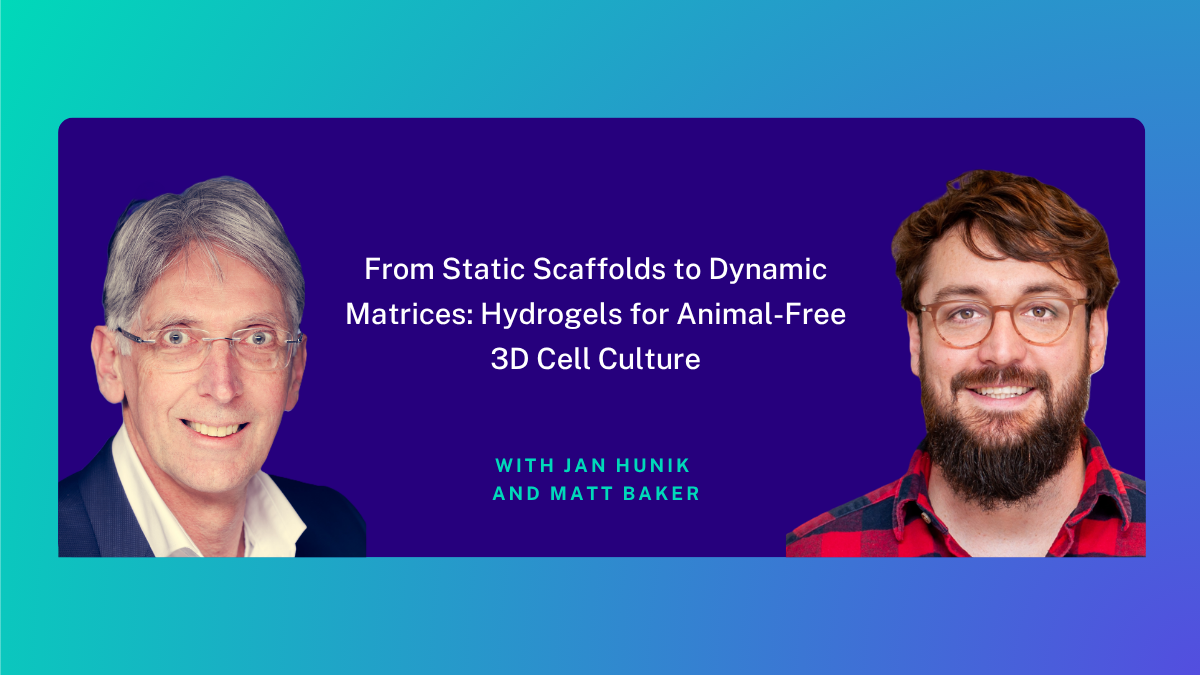
For years, most cell culture has relied on flat plastic and passive scaffolds. But biology doesn’t happen on a petri dish. Cells live in three dimensions, pressed on all sides by a dynamic, responsive environment—one that talks back, adapts, and shapes development in ways static gels simply cannot.
Join host David Brühlmann as he sits down with Jan Hunik, CEO of MosaMatrix, and Matt Baker, CTO and inventor behind a new class of hydrogels, for a grounded exploration of bioprocess development and the future of 3D cell culture.
Episode Highlights
- Why traditional flat, 2D cell culture misses the biological mark and what a responsive cell environment really looks like [00:27]
- The origins of MosaMatrix and the realization that new, adaptive hydrogels were needed for dynamic cell culture [04:45]
- What makes the MosaMatrix hydrogel different—and why passive scaffolds fall short [06:12]
- Mechanical and biological characteristics that define hydrogel performance, from stiffness to stress relaxation [07:48]
- The company’s pivot from 3D tissue printing to focusing on high-throughput 3D cell culture for drug discovery [08:42]
- Advantages of a non-animal-derived, reproducible matrix for research and industry [10:20]
- Strategies for obtaining real-world customer feedback and working in consortia with academia and industry partners [11:51]
- Key hurdles in quality control, reproducibility, and measuring success in the emerging field [16:05]
- Challenges with standardizing organoids and the move to smaller, more automatable culture systems [17:50]
- The impact of automation and data consistency for scaling up 3D cell culture [18:14]
In Their Words
But as we advance as a field, you really quickly see that that is not the biological situation whatsoever. And if you want to go more biomimetic, if you want these cells to do things over time, divide and then differentiate, you need different environments. And so we really have a challenge in front of us now as a field that we have to make these matrices that can adapt and can change over time to the cells. And in fact, we started with just a simple version where our matrix is constantly dynamically adapting, and we find already major benefits. – Matt Baker
Podcast Transcript
David Brühlmann [00:00:27]:
For decades, we’ve grown cells flat on plastic and called it biology. But cells don’t live in two dimensions. They live in a soft, responsive world that pushes back. What if the gel surrounding a cell wasn’t a passive bystander, but an active conversation partner?
Today, I’m joined by Jan Hunik, CEO of MosaMatrix, and Matt Baker, its CTO and the inventor of a new class of hydrogels. Let’s build the cell’s world together.
Welcome, Jan and Matt. It’s good to have you on today.
Matt Baker [00:02:17]:
Thanks. It’s great to be here.
Jan Hunik [00:02:18]:
Thanks, David, for the invitation. Great opportunity.
David Brühlmann [00:02:21]:
A pleasure. Let’s start with this perhaps controversial question. Share something that you believe about bioprocess development that most people disagree with.
Jan Hunik [00:02:31]:
I think the mechanical and biological behavior of hydrogels is really a crucial aspect of the natural physiology and morphological behavior of cells.
Matt Baker [00:02:41]:
David, this is a tough question, but I think this is always a good one to start with. I think a lot of people would disagree that materials are critical for the future of tissue engineering. A lot of people think that you can do this with cells alone, and I would strongly disagree. And not just from the materials point of view, but also from the process point of view. I think it’s going to be critical as we scale up. We have to get these materials right.
David Brühlmann [00:03:02]:
Tell us about yourself before we move into the science. What sparked your interest in the field, and what eventually led you to founding MosaMatrix? What were some perhaps interesting pit stops along the way?
Matt Baker [00:03:15]:
Okay, this is an interesting one. I’m a scientist. I find it really interesting that if we can make and we can control things, I think Feynman nicely said, “What I cannot create, I do not understand.” And for better or worse, I’m sometimes a believer in that philosophy. But I also always had a really big interest in how things made it to the market and the fact that what dies in the lab becomes useless to society.
I think my biggest interest started when I took a night class at Clemson University during my undergrad, and I had a CEO of a company come and teach us how to commercialize things. I saw it was totally different from the lab, and just being able to think that way really inspired me. We always wanted in our research group to try to commercialize some of our technologies, and we found that some of the base technologies for MosaMatrix were a good place to start. And I’m also a firm believer that, at some point, you just have to get started and see how it goes.
David Brühlmann [00:03:59]:
Yeah, excellent. How about you, Jan?
Jan Hunik [00:04:02]:
It really started with some microbiology lessons—microbial physiology at university—a long time ago. And there you can see how versatile biology is. It’s amazing what you can do with it. Look around you. I mean, it’s all biology if you can use it to your own benefit. It has been a remarkable journey for close to 40 years, and it still is. And I’m really intrigued by how the technology has developed to the point where we now can grow human cells. And maybe, as MosaMatrix, we can really give that opportunity a big boost.
David Brühlmann [00:04:34]:
Matt, take us back to the beginning. What was the problem you encountered that convinced you the field needed a genuinely new class of hydrogels?
Matt Baker [00:04:45]:
This one’s actually quite simple. I worked in an area of chemistry called supramolecular assembly, where we worked on dynamic molecules flying around and making these superstructures. And we realized that, in fact, that’s what your body’s really good at. Your body’s really good at building up these matrices from smaller protein fragments, having them respond to stimuli, and changing properties over time.
We looked at current hydrogels and saw that, in fact, we weren’t really good at doing that. And our group was trying to see if we could take this fundamental way of making matter and bring that toward hydrogels for tissue engineering, just to make things more dynamic, a little bit more lifelike, and see how powerful that was for the field.
David Brühlmann [00:05:20]:
And you, Jan, when you encountered Matt and, particularly, his hydrogel work, what made you believe that this could be a company worth building?
Jan Hunik [00:05:29]:
I was really intrigued by the beauty of the simplicity. One large molecule and two smaller molecules, and you can make a wealth of different conditions for those cells. But from a business perspective, I also saw the regulatory hurdles to get it to the market are extremely low. And of course, I’m looking at a market that is fast-moving, so those new developments can quickly be adopted by this market. So without really looking into all the details, that was the starting point. And we’ll come to those details later, I think.
David Brühlmann [00:06:02]:
So, Matt, tell us about the hydrogel, because not every Smart Biotech Scientist listening might be familiar with that. Usually what comes to my mind is a passive scaffold that cells just sit in. But why is that picture wrong? And how does your matrix actually work?
Matt Baker [00:06:21]:
I won’t say that that picture is wrong, because in fact, that’s what a lot of the hydrogels out there currently do. The scaffold challenge is fun for bioengineering because, at first, you really need something that is a bit static. That way you can make it reproducible, and you can get cells to grow into it. But as we advance as a field, you really quickly see that that is not the biological situation whatsoever. And if you want to go more biomimetic, if you want these cells to do things over time, divide and then differentiate, you need different environments.
And so we really have a challenge in front of us now as a field: we have to make these matrices that can adapt and can change over time with the cells. And in fact, we started with just a simple version where our matrix is constantly, dynamically adapting. And we find already major benefits. Cells spread differently. They’re able to move the matrix out of the way and create their own tissue—all things that you can’t do in these first-generation hydrogels, if you will.
David Brühlmann [00:07:08]:
How do they adapt to the cell? How does that work?
Matt Baker [00:07:12]:
They are dynamically reconfiguring. The bonds are moving around in real time, so they have the ability to… if a cell wants to produce its own matrix, for example, it can kind of push against the material, and the material will give it that space. But also, as cells start to pull on the material, they can start to reconfigure the material and create space for themselves as well. It’s something that we’re actually trying to get better at characterizing on the academic level, but on the product level, it just works.
David Brühlmann [00:07:36]:
And what are the important characteristics of the gel? What comes to my mind is stiffness or how it relaxes, especially as you’re talking about a more dynamic one. Tell us a bit more about that.
Matt Baker [00:07:48]:
Hydrogel stiffness is really critical to getting cells to do what you want them to do, especially as you’re trying to create tissue or move toward more advanced bioprocessing.
And I think that was shown maybe 20 or 25 years ago in a few landmark papers by Engler and Discher. But more recently, over the past 10 years, we’ve seen that how a gel relaxes stress is also critical. That’s where you get into the biomimetic aspect.
Biological tissues relax stress very well because they’re made of large molecules that can move past one another. And we weren’t so good at doing that synthetically until just recently.
We are one of the first hydrogels on the market that has tunable stiffness and stress relaxation. So we can really start to show that we can achieve good tissue formation, and we can tune the material based on the customer’s needs.
David Brühlmann [00:08:27]:
Now, looking at the company’s evolution, Jan, you started with the ambition of 3D-printing human tissue. Your focus has now changed. Tell us a bit more about why you started out with that and what drove that pivot.
Jan Hunik [00:08:42]:
I think it was a good starting point to think about 3D bioprinting. But what immediately attracted my attention was that the conditions for cell growth were also optimal. Matt showed in several articles and publications that the morphology and the physiological characteristics of the cells were also much better.
Then, last year, I was on a trade mission of the Dutch Ministry of Economic Affairs in Switzerland, listening to presentations from pharmaceutical companies and startup companies. That’s when I started realizing that one of the problems the industry is facing is how we can not only have a matrix and hydrogels for those cells, but also use them in high-throughput screening systems. It’s really a hassle at this moment, and it’s hindering applications in the drug discovery market.
Then, when you think about 3D bioprinting, you need a hydrogel that is very processable. One of the things you have in a 3D printer is that you need to mix it, pump it around, and deposit droplets in a specific location. That would also ideally fit into a high-throughput screening system.
With those two elements combined, we very quickly came to the conclusion that it really makes sense to focus ourselves on 3D cell culture for drug discovery using high-throughput screening systems. Since then, we’ve seen a lot of traction and have been approached by companies that want to work with and try our material after hearing about it.
David Brühlmann [00:10:10]:
What is your target these days? What kind of applications or people would benefit from this technology versus using older systems?
Jan Hunik [00:10:20]:
There are several important reasons why people can use us, but we are a very versatile platform. So we are not bound to one particular cell type. Especially because of the adaptations that Matt explained, we can tune those properties very well. There’s a wide variety of cell types that we can accommodate.
On the other hand—and I think that’s also very beneficial in this industry—our material is much more reproducible than what’s currently on the market. And that reproducibility is something that really hinders applications in the drug discovery field. There, we have a big advantage, and we should benefit from that.
David Brühlmann [00:10:56]:
And how does this advantage of the new technology—what I’m hearing is that it’s better controlled and more suited to what cells need—actually change the quality and reliability of the results?
Jan Hunik [00:11:10]:
That’s something that we still have to demonstrate. What we do see is that the current materials are really a source of frustration, especially for people in that research field who are trying to find applications. Our material is not animal-derived. You can make it in a very pure form with well-defined chemistry. I think from that point of view we should be able to make it much more reproducible—or, in fact, we already do—than what’s currently available on the market.
David Brühlmann [00:11:37]:
As you’re further developing this technology, I’d be curious about your strategy for getting early customer feedback to really understand what your target audience needs. What is your approach there?
Jan Hunik [00:11:51]:
We work with academia to learn more about how our material behaves with different cell lines, and that’s also a very useful pathway for us. We’re building that knowledge.
To give you an idea, we recently entered a large consortium that is looking at how we can develop better 3D cell culture and bring it to the marketplace as a valuable tool. That’s a large consortium of about 50 companies working together. We are one of the suppliers of the matrix material for those living cells.
And since last week—which is now official—we are also part of a consortium focused on improving kidney dialysis by using living human cells. That consortium is funded by the Dutch patient organization for kidney patients. It’s another collaboration between academia and industry, working together to move this technology forward and see whether we can improve patients’ lives with our technology.
I think that very well describes the different ways we try to find applications: first, by working directly with potential customers, and second, by working with academia, preferably in consortia where we provide the matrix, other partners contribute their cell technologies, and together we try to move this forward into applicable products for the market and ultimately for patients.
David Brühlmann [00:13:09]:
So you work in direct collaboration with various partners to get instant feedback, shall I say.
Jan Hunik [00:13:16]:
Yes. It’s quite interesting—sometimes very confusing. We have a lot of discussions with them, as you can imagine, but we’re definitely moving forward.
David Brühlmann [00:13:24]:
I’m curious, if you can share it, what were some interesting pieces of feedback you received, or perhaps ideas you would not have thought of?
Jan Hunik [00:13:31]:
A lot of the things that we encounter, for example, are that the culture media being used are very diverse. I think the impact of the media is much greater than we initially thought.
Also, the cells themselves influence how the matrix behaves mechanically and how it performs in the application. It’s biology, after all, so all of those interactions need to be taken into account and understood.
So it will be a journey, but the initial results are looking very promising.
David Brühlmann [00:13:57]:
That’s fantastic. I’d love to dive into the media since you mentioned it. I imagine that, especially within your field of application, a lot of people are still using animal-derived components or perhaps non-defined components. What are the challenges there, and where are you today with this kind of development?
Jan Hunik [00:14:17]:
Our material is not animal-derived. I think that’s also the main reason why it can be so much better defined than what’s out there. That helps. But we know that there are a lot of animal-derived materials around, and those are a mixture of not only matrix components, but also signaling molecules, growth factors, and whatever else you can imagine. Once those are removed, what’s left, of course, is the interaction between our material, the cells, and the culture medium. And that’s something that we have to further understand, work with, and make sure our material performs as it should.
And by the way, we can also functionalize our material, but that’s something Matt can tell you a little bit more about to make it more suitable for different applications.
Matt Baker [00:15:02]:
I think it’s a nice question to think about because, in fact, mammalian cells were not evolved to grow on plant-based materials or non-animal-based materials. Scientifically, you have a giant challenge there. I think that’s where the science and the technology become really interesting.
How do you put back the pieces that are important for cells? And then what it enables for the field is that, all of a sudden, if you don’t rely on animal-derived matrices anymore, your ability to scale and your ability to open up the processing window become enormous.
So I think it’s a really important transition for the future of the field, not just from an ethical point of view, but from the perspective of opening up the technology. But it comes with some big scientific hurdles. You need to make something biocompatible when evolution didn’t evolve in that direction.
David Brühlmann [00:15:41]:
Yeah, this is definitely a challenge for a lot of cell types, no doubt about that. And speaking of challenges, since you’re using all kinds of different cells combined with your hydrogel, how does scaling work? I don’t know if you can talk about scale-up—or should we rather say scale-out? What are some of the technical challenges people face with this kind of culture?
Matt Baker [00:16:05]:
I think there are a lot of challenges. One thing that’s really in front of the field right now is reproducibility. That’s always a challenge, so I’m not going to dwell on that.
But two big challenges for this field specifically are characterization and scaling.
Once you make something in 3D, it takes much longer to characterize it. Then you need to be able to measure it and make sure that your process is working well.
On the other hand, there’s the technology required to scale—both the instrumentation or machinery, and the materials that allow this scalability while keeping cells alive. It’s not a problem that science has really tackled in this field in the past with so much vigor.
So that technology push is coming along. But then there’s also the challenge of actually being able to measure and know that what you made is good and how to make these changes on the fly.
David Brühlmann [00:16:49]:
And how does this impact the way you think about quality control, for instance, for a process?
Matt Baker [00:16:57]:
As a chemist, we have decent quality control standards for some of the measurements that we make from the chemical point of view. So we’re relatively confident that our molecules are what we think they are, and we can ensure that.
As you start working with customers on much more complex situations—where we’re part of a high-throughput platform, or we’re helping to create more organoids—it makes you think about quality control very quickly. That becomes an early conversation with customers.
How do we measure success here? How do we know we’re going in the right direction? We also want to make sure that our culture of maintaining good quality control matches the customer’s ability to measure their own process and have confidence in what they’re doing.
David Brühlmann [00:17:34]:
What is key in order to scale these organoids? They’re difficult to standardize and to scale. How can you run them at higher throughput and, shall I say, at larger scale?
Matt Baker [00:17:48]:
Jan wants to answer that one. We’ll let him go.
Jan Hunik [00:17:50]:
The interesting thing I see is two things from observing and talking to some of the external parties we work with. First of all, they want to make everything smaller. They want very small cultures. They move from 96-well plates to 384-well plates. Another thing we see is that automation improves reproducibility. They want to automate wherever they can because that’s their major struggle. Automation has two functions. One is enabling higher throughput. The other is improving the quality and consistency of the data. I think that’s one of the reasons why we can become an attractive partner. We can contribute to both objectives, and that’s also what I hear back from them.
They tell us: “Show us the data,” because we need to generate data. If the data are good, they will give this a try and see what they can do with it. And, of course, smaller-scale cultures mean you can screen many more samples in a much shorter period of time.
David Brühlmann [00:18:46]:
The scaffold was never passive. Stiffness, stress relaxation—the whole mechanical handshake shapes the biology long before any drug ever enters the picture. We’ve traced how a chemistry problem became a company, and why getting the matrix wrong quietly corrupts everything downstream. In Part Two, we head into organoids, throughput, and quality control.
If this reframed how you think about 3D cell culture, leave a review on Apple Podcasts or your favorite podcast platform. Thank you so much for tuning in, and we’ll see you next time.
Disclaimer: This transcript was generated with the assistance of artificial intelligence. While efforts have been made to ensure accuracy, it may contain errors, omissions, or misinterpretations. The text has been lightly edited and optimized for readability and flow. Please do not rely on it as a verbatim record.
Next Step
If you found value in today’s episode, take a moment to like, follow, and leave a review on Apple Podcasts or your favorite platform—it helps us reach and support more scientists like you.
Thanks for tuning in to the Smart Biotech Scientist podcast and being part of this journey toward bioprocess mastery. For more insights and practical tips, visit
About Jan Hunik and Matt Baker
Jan Hunik is the CEO of MosaMatrix and a lifelong biotechnology entrepreneur with a PhD and extensive experience commercializing innovative biotech products. He is leading the development of next-generation regenerative solutions, including novel treatments for osteoarthritis that aim to improve patient mobility and quality of life.
Connect with Jan Hunik on LinkedIn.
Matt Baker is the CTO of MosaMatrix and the inventor of a new class of hydrogels for regenerative medicine. Holding a PhD in Physical Organic Chemistry, he has a strong background in developing advanced biomaterials that support human tissue growth and innovative medical applications.
Connect with Matt Baker on LinkedIn.
Further Listening
If you enjoyed this episode you might also like listening to:
Episodes 221 - 222: From 2D Cultures to Advanced 3D Cell Models for Preclinical Research with Catarina Brito
Episodes 259 - 260: Why Strong Science Isn't Enough to Get Funded: What Investors Actually Look For with Michael Rome
Episodes 265 - 266: From Human Variability to Automated Precision: Accelerating Cell and Gene Therapy Manufacturing Scale-Out with Farlan Veraitch
Episodes 223 - 224: From Cultivated Meat to Chocolate: Rethinking Cellular Agriculture Scale-Up with Steven Lang
Want to Join?
Are you a CMC or biomanufacturing leader with hard-won lessons on process development, scale-up, or CDMO management? We're always looking for practitioners with real execution stories to share on Smart Biotech Scientist.
Apply to be a guest or recommend someone:
hello@smartbiotechscientist.com
David Brühlmann is a strategic advisor who helps C-level biotech leaders reduce development and manufacturing costs to make life-saving therapies accessible to more patients worldwide.
Hear It From The Horse’s Mouth
Want to listen to the full interview? Go to Smart Biotech Scientist Podcast.
Want to hear more? Do visit the podcast page and check out other episodes.
Do you wish to simplify your biologics drug development project? Contact Us